Dry Nurses
Original title: Dry Nurses
kurzbeschreibung
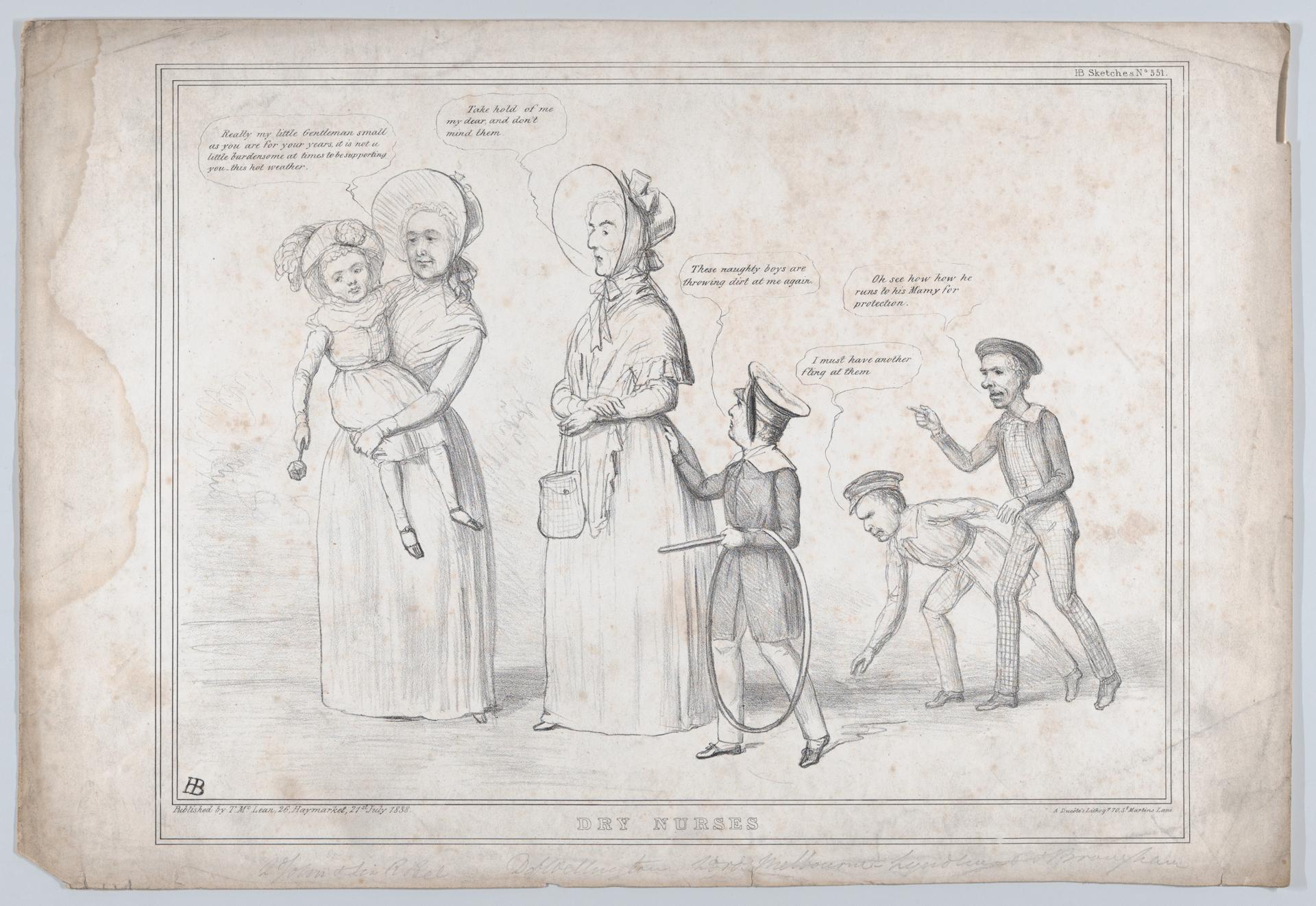
This 1838 lithograph by John Doyle presents a cheerful street scene: two women with children stand facing two uniformed men who are busy with a hoop. The landscape sheet measures 29.6 × 43.7 cm and belongs to political and social satire; speech bubbles quote what the participants are saying.
Description
Stretched wide, five figures line up side by side. On the left, two women in traditional dress each hold a child in her arms, one wearing an apron and carrying a basket. Beside them, two men in uniform fool around with a hula hoop. Behind the main figures, two more people are talking. Dialogue bubbles with text float above the heads. Everything is drawn in a single colour in shades of grey, with contours and shadows standing out clearly; the light falls evenly, without hard cast shadows.
Context
The Irish-British caricaturist John Doyle, known by the initials 'H.B.', worked in London in the 1830s. His lithographs appeared regularly in the 'Political Sketches' series and took up current political and social issues. The date 'July 21, 1838' places the sheet in the early Victorian era, when social reform and the public role of women were under debate. 'Dry Nurses' refers to nurses who did not breastfeed infants but fed them with bottle food — a much-discussed topic of childcare at the time.
Impact
Clear lines and the calm, symmetrical row of figures keep the image easy to read. Because an everyday scene meets speech bubbles, an ironic, narrative tone emerges that invites a smile without being insistent. The grey tones give the sheet a timeless, documentary feel.
Technique
Lithography — a planographic process in which the drawing is applied to a limestone with greasy chalk and then printed with water and ink. This allows fine, detailed lines and soft tonal gradations, as can be seen in the grey values of this sheet. The paper size of 29.6 × 43.7 cm matches the usual format of contemporary prints, which circulated in portfolios or as single sheets.
AI-generated description text
Source: Metropolitan Museum of Art · Public Domain (CC0 1.0)