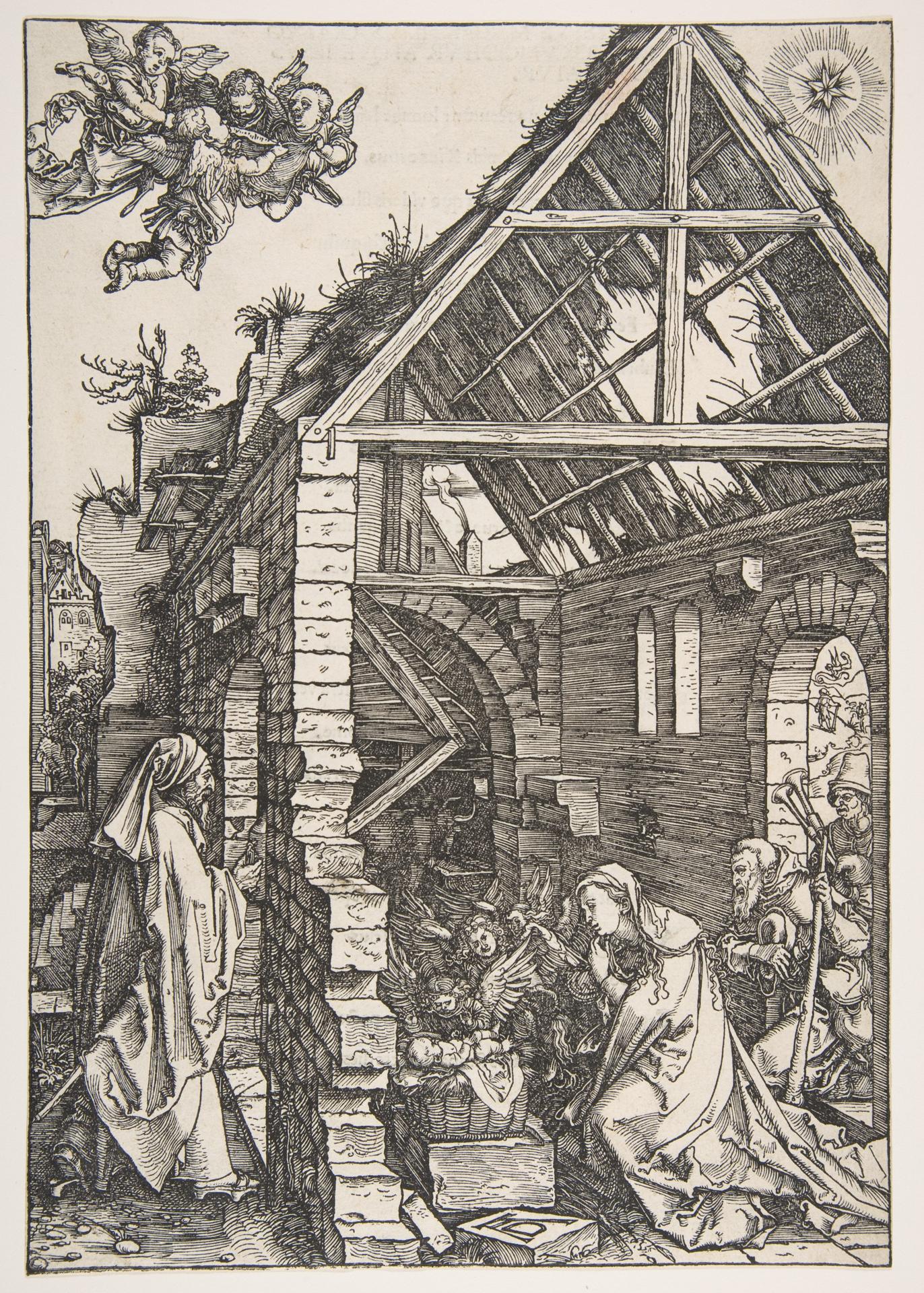
The Nativity, from The Life of the Virgin, Latin Edition
Original title: The Nativity, from The Life of the Virgin, Latin Edition, 1511
kurzbeschreibung
Albrecht Dürer's woodcut 'The Birth of Christ' from 1511 belongs to his series 'The Life of the Virgin'. This print shows the adoration of the newborn Jesus in a wooden stable, surrounded by angels and saints. It is considered a masterpiece of Dürer's graphic work and an example of the high art of woodcut.
Description
The Christ Child lies in a manger at the center of the image. Mary and Joseph stand beside him, along with other saints. Above the group, angels hover, looking up to heaven. The background consists of a simple stable with a roof of wooden beams on a stone base. The figures' garments follow traditional depictions of saints and angels. The arrangement is symmetrical, the lines clear and detailed.
Context
In 1511, the woodcut appeared in the Latin edition of Dürer's 'Life of the Virgin'. This series comprises twenty woodcuts on the life of the Virgin Mary. Dürer worked on the printing blocks between 1502 and 1504, but they were published only in 1511 with Latin texts. The series sold well and cemented Dürer's reputation as a leading graphic artist of his time.
Impact
A calm, devotional mood pervades the print. It arises from the symmetrical layout and the even distribution of light and shadow. The careful hatching and precise linework give the woodcut a painterly depth that draws the viewer into the scene.
Technique
The lines of this sheet were printed in black ink onto paper, and the even, flat tone of the impression shows how the ink sits on the surface without the depth of painterly shading. Dürer built the modelling of the figures and the wooden architecture through dense cross-hatching and parallel strokes, so that the monochrome print reads as a graphic structure of sharp contours and controlled light. The preservation of the sheet keeps these fine linear patterns legible, which is what gives the Nativity its clarity and devotional calm.
AI-generated description text
Source: Metropolitan Museum of Art · Public Domain (CC0 1.0)