Hugh Hall
Original title: Hugh Hall
kurzbeschreibung
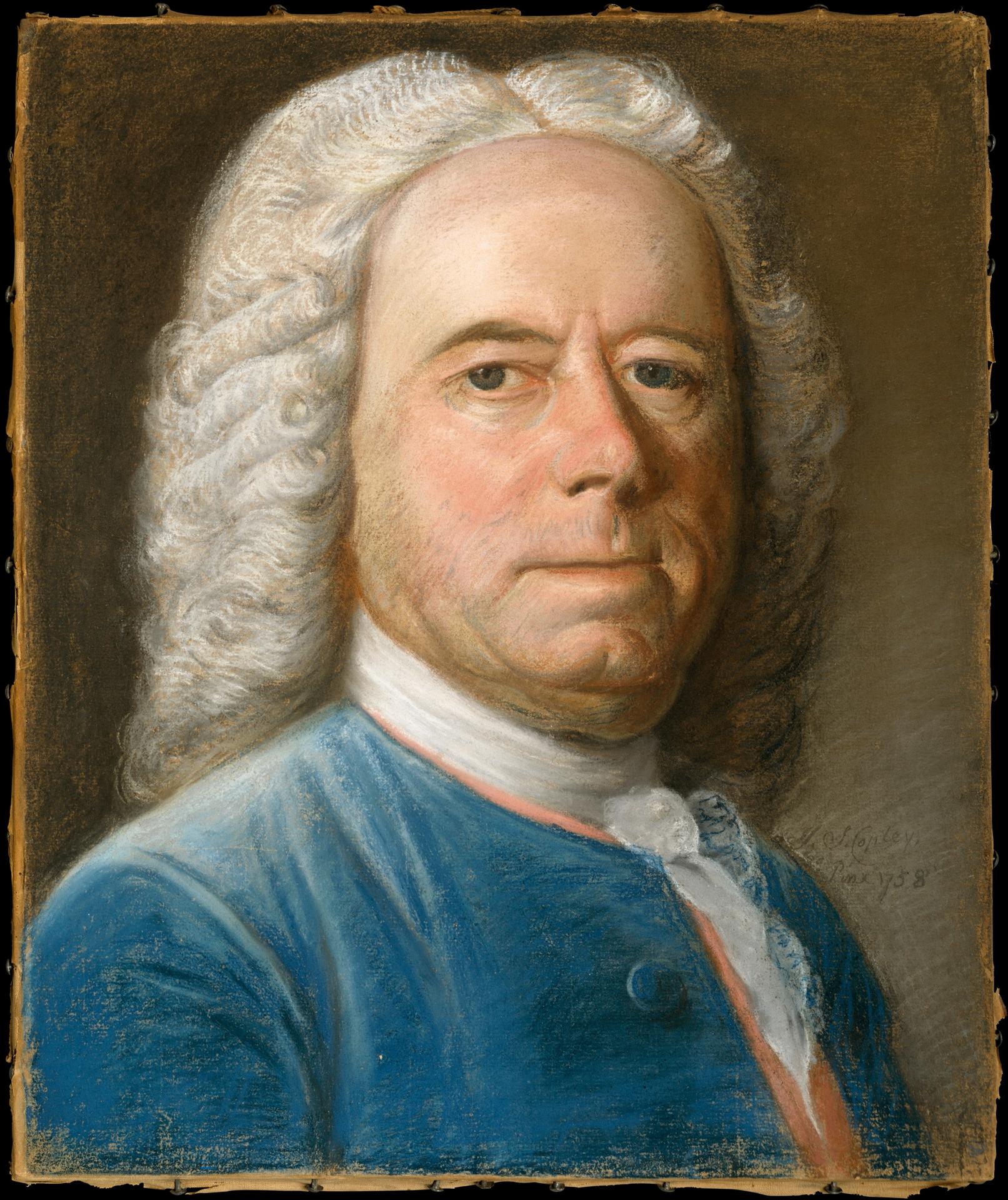
In 1758 John Singleton Copley drew the merchant Hugh Hall in pastel. The portrait, made on off-white laid paper that was later mounted on canvas, presents Hall bust-length, his hair powdered white and his coat blue.
Description
The eye goes first to the man's head, framed by white curls. A blue shirt with a white neckcloth and a red collar makes up his dress. The ground stays dark and blurred, so face and shoulders stand out. At the lower right are the artist's signature and the year 1758.
Context
Copley made the portrait in 1758 in Boston, where he ranked among the most respected portraitists of the colonial period. Hugh Hall came from a well-to-do merchant family, which explains the commission in the setting of New England's rising middle class. Pastels were then valued as a means of dignified private portraiture.
Impact
Soft and intimate, the pastel technique sits almost at odds with the sitter's sturdy presence. The dark ground and the careful modeling of the face give the picture a calm, dignified air.
Technique
Pastel crayon was applied to off-white, ribbed paper, which was afterward mounted on canvas. This yields fine gradations of shadow and a matte surface typical of pastel work. The mounting was meant to stabilize the delicate paper.
AI-generated description text
Source: Metropolitan Museum of Art · Public Domain (CC0 1.0)