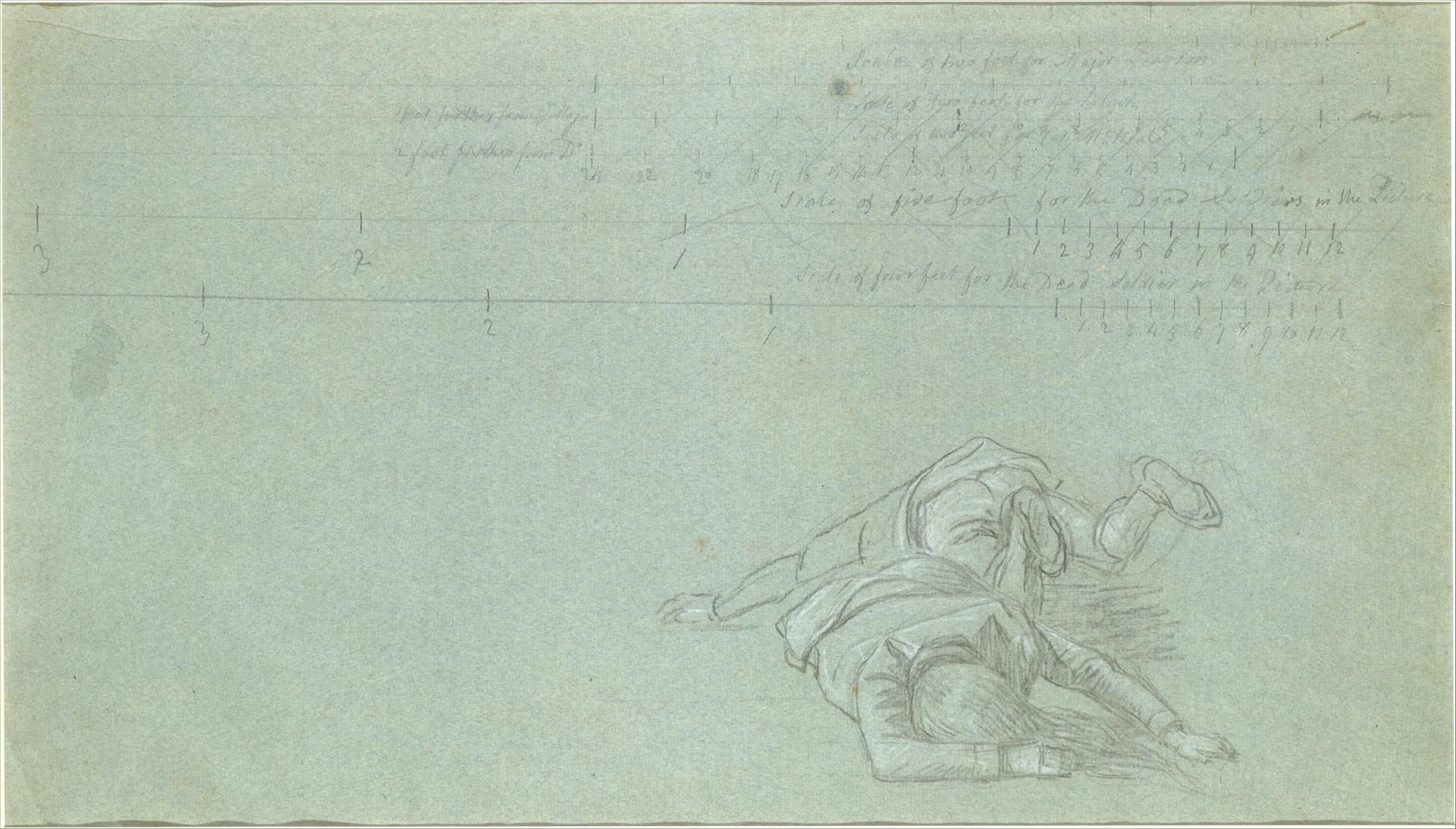
Study for "The Death of Major Peirson": Two Dead Figures
Original title: Study for "The Death of Major Peirson": Two Dead Figures
kurzbeschreibung
Unlike many figure studies by his contemporaries, John Singleton Copley's sheet "Study for 'The Death of Major Peirson': Two Dead Figures" of 1782–83 combines the looseness of a sketch with anatomical precision. Drawn in black chalk with white-chalk heightening on light blue laid paper, it presents two bodies lying on the ground, made as preparatory work for the large history painting. Measuring 36 x 58.4 cm, the sheet belongs to the collection of the Metropolitan Museum of Art.
Description
Across the foreground stretches a prone figure in a pose that seems almost staged for the theater: arms flung wide, head tilted slightly to the right. Jacket and trousers are worked out as carefully as the muscles and bone structure. Behind it appear scale marks and notes recording the proportions and placement of the figures. Black and white tones govern the image, with the white chalk picking out selected passages. The light blue paper stays uniform in color and gives the whole a calm underlying key.
Context
This drawing arose as a preparatory work for Copley's painting "The Death of Major Peirson," which recounts the Battle of Jersey (1781). During the 1780s the artist worked in London and was known for his carefully considered history paintings. The sheet documents his method of working out individual figures separately before inserting them into the overall composition. The painting itself ranks among his major works and was exhibited in 1784.
Impact
Precise lines and white heightening give the study something plastic, almost sculptural. The theatrical attitude of the figure creates a dramatic tension that anticipates the pathos of the later painting. The pale blue of the paper forms a calm counterpoint to the animated drawing and lets Copley's draftsmanship come to the fore.
Technique
For contours and shading Copley used black chalk, for the accents of light white chalk. The light blue laid paper served as a toned ground that held the chalk drawing together optically. The combination of precise line and targeted heightening shows the mix of sketch-like openness and anatomical exactness typical of studies.
AI-generated description text
Source: Metropolitan Museum of Art · Public Domain (CC0 1.0)