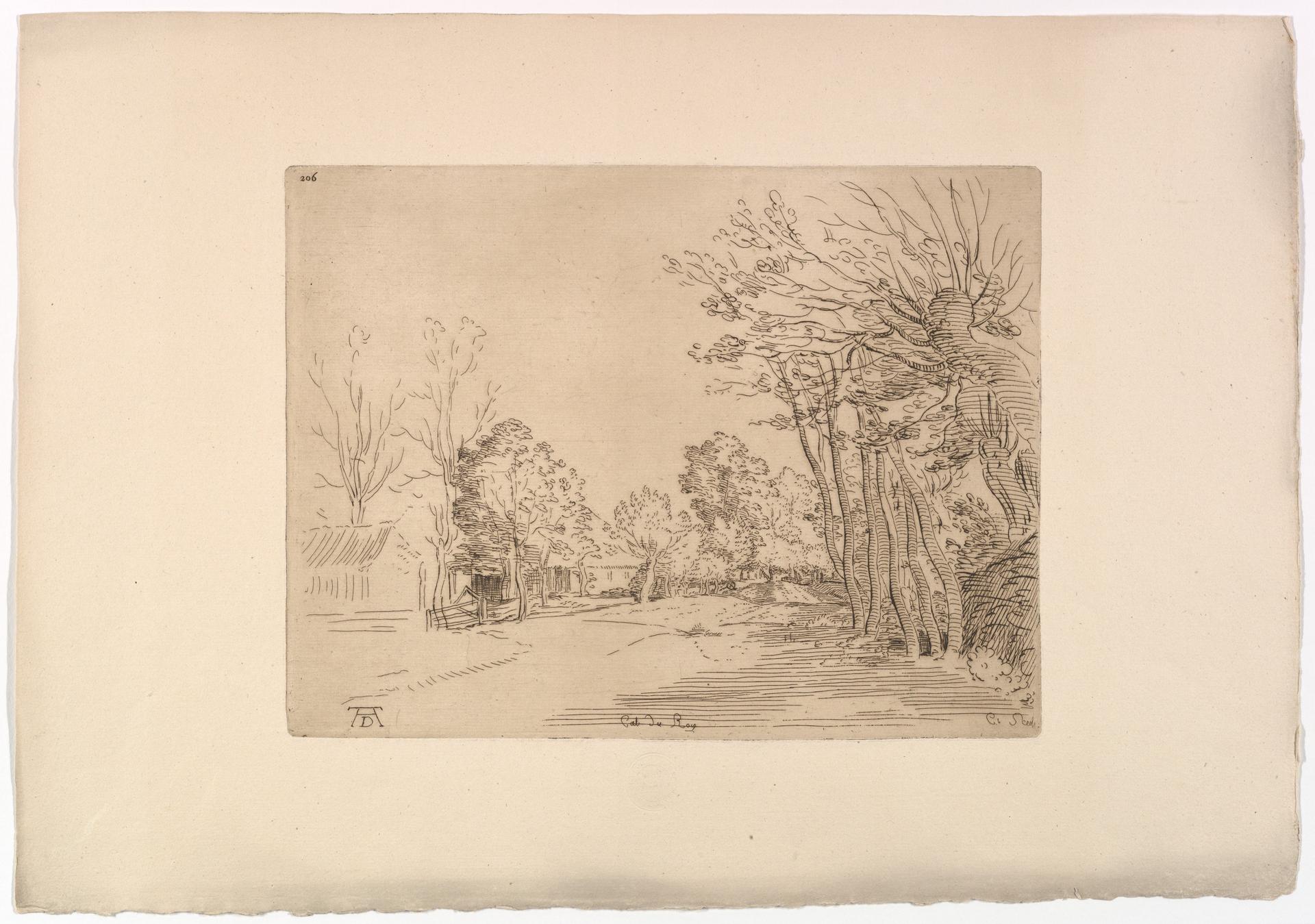
Landscape after Dürer
Original title: Landscape after Dürer
kurzbeschreibung
Trees with finely worked branches and leaves, some in leaf, some bare, anchor the foreground of this etching by Anne Claude Philippe de Tubières, comte de Caylus. The undated print captures a quiet landscape after Albrecht Dürer, its mood arising entirely from the etching technique.
Description
Several trees, their branches and leaves rendered with delicate precision, dominate the foreground—some still leafy, others stripped bare. Behind them rise more trees and shrubs, among which a small structure can be made out. A gentle path winds through the landscape, laid down in monochromatic greys with fine hatching. Light spreads evenly, with no direct sunlight, creating a calm, diffuse atmosphere. Near the bottom, a signature and date are visible.
Context
Anne Claude Philippe de Tubières, comte de Caylus, was an 18th-century French nobleman, antiquarian, and printmaker. He produced numerous reproductive engravings after old masters, including Albrecht Dürer. This etching likely arose from his art-historical studies, which he documented in an extensive body of graphic work. Caylus was known for his precise copies, which served artists and collectors as references.
Impact
The etching evokes a still, contemplative mood that grows out of soft transitions and even light distribution. The delicate lines and detailed rendering of the trees recall Dürer's graphic precision and lend the sheet a timeless, classical grace.
Technique
The work is an etching, in which the drawing was incised into a metal plate and bitten with acid. Fine lines and hatching produce nuanced greys and a sense of volume. The sheet measures 30.6 x 43.7 cm, the plate 19.5 x 25.8 cm, indicating a handy, detail-rich format.
AI-generated description text
Source: Metropolitan Museum of Art · Public Domain (CC0 1.0)