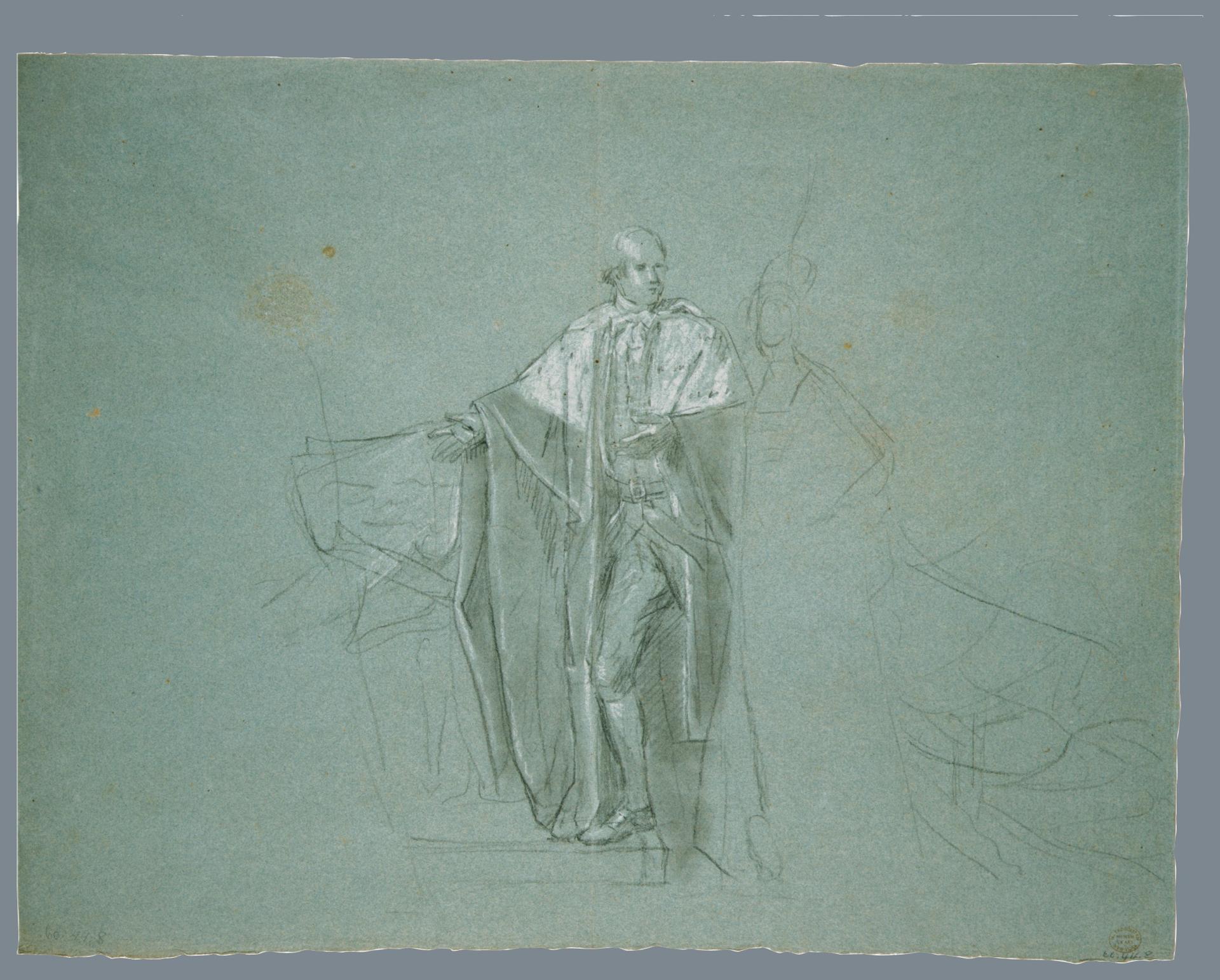
Study for "The Death of the Earl of Chatham"
Original title: Study for "The Death of the Earl of Chatham"
kurzbeschreibung
In 1779 John Singleton Copley made this drawing as a preparatory step toward his painting "The Death of the Earl of Chatham." Executed in black and white chalk on blue paper, it records a cloaked figure reaching out one hand. The sheet belongs to a series of figure studies for the large history painting.
Description
A figure appears in half profile, wrapped in a long coat, one hand extended forward. Head, face and clothing are worked out in detail, down to the shoes and headwear. Off to the side sit further sketches, presumably for other figures or parts of the scene. The blue paper carries a faint tone along with signs of creasing and wear.
Context
Copley made the study in London in 1779, the city to which he had moved from America and where he had established himself as an artist. The painting this preparation serves depicts the famous speech of the Earl of Chatham in the House of Lords in 1778, which ended in his collapse. Copley worked on the history painting over several years, producing numerous figure studies to think through the dramatic scene precisely.
Impact
Strong black contours meet white heightening, giving the figure a sculptural presence against the blue ground. The sketchy lines around it make the working process visible and lend the sheet liveliness and immediacy.
Technique
Black chalk with white heightening on blue paper forms the basis. The tone of the paper serves as the middle value, so that the chalks draw out light and shadow. This method was common for figure studies in eighteenth-century academic training.
AI-generated description text
Source: Metropolitan Museum of Art · Public Domain (CC0 1.0)