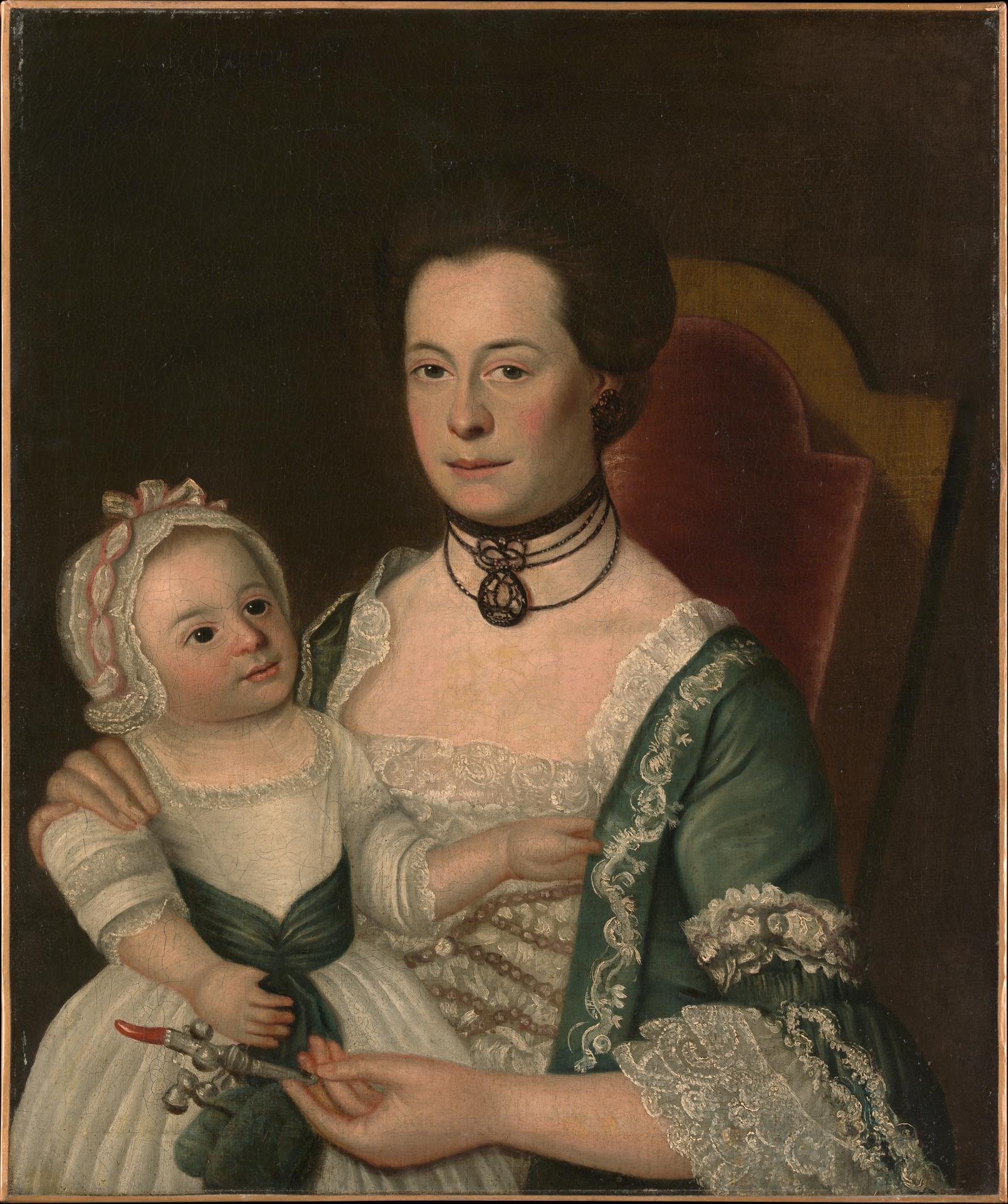
Mrs. Jacob Hurd and Child
Original title: Mrs. Jacob Hurd and Child
kurzbeschreibung
William Johnston painted this portrait around 1762. It shows Mrs. Jacob Hurd with her child in an interior. Oil on canvas, the work measures 76.2 x 63.5 cm. The mother wears a green dress with lace trim, and the child, in white, holds a small red pipe.
Description
Mrs. Jacob Hurd sits with her child on her lap. Her dark hair is gathered in a knot; she wears a green dress with lace edging and a black necklace. The child appears in a white dress with a green sash and a cap with red ribbons; a small red pipe rests in its hand. Part of a red chair is visible. Light falls on the figures from the front, highlighting faces and clothing, while the colors overall remain muted.
Context
The American portraitist William Johnston was active in New England during the 18th century. This painting was made around 1762, in a period when prosperous families in the American colonies increasingly commissioned portraits. Mrs. Jacob Hurd likely belonged to Boston's merchant class, where Johnston is known to have worked. Mother and child are presented according to the conventions of colonial portraiture, which often emphasized status symbols such as clothing and accessories.
Impact
The portrait conveys a quiet dignity, due in no small part to the subdued colors and soft light. The direct juxtaposition of mother and child feels intimate yet formal, reflecting the family's social aspirations. The arrangement draws the eye to the faces and the fine details of the clothing, creating a sense of closeness with the viewer.
Technique
Oil on canvas—a common technique for portraiture in the 18th century—forms the basis. With fine brushstrokes, the artist rendered the textures of fabric and lace. The palette remains restrained; accents of red and green are brought out by the lighting.
AI-generated description text
Source: Metropolitan Museum of Art · Public Domain (CC0 1.0)