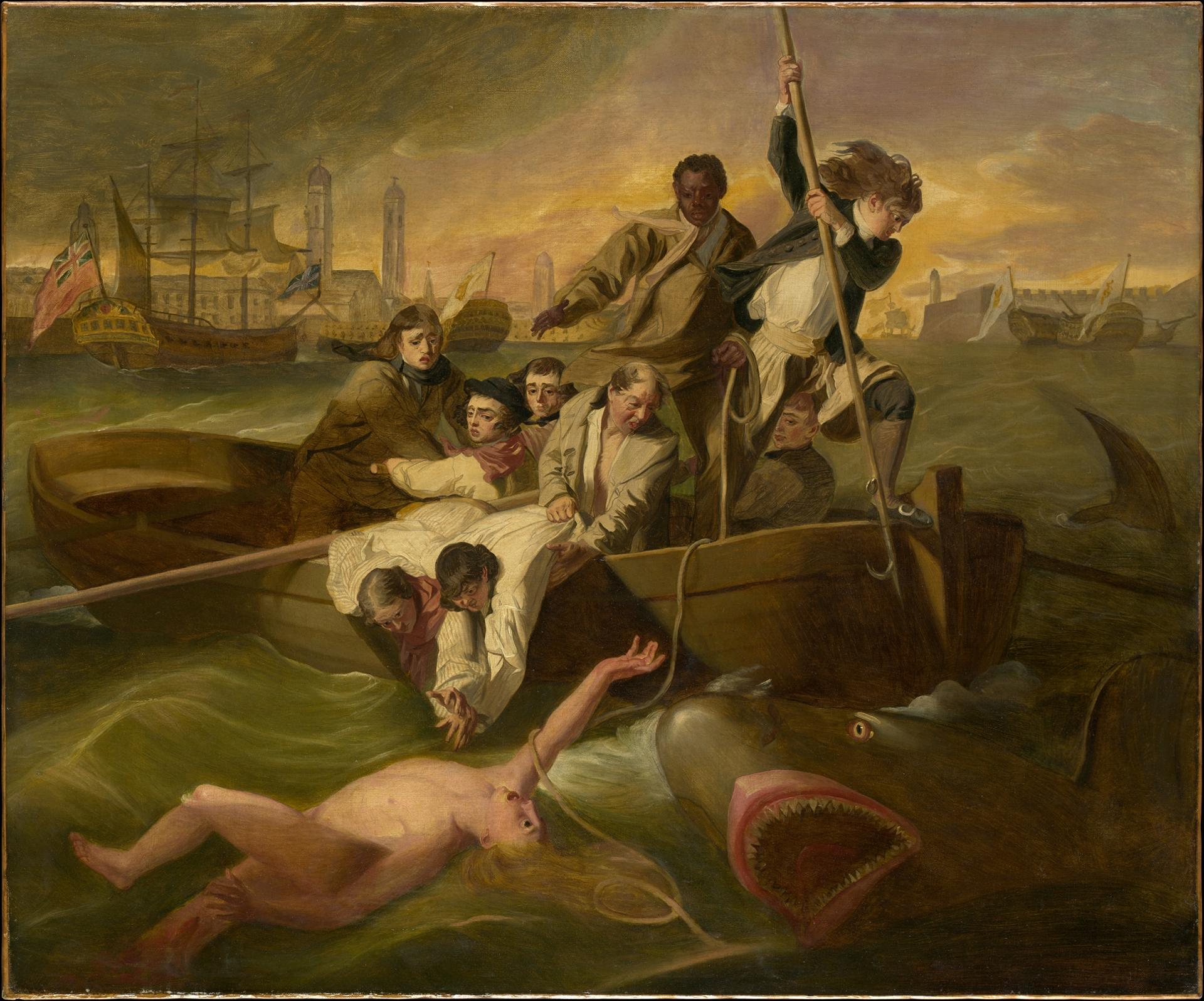
Watson and the Shark
Original title: Watson and the Shark
kurzbeschreibung
John Singleton Copley's oil painting Watson and the Shark, made around 1778, recounts the rescue of young Brook Watson from the waters of Havana harbor after a shark attack. The picture is considered an early example of a history painting that takes a contemporary event as its subject.
Description
A drama unfolds on the open sea: a man lies helpless in the water, clearly the victim of a shark attack, while several men in a boat try to haul him to safety; some hold a rope that leads to the vessel. Several sailing ships and harbor buildings layer the background. Muted colors and gloomy light heighten the tense mood. The arrangement feels agitated—the figures strain in different directions, underscoring the urgency of the moment.
Context
Copley based the painting on a real event from 1749: fourteen-year-old ship's apprentice Brook Watson was attacked by a shark in Havana harbor and lost a leg. The American-born artist created the work in London, where he had moved after 1774. It was his first major history painting, shown at the Royal Academy in 1778. Watson, who later rose to become Lord Mayor of London, commissioned several versions of the picture, some of which he gave to charitable causes.
Impact
The dark light and turbulent layout make an immediate danger palpable, drawing the viewer into the action. The lifelike rendering of the people and their surroundings intensifies the emotional force of the event.
Technique
Executed in oil on canvas, the painting displays a detailed, realistic manner. Copley used a muted palette and a pronounced interplay of light and shadow to heighten the dramatic atmosphere.
AI-generated description text
Source: Metropolitan Museum of Art · Public Domain (CC0 1.0)