Study for "The Surrender of the Dutch Admiral De Winter to Admiral Duncan, October 11, 1797": Lord Admiral Duncan
Original title: Study for "The Surrender of the Dutch Admiral De Winter to Admiral Duncan, October 11, 1797": Lord Admiral Duncan
kurzbeschreibung
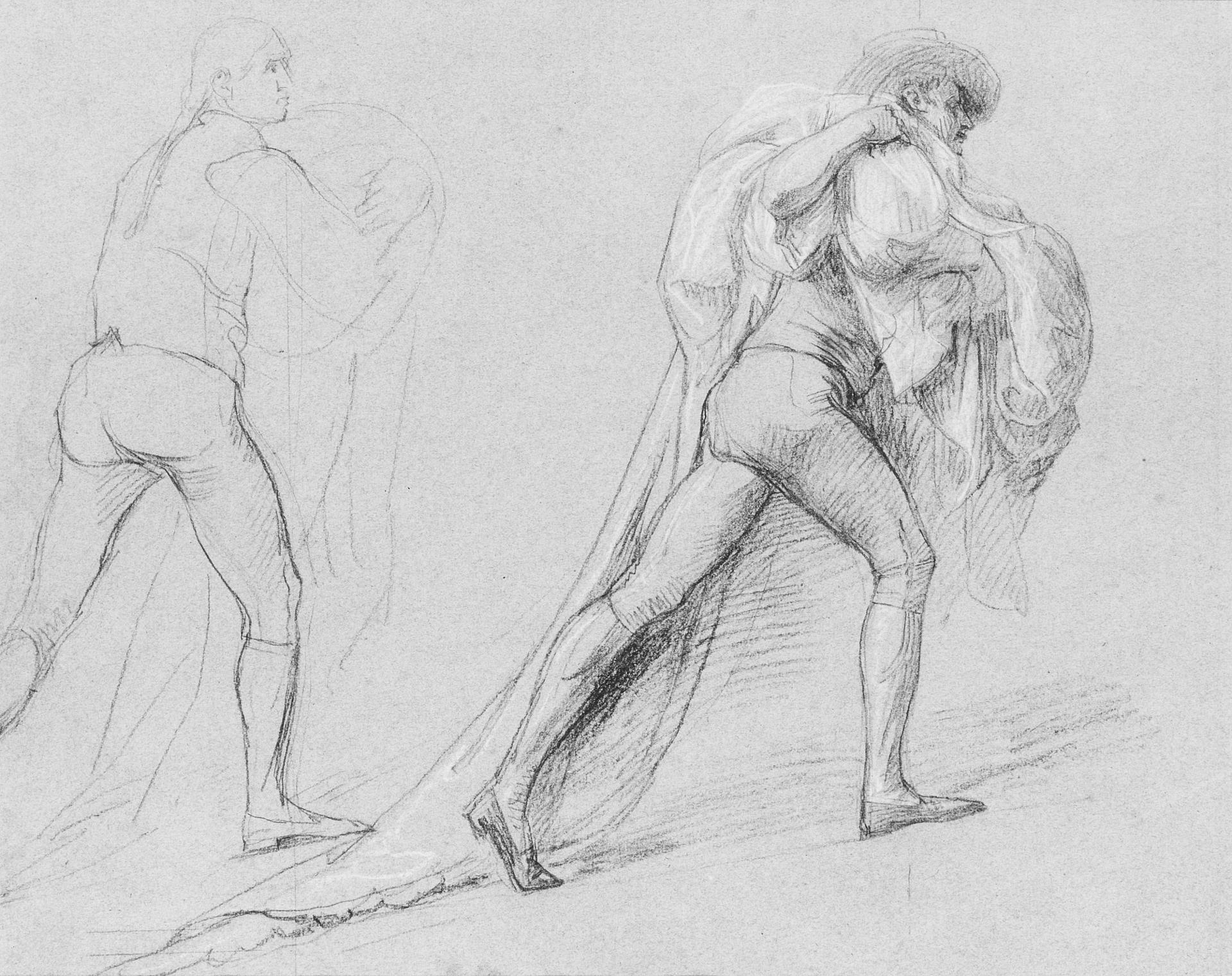
John Singleton Copley made this drawing in 1798 as a study for his painting of the surrender of the Dutch admiral De Winter. Two figures in animated poses appear in black and red chalk, with white heightening on blue laid paper. The sheet prepared the main figure of Lord Admiral Duncan in the large history composition.
Description
Two figures are visible: the left one stands upright in the center of the image, the right one leans forward with a coat over his shoulder. The garments of both seem stirred, as if caught by wind or by the turn of the body. The arrangement is asymmetrical: the left figure sits centrally, the right one is shifted slightly to the right. Background details or other objects are absent; the sheet confines itself entirely to the pair of figures.
Context
This preparatory work for Copley's history painting, which depicts the handing over of the defeated Dutch admiral to the British admiral in October 1797, was made in 1798. The naval battle at Camperdown was regarded as an important British success in the coalition wars. Copley was known for thorough preliminary studies with which he developed the compositions of his large paintings. The sheet belongs to a series of studies that the artist produced for this commission.
Impact
The animated postures and flowing garments create an immediate drama. Because all accessories are missing, the gaze is directed entirely at the interaction of the two people. Chalk and white heightening together produce a lively light atmosphere on the blue paper.
Technique
Black and red chalk, along with white heightening on blue laid paper, were used here. With the white heightening Copley sets accents of light and strengthens the plastic effect. The blue tone of the paper gives the drawing a distinct color quality that goes beyond a purely black-and-white reproduction.
AI-generated description text
Source: Metropolitan Museum of Art · Public Domain (CC0 1.0)