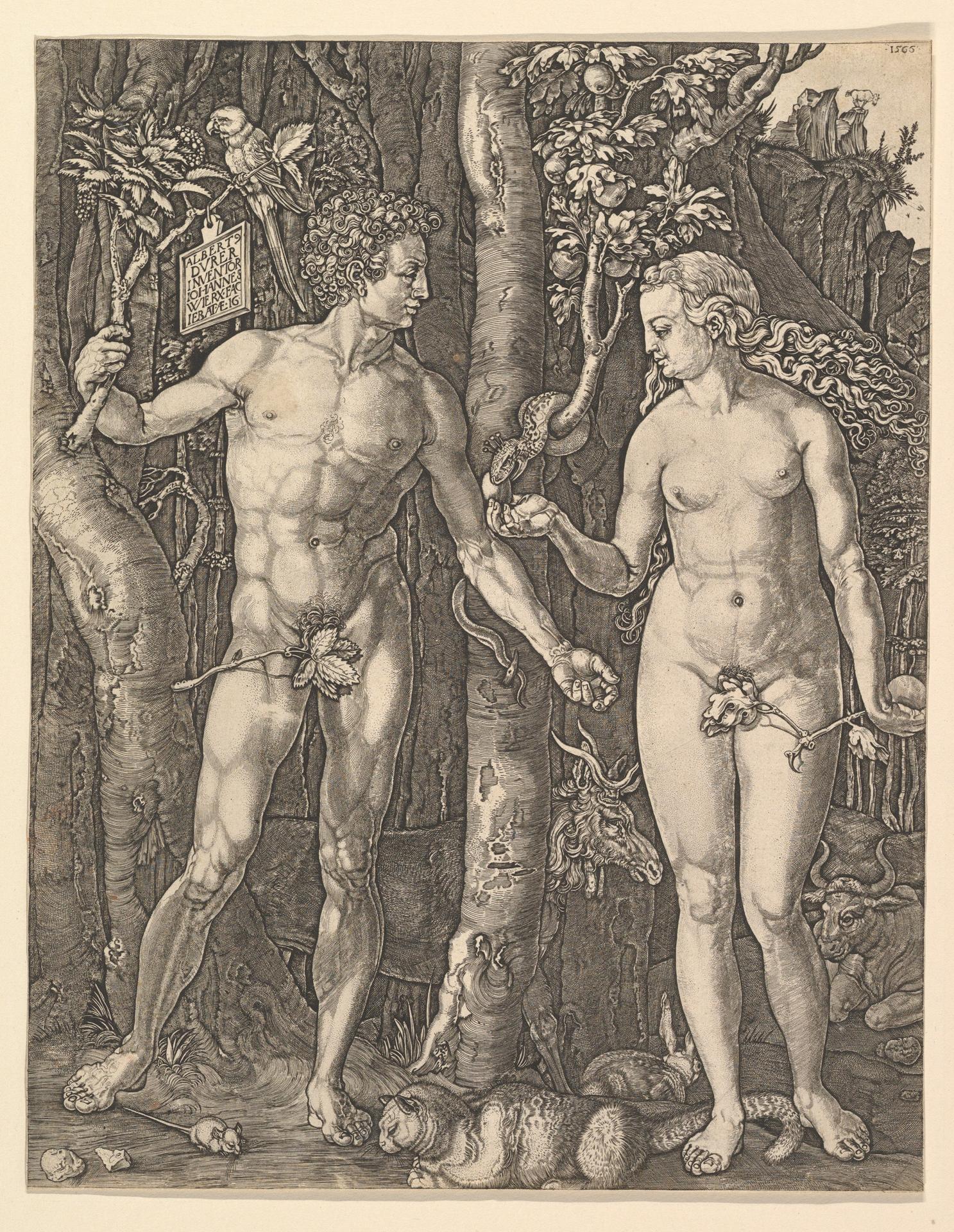
Adam and Eve (1566)
Original title: Adam and Eve
kurzbeschreibung
This 1566 engraving by Jan (Johannes) Wierix presents Adam and Eve in a lush garden setting, likely the expulsion from Eden. A third state of three, the print is distinguished by its meticulous and precise linework.
Description
Adam stands on the left, Eve on the right, both nude with pronounced musculature. Adam holds a branch with grapes, Eve an apple. Trees, plants, and animals such as a deer and a donkey fill the background, with a bird perched on a branch. A snake coils around a tree trunk, and the ground is strewn with creatures and vegetation. The image is monochrome, with even lighting typical of engraving.
Context
Jan Wierix, a sixteenth-century Flemish engraver, was known for his delicate and richly detailed prints. Created in 1566, a time when biblical subjects were widespread in printmaking, this work reflects the popularity of Adam and Eve as a motif, blending religious interest with artistic ambition. Wierix produced numerous engravings after his own designs and those of other artists.
Impact
At first glance, the calm balance of the image captivates, arising from the symmetrical arrangement and the abundance of flora and fauna. The even light guides the eye across the figures and the surrounding nature. The precise linework reveals high technical mastery and invites slow, attentive looking.
Technique
The print was made as an engraving, with lines incised into a copper plate. The exact linear execution and even distribution of light are characteristic of this method. That it is the third of three states suggests possible revisions or additions compared to earlier impressions.
AI-generated description text
Source: Metropolitan Museum of Art · Public Domain (CC0 1.0)