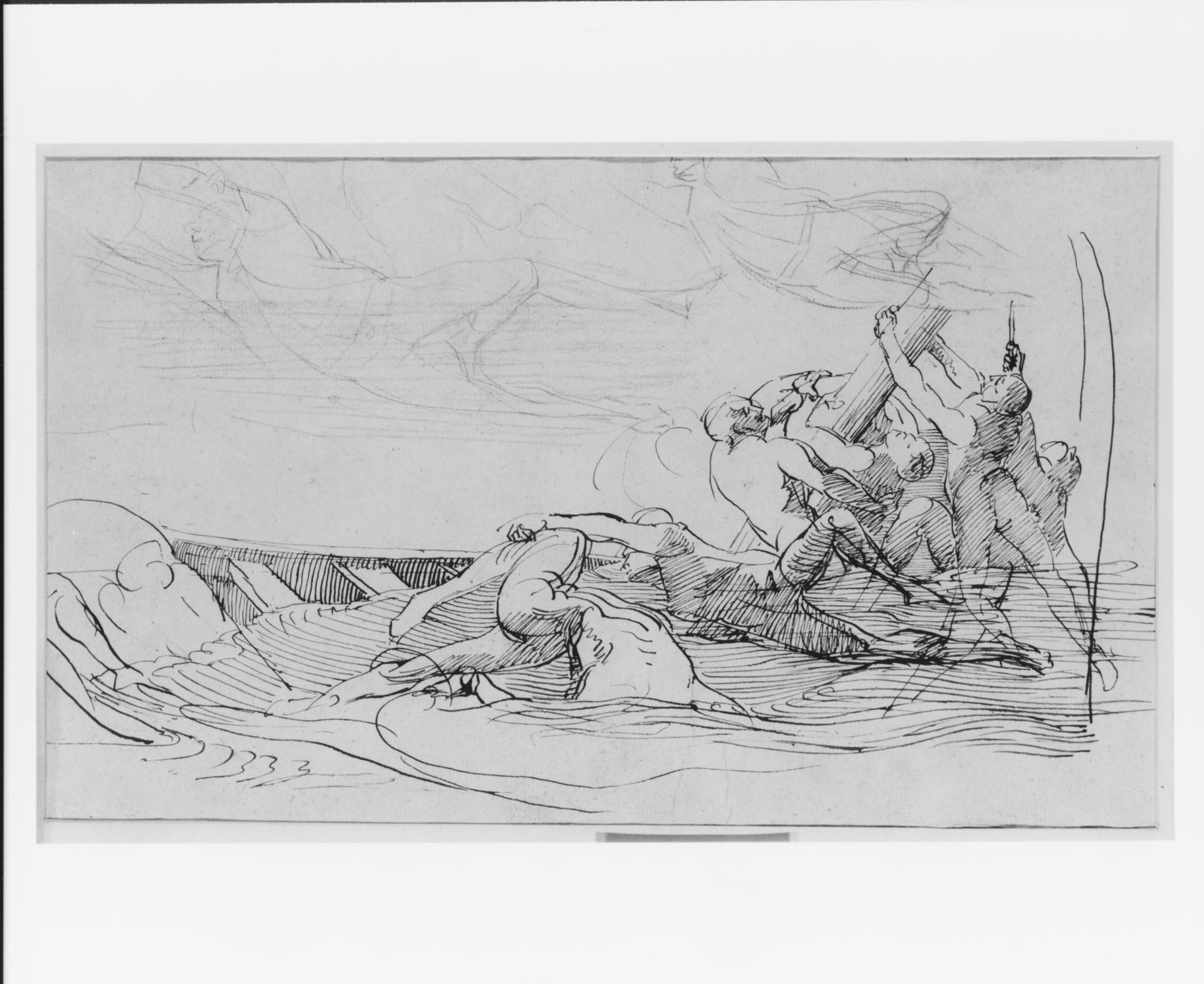
Study for "The Siege of Gibraltar": The Wrecked Longboat
Original title: Study for "The Siege of Gibraltar": The Wrecked Longboat
kurzbeschreibung
Drawn in 1785–86 as a study for John Singleton Copley's painting The Siege of Gibraltar, this sheet presents a group of people in a badly damaged longboat, a rescue scene set against the backdrop of the siege. Pen and brown ink, together with black chalk on cream laid paper, carry the whole of it.
Description
Several figures are scattered through a damaged boat drifting on the water. Their postures tell of despair and exhaustion: some lie stretched out on the boards, others push themselves upright or try to keep the boat balanced. Waves and a hinted sail behind them suggest stormy weather or a fight. Black and white are the only colors here, and precise strokes alternate with flowing lines, so that movement and momentum stay palpable throughout.
Context
The sheet served as a preparatory study for the large painting The Siege of Gibraltar (1785–86), in which Copley recounts the heroic defense of the British fortress against Spanish and French besiegers in 1782. Living in London, the American painter researched the event thoroughly and produced numerous figure studies for it. The work attests to his interest in contemporary historical subjects and in rendering human drama.
Impact
The drawing feels immediate, almost documentary: the viewer is placed right inside the figures' distress. Out of the interplay of precise detail and loose, dynamic lines grows a tension that heightens the drama of the scene.
Technique
Copley worked in pen and brown ink with black chalk on cream laid paper. This allowed him to set fine contours as well as broad, expressive hatching, with which he modeled light, shadow and movement.
AI-generated description text
Source: Metropolitan Museum of Art · Public Domain (CC0 1.0)