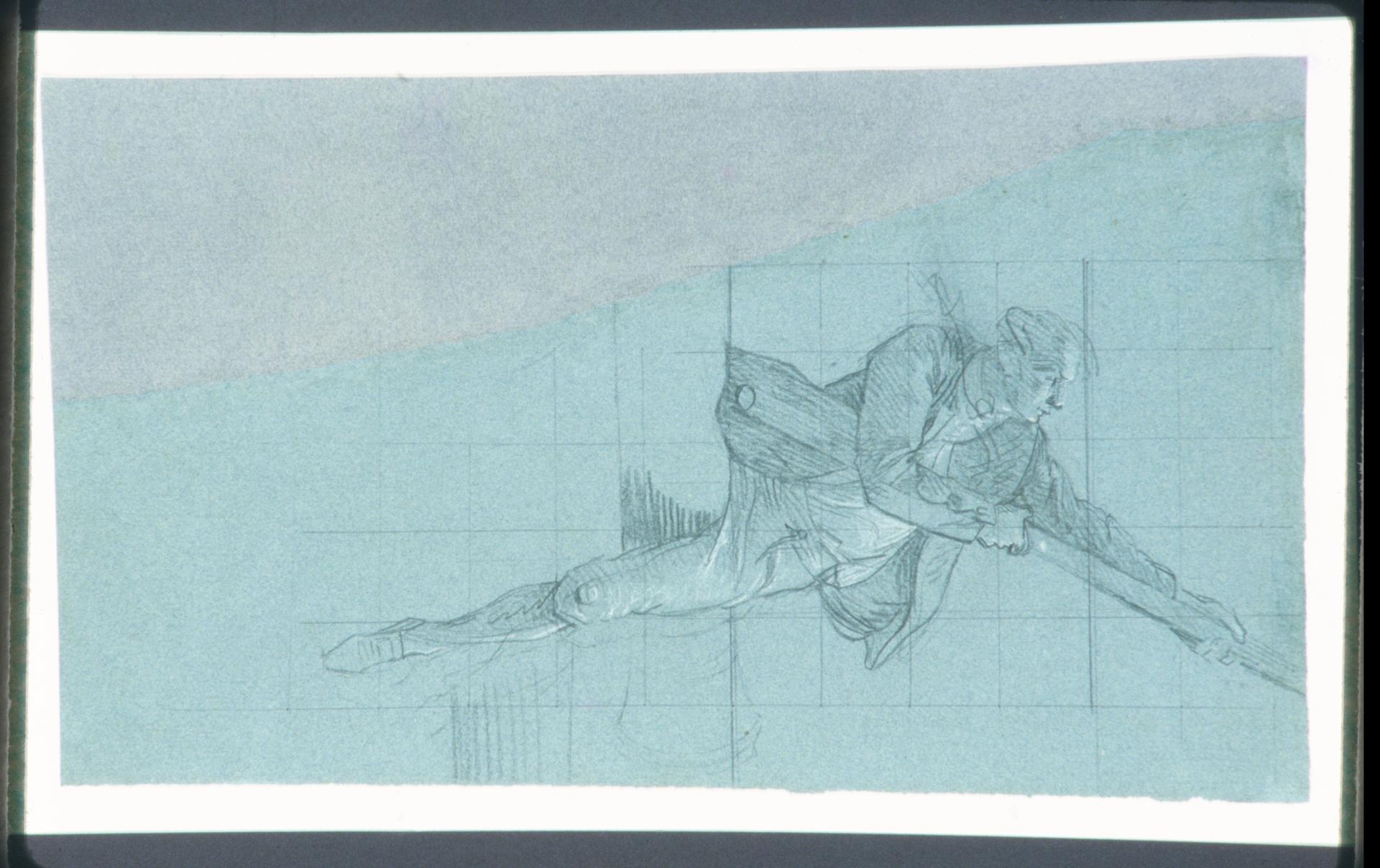
Study for "The Siege of Gibraltar": Figure Astride Cannon Pulling Down Spanish Colors
Original title: Study for "The Siege of Gibraltar": Figure Astride Cannon Pulling Down Spanish Colors
kurzbeschreibung
A man straddles a cannon barrel, pulling on a rope that leads to a mast flying the Spanish colors. John Singleton Copley drew this figure in 1785–86 using black and white chalk with graphite on blue laid paper. The sheet served as a preparatory study for his large history painting The Siege of Gibraltar.
Description
The man sits astride the barrel, one hand gripping the rope attached to the Spanish flag mast, the other holding a long pointed object, likely a sword or lance. A flat horizontal line marks the ground or a platform; the background offers nothing more. Working in black and white with graded grays, the drawing brings out contours and shadows; spare, assured strokes capture movement and musculature. No other figures or equipment appear.
Context
This study was made as preparatory work for the monumental painting The Siege of Gibraltar. That picture depicts the defense of the British fortress against Spanish and French forces in 1782 and was completed in 1788; it ranked among the artist's most ambitious undertakings. Copley, an American who had settled in London, aimed to capture contemporary events in the tradition of history painting.
Impact
The sheet feels energetic and immediate, driven by the figure's dynamic pose and clear line work. With all extraneous detail omitted, the viewer's attention focuses entirely on the man's action, generating a palpable narrative tension.
Technique
Black chalk, white chalk for heightening, and graphite were used on blue laid paper. This combination produced a fine gradation of light and shadow, with the blue paper serving as the middle tone. White chalk sets the illuminated passages, while black models contours and shadows.
AI-generated description text
Source: Metropolitan Museum of Art · Public Domain (CC0 1.0)