Study for "The Knatchbull Family": Sir Edward Knatchbull
Original title: Study for "The Knatchbull Family": Sir Edward Knatchbull
kurzbeschreibung
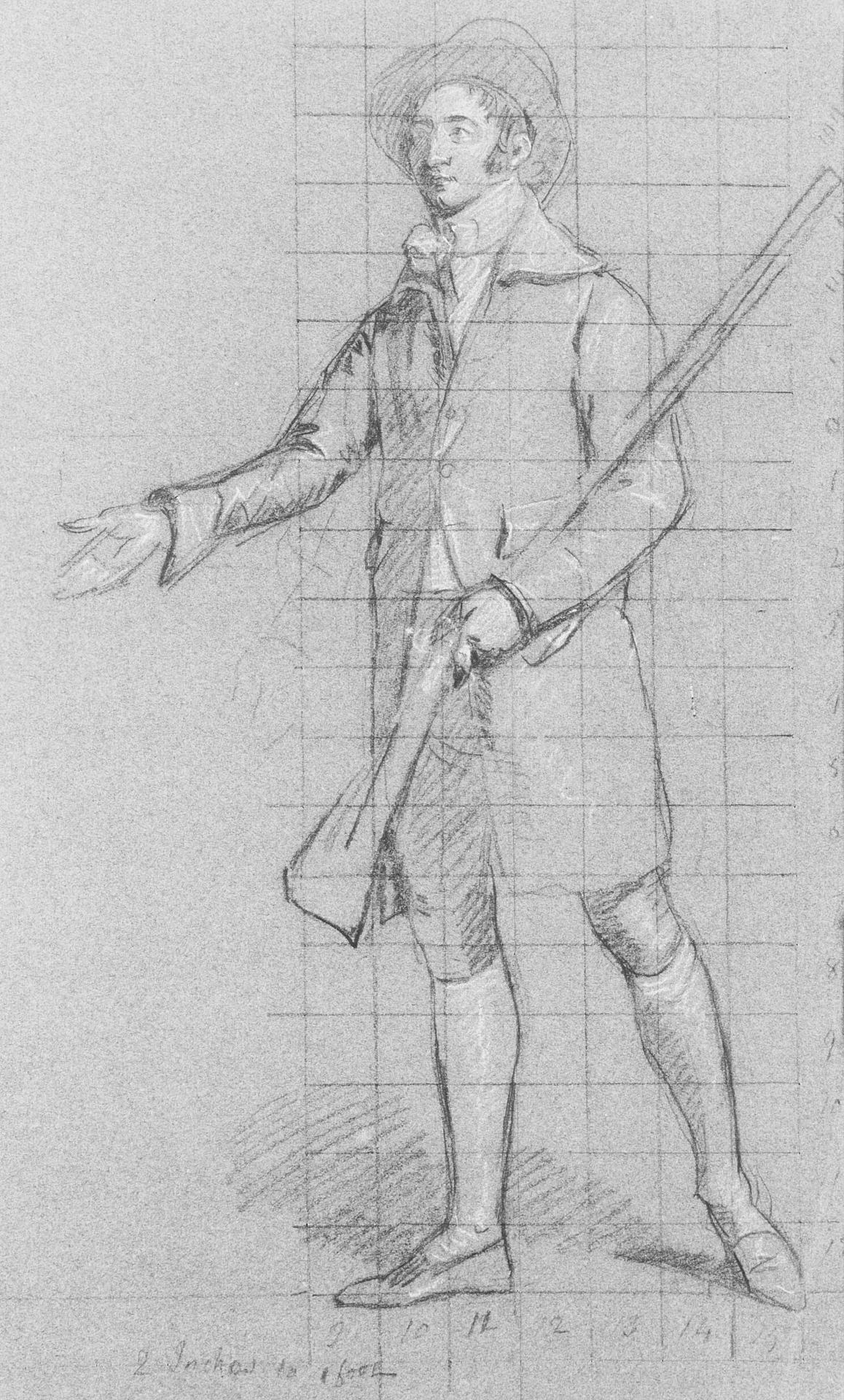
Unlike Copley's other preparatory studies for the Knatchbull family portrait, this sheet captures Sir Edward Knatchbull in a pose full of movement. Drawn between 1800 and 1802, it isolates the politician as a single figure, rendered in black chalk with white heightening and graphite on dark blue laid paper. It thus belongs among the direct preliminary works for the large group portrait.
Description
A man in historical dress appears, wearing a hooded jacket and a hat. His right hand grips a long, curved pole, while his left is extended forward; his legs are slightly bent. A regular grid covers the entire surface, serving to establish proportions. Black and white build up in graded tones, creating a sense of fabric and spatial depth.
Context
The Knatchbull family group portrait, which Copley painted around 1800 to 1802, grew out of a series of such individual studies. Sir Edward Knatchbull was a British politician and sat in Parliament. The drawing fixed the figure's pose and bodily proportions before it was transferred to the scale of the painting.
Impact
The sheet feels lively and resolute, chiefly through the animated pose and the strong contrast of strokes. On the dark paper, the areas touched with white stand out clearly, making the figure seem physically present.
Technique
Black chalk, white chalk for heightening, and graphite were used on dark blue laid paper. This combination allowed both soft shading and targeted bright accents. The drawn grid points to a deliberate transfer to the final scale.
AI-generated description text
Source: Metropolitan Museum of Art · Public Domain (CC0 1.0)