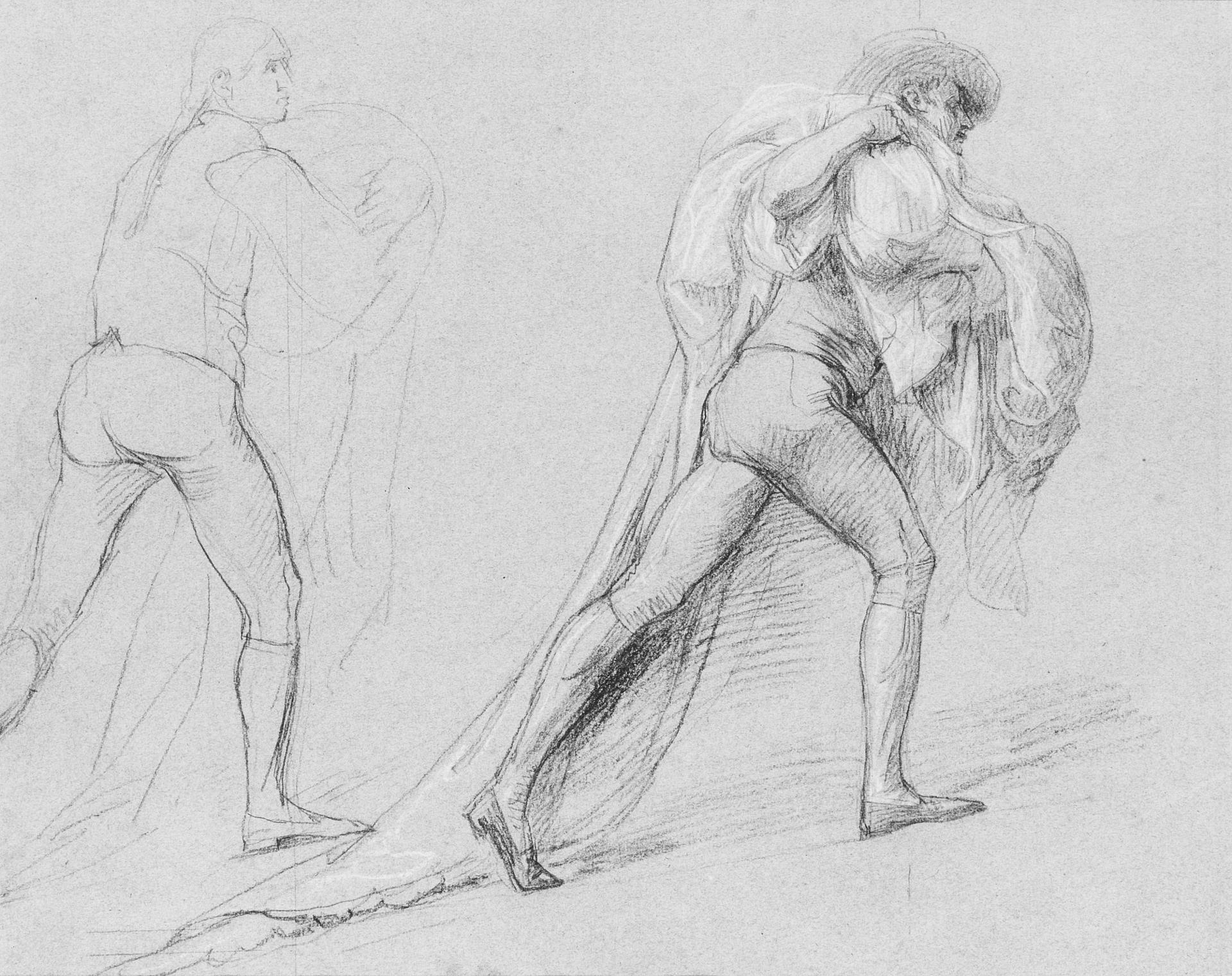
Study for "The Surrender of the Dutch Admiral De Winter to Admiral Duncan, October 11, 1797": Admiral De Winter Raising the Colors
Original title: Study for "The Surrender of the Dutch Admiral De Winter to Admiral Duncan, October 11, 1797": Admiral De Winter Raising the Colors
kurzbeschreibung
John Singleton Copley made this study in 1798 for a larger history painting: Admiral De Winter raising the flag. Drawn in black chalk with white-chalk heightening and gouache on blue laid paper, it anticipates the Dutch admiral's surrender after the naval battle of Camperdown.
Description
On the right, a figure leans back with one arm stretched high, while the left hand gathers a cloak; on the left, a second, half-visible figure holds something aloft, the other hand behind the back. Long, wind-blown garments swirl around both. Black and white with bright accents from white chalk, flowing, detailed strokes and an asymmetrical arrangement without background elements define the sheet.
Context
The study was made in 1798 as preparation for a large history painting, shortly after the naval battle of Camperdown on 11 October 1797, in which the British fleet under Admiral Duncan defeated the Dutch. The American painter Copley had lived in London since 1774 and was established there as a history painter. In Britain the event was regarded as a significant victory.
Impact
Sweeping lines and dynamic poses generate a strong energy of movement that carries the viewer's eye along. Because the background is absent, attention focuses entirely on the gesture of raising the flag and the drama of the moment. Precise contours meet loose hatching, producing a lively, sketch-like effect.
Technique
Black chalk, white-chalk heightening and gouache on blue laid paper were used. The combination of dry chalk and opaque gouache allowed fine gradations of light and shadow. The blue paper acts as a middle tone against which dark chalk passages and bright white heightenings stand out in contrast.
AI-generated description text
Source: Metropolitan Museum of Art · Public Domain (CC0 1.0)