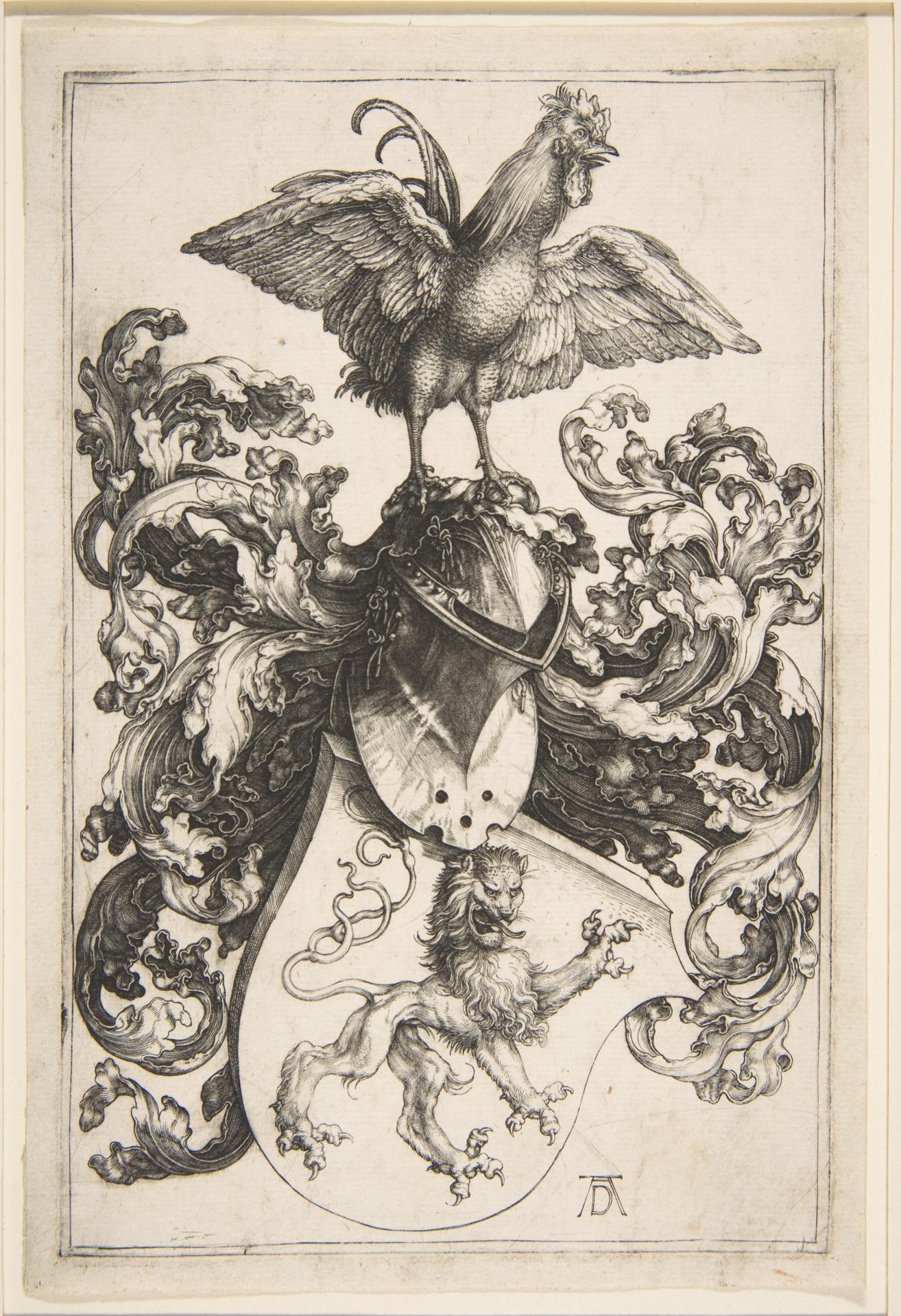
Coat of Arms with Cock
Original title: Coat of Arms with Cock
kurzbeschreibung
Coat of Arms with Cock is an engraving by Albrecht Dürer, dated to around 1502. The work features a heraldic composition with a rooster as the central charge, set within an ornamental frame. It exemplifies Dürer's mastery in printmaking during the Northern Renaissance.
Description
The composition centers on a shield bearing a rooster in full flight, with wings spread and throat raised. The shield is flanked by two stylized, cloud-like elements, while a lion in a dynamic pose appears below it. The entire design is enclosed by a decorative frame with additional stylized details. The monochrome image relies on precise lines and cross-hatching to define forms, typical of engraving.
Context
This engraving was created around 1502, during a period when Dürer was producing numerous prints for the art market. Heraldic imagery was popular among patrons, and Dürer often incorporated symbolic animals like the rooster and lion. The work reflects the Renaissance interest in classical motifs and naturalistic detail, even within a decorative format.
Impact
The engraving impresses with its sharp, precise linework, giving the heraldic subject a sense of vitality and movement. The dynamic poses of the rooster and lion create a lively contrast to the formal structure of the coat of arms. Dürer's attention to detail invites close viewing, rewarding the eye with intricate textures and patterns.
Technique
The work is an engraving, a technique in which lines are incised into a metal plate with a burin. Dürer employed fine, controlled lines and cross-hatching to create shading and depth. This method allowed for high detail and multiple impressions, making prints widely distributable.
AI-generated description text
Source: Metropolitan Museum of Art · Public domain (CC0)