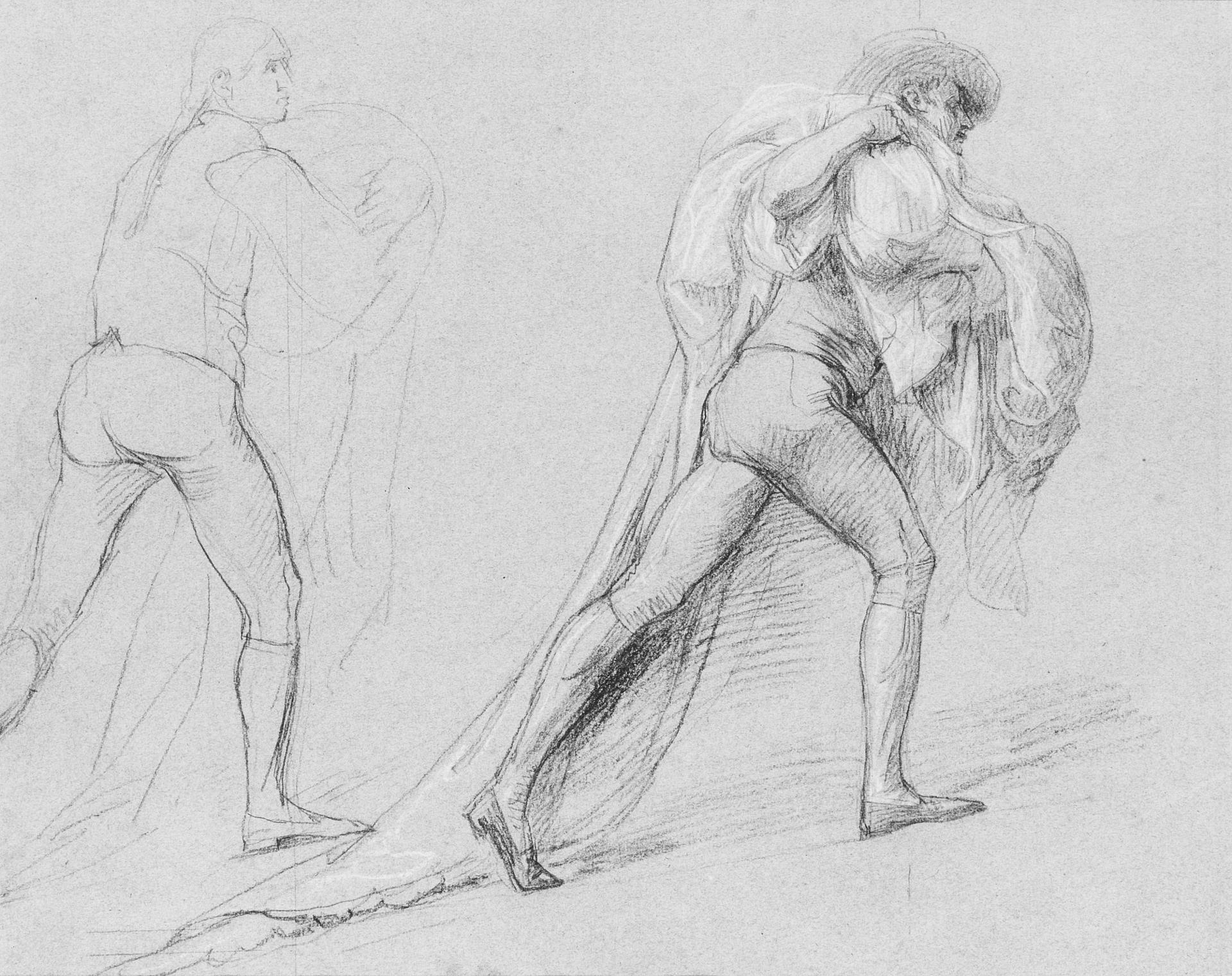
Study for "The Surrender of the Dutch Admiral De Winter to Admiral Duncan, October 11, 1797": Two Studies of a Man with a Sail or Flag
Original title: Study for "The Surrender of the Dutch Admiral De Winter to Admiral Duncan, October 11, 1797": Two Studies of a Man with a Sail or Flag
kurzbeschreibung
This 1798 preparatory drawing by John Singleton Copley relates to his large history painting of the surrender of the Dutch Admiral De Winter. On the sheet are two sketches of a man holding a sail or flag, executed in black and red chalk with white heightening and graphite on blue laid paper.
Description
Two figure studies appear: the left shows the man from behind, the right from the side. Black-and-white sketches with pencil lines and white accents shape shadows and textures. The muscular anatomy, the folds, and the movement of the sail or flag are worked out in detail. The background stays minimal, drawing attention to the figures. The arrangement feels symmetrical, though the left study is slightly offset to suggest motion.
Context
Copley made this study in 1798 as preparation for his history painting The Surrender of the Dutch Admiral De Winter to Admiral Duncan, which depicts the naval battle at Camperdown (1797). The painting was a commission that glorified the British naval victory in propagandistic terms. Copley was known for his careful preparatory studies, often capturing anatomical details and movement. The sheet demonstrates his interest in an authentic rendering of figures in action.
Impact
Precise lines and subtle modeling of the musculature give the study an immediate, dynamic presence. The focus on essentials—the figure and the piece of cloth—creates an almost sculptural quality. Black, red, and white on a blue ground lend the sheet a calm yet lively effect.
Technique
Copley used black and red chalk, white heightening, and graphite on blue laid paper. The white heightening sets targeted accents for highlights, while the chalks model the shadow areas with nuance. The blue paper acts as a tonal value that holds the drawing together visually.
AI-generated description text
Source: Metropolitan Museum of Art · Public Domain (CC0 1.0)