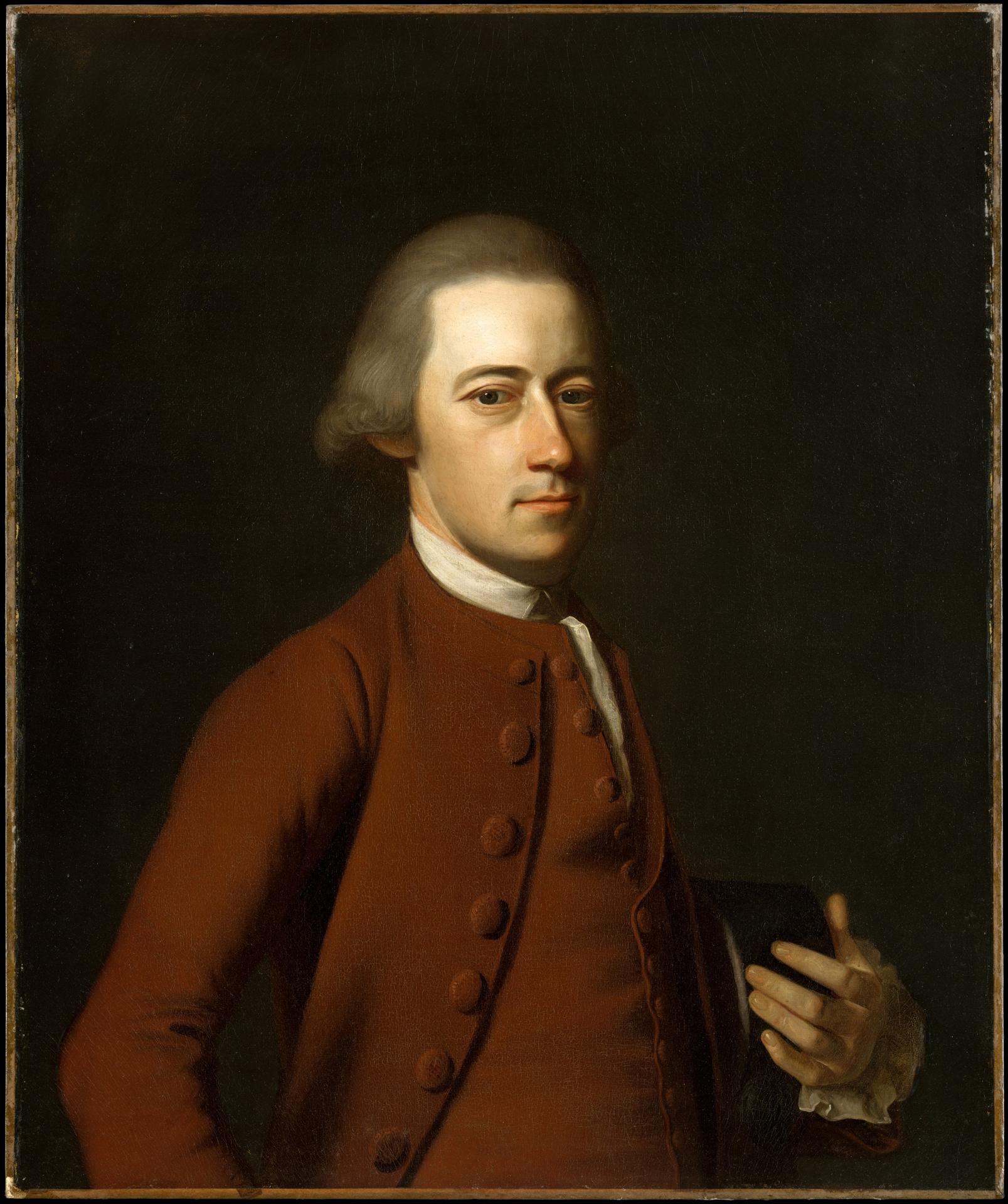
Samuel Verplanck
Original title: Samuel Verplanck
kurzbeschreibung
Unlike the many full-length portraits of those years, this painting limits itself to a bust of Samuel Verplanck. John Singleton Copley executed it in 1771 in oil on canvas, measuring 76.2 by 63.5 cm. The sitter appears in the clothing of the eighteenth century; his posture is conventional, but his gaze is attentive.
Description
A red-brown coat, buttoned at the front, is worn over a white collared shirt. Short grey hair frames a face whose calm, thoughtful expression gives the picture its stability. The eyes turn slightly to the right, the right hand is raised a little, the left touches the edge of the image. A plain dark ground recedes behind the figure; light falls on the face and the right side of the shirt, drawing out shadows and contours.
Context
When Copley painted this portrait in 1771, he was already regarded in Boston as the most sought-after portraitist in the American colonies. Samuel Verplanck came from a wealthy New York merchant family, and like many members of the colonial elite he valued a dignified representation of his person. Three years before Copley moved permanently to England, the painting was still made in America.
Impact
The portrait radiates a quiet dignity, a self-assured presence without pose. Because the colours stay restrained and the light is placed clearly, the closeness to the viewer feels immediate and focused; almost one has the impression of a conversation that could begin at any moment.
Technique
Copley worked with oil paint on canvas, applied in thin layers one over another. He renders fabrics and facial features with great precision, showing his sure command of realistic portraiture. The dark ground and the deliberately directed lighting correspond entirely to his working method in these years.
AI-generated description text
Source: Metropolitan Museum of Art · Public Domain (CC0 1.0)