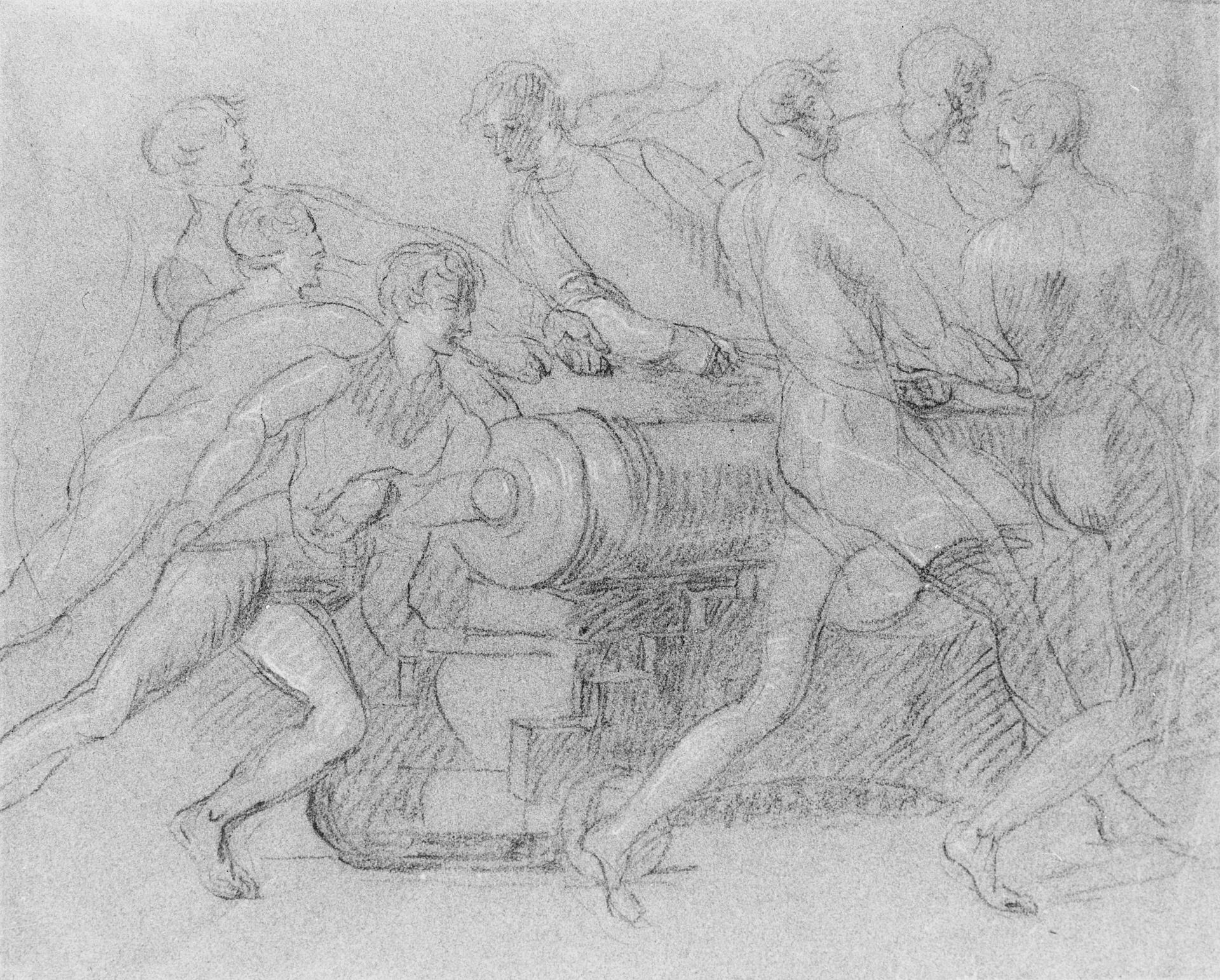
Sailors Maneuvering a Cannon, Possibly a Study for "The Death of Sir John More at Corunna"
Original title: Sailors Maneuvering a Cannon, Possibly a Study for "The Death of Sir John More at Corunna"
kurzbeschreibung
Around 1810 John Singleton Copley drew a scene of sailors working a cannon together. Executed in black chalk with white heightening on blue laid paper, the sheet is regarded as a possible preparatory study for a larger painting.
Description
A massive cannon anchors the layout, closely surrounded by several men in shifting poses: standing upright, kneeling, or lying on the ground. This creates a lively, tense impression. The figures appear in contemporary dress, pointing to a historical scene. The sheet remains in black and white; meticulous strokes bring out the cannon. The irregular arrangement of the figures heightens the sense of movement and haste.
Context
This study probably belongs to Copley's unfinished history painting 'The Death of Sir John More at Corunna', which takes up an event from the Napoleonic Wars. The Battle of Corunna took place in 1809, and Copley showed great interest in contemporary historical events. The sheet was made in London, where the artist lived and concentrated on monumental history paintings.
Impact
The lively poses and the dominant position of the cannon evoke a feeling of energy and urgency. The restriction to black and white directs attention to the layout and the interplay of figures, bringing out the drama of the scene.
Technique
For this preparatory study Copley used black chalk and white heightening on blue laid paper—a common material for such designs. The combination allowed rapid, precise sketches that effectively capture the movements of the figures.
AI-generated description text
Source: Metropolitan Museum of Art · Public Domain (CC0 1.0)