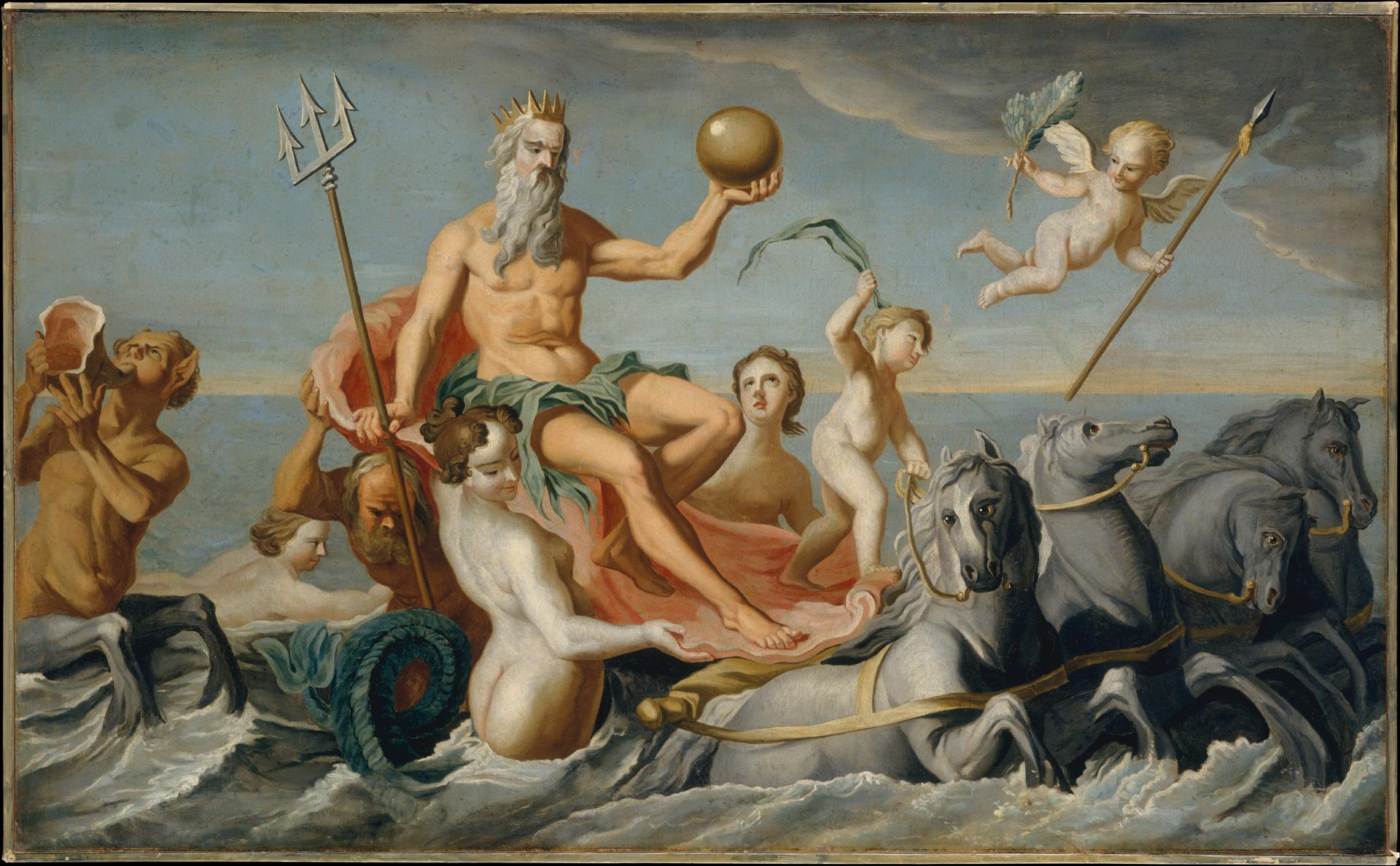
The Return of Neptune
Original title: The Return of Neptune
kurzbeschreibung
John Singleton Copley painted 'The Return of Neptune' around 1754, during his Boston years before he moved to England. This oil on canvas, measuring 27 1/2 by 44 1/2 inches, presents the sea god riding a shell drawn by horses, surrounded by other figures from myth.
Description
Neptune sits enthroned on a large red shell that a team of horses pulls forward. In his right hand he holds a golden globe, in his left a trident. Beside him sits a female figure, likely Amphitrite, holding a sea cucumber. To the right, putti frolic—one with bow and arrow, another with a bouquet. On the left stand further figures, one with a jug, another bent forward. Waves and sky close off the background.
Context
The picture belongs to Copley's early period, when he worked in Boston as a portrait painter and also turned to mythological subjects. The influence of European Baroque painting is evident. Neptune as an allegory was a common motif in the eighteenth century, symbolizing maritime power and dominion.
Impact
Neptune's central position and the strong colors give the painting splendor and movement. Bright figures stand out against the darker sea and sky, lending the whole dramatic depth. Clear outlines and carefully executed figures carry the narrative message of the allegory.
Technique
Executed in oil on canvas, a technique Copley used for fine details and color transitions. Luminous colors and a strong contrast of light and dark show a confident handling of light and shadow. The precise working of the figures and the soft modeling of the skin are characteristic of Copley's style.
AI-generated description text
Source: Metropolitan Museum of Art · Public Domain (CC0 1.0)