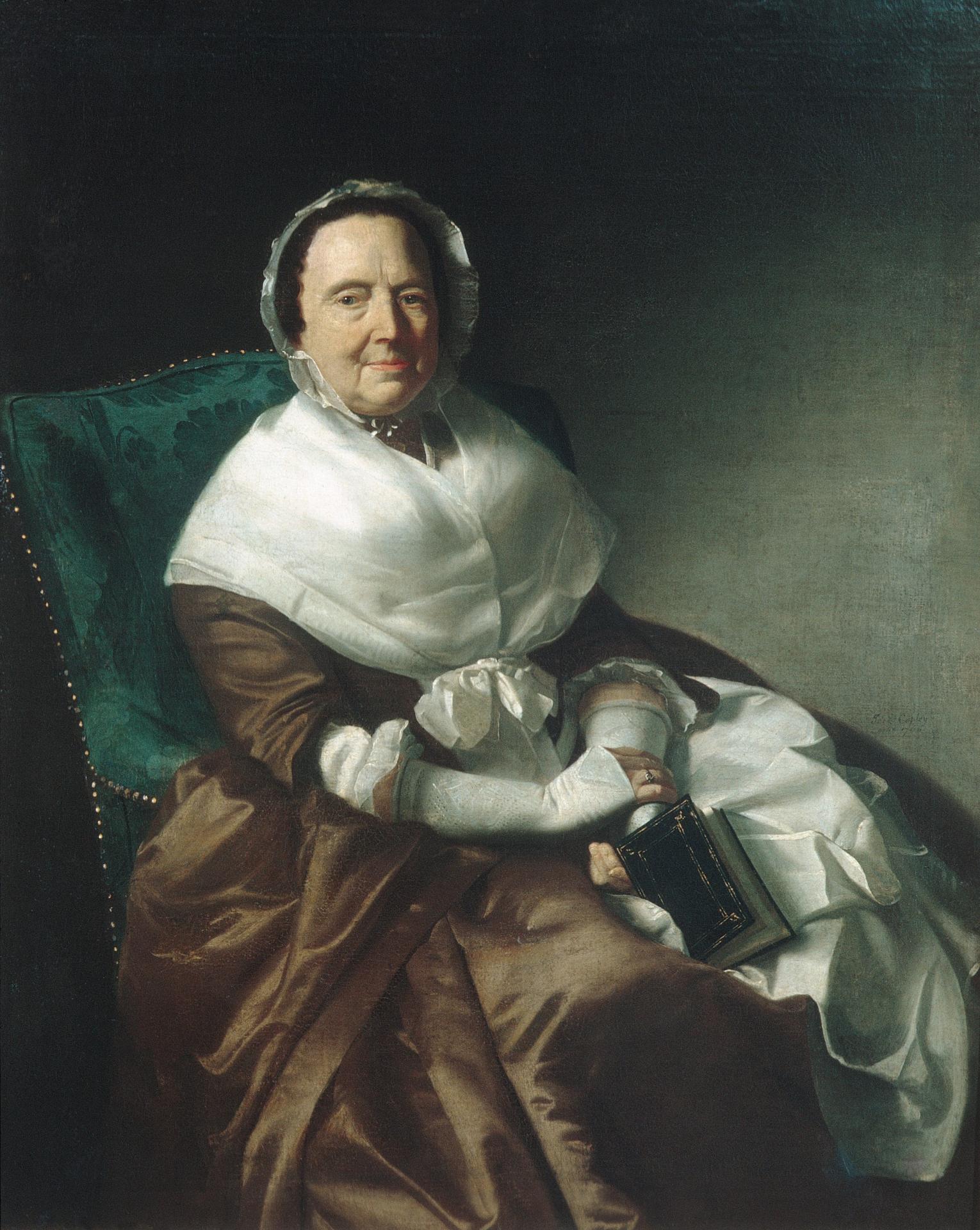
Mrs. Sylvanus Bourne
Original title: Mrs. Sylvanus Bourne
kurzbeschreibung
A closed book rests in the left hand of the seated woman, her hands folded in her lap. John Singleton Copley painted this portrait of Mrs. Sylvanus Bourne in 1766 in oil on canvas. She sits in a plain, dim interior, and the picture stands as an example of the exacting observation that marked Copley's work in colonial America.
Description
Upright in her chair, the sitter holds her hands one over the other, a shut book in the left. A white cloth covers her hair, a brown dress lies beneath it, and a white wrap is draped around her shoulders. Behind her the room stays dark and undefined, so the figure stands out clearly. Light enters from the side, drawing out the features of her face and following the folds of the fabric. The palette is muted and earthy, with a few white accents, giving the image a sober, dignified mood.
Context
Copley was the leading portrait painter of the American colonies, working in Boston in 1766, where this portrait was made. Mrs. Sylvanus Bourne belonged to the prosperous merchant class of New England, and paintings of this kind recorded social standing and civic virtue. Copley had no academic training, yet he developed a manner of his own that was much in demand in the New World. The picture dates from shortly before he moved to England, where his real career later took off.
Impact
Quiet dignity and seriousness emanate from the portrait, in the way typical of Copley's images of bourgeois virtue. Fabric and face are recorded so precisely that the person seems immediately present, carrying the viewer back to the time of colonial America.
Technique
The picture is worked in oil paint on canvas. With fine brushstrokes Copley rendered textures, such as the smooth cloth of the dress and the delicate features of the face. Glazes allowed him graded effects of light and natural skin tones, while the dark background is laid on in a thicker, pastose layer.
AI-generated description text
Source: Metropolitan Museum of Art · Public Domain (CC0 1.0)