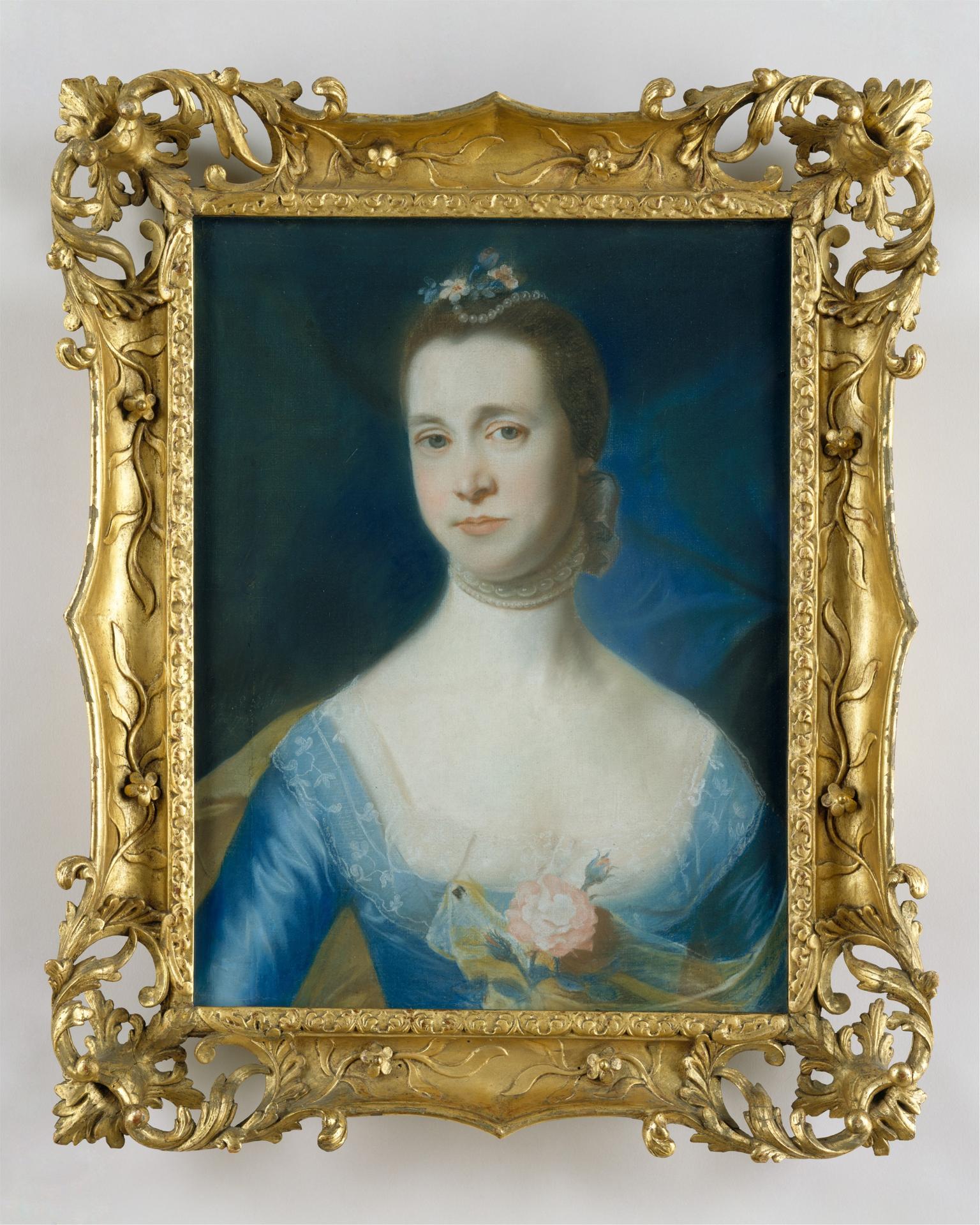
Mrs. Edward Green (Mary Storer)
Original title: Mrs. Edward Green (Mary Storer)
kurzbeschreibung
Mary Storer, the wife of Edward Green, appears in this pastel portrait made by John Singleton Copley in 1765. The likeness is worked in pastel crayon on laid paper, which was later mounted on canvas. The sitter stands out in a blue dress edged with lace, while the ground behind her is a deep, dark blue.
Description
A blue gown lies over a white undergarment, its lace trim clearly drawn. At the left side of the chest sits a rose-shaped brooch. Her hair is gathered back and held by an ornament of blossoms and pearls. Against the dark blue ground the figure stands out sharply. A richly decorated gilded frame with plant motifs surrounds the picture.
Context
Copley made the portrait in 1765, when he ranked among the most respected portraitists in Boston. Mary Storer came from an influential Boston family; her husband Edward Green ran a successful business as a well-to-do merchant. In the American colonies at that time the upper class liked to choose pastel portraits, since they offered a less costly option than oil painting.
Impact
What first holds the eye is the calm, dignified expression that the muted pastel tones bring out. Even light makes contours and surfaces read clearly and lends the portrait something personal, almost intimate. The style reflects the eighteenth-century approach to portraiture, which aimed at exact likeness and a representative bearing.
Technique
Pastel crayon on laid paper, mounted on canvas, forms the base. This method allows soft transitions of color and a matte, velvety surface. In the eighteenth century laid paper was often used as a support for pastel work, since its texture took the pigments well.
AI-generated description text
Source: Metropolitan Museum of Art · Public Domain (CC0 1.0)