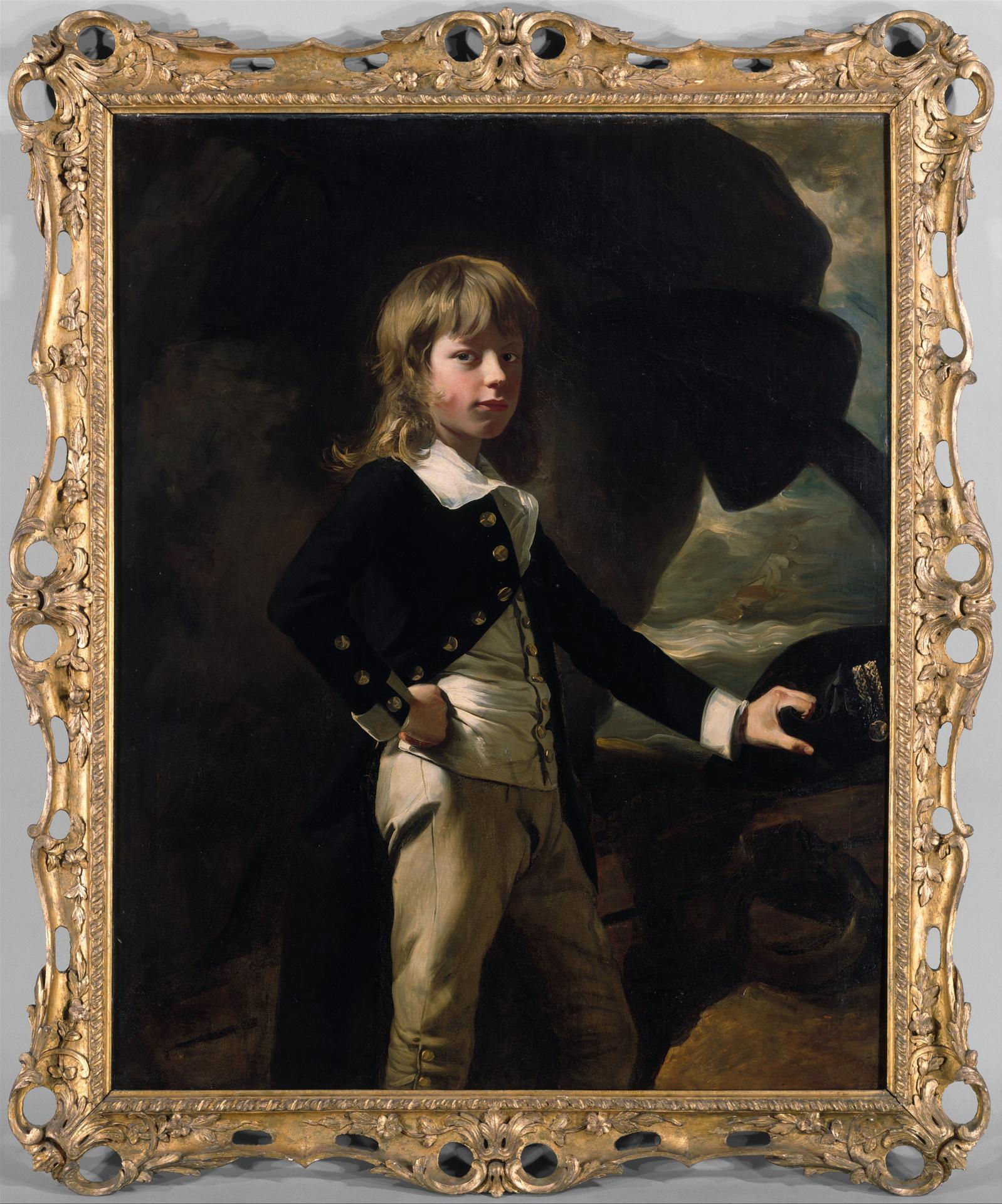
Midshipman Augustus Brine
Original title: Midshipman Augustus Brine
kurzbeschreibung
Augustus Brine, a young midshipman, appears in this 1782 oil painting by John Singleton Copley. On canvas (127 x 101.6 cm), the artist captured the officer candidate in a dark jacket with gold buttons and light trousers, holding a compass in his hand.
Description
The young man stands centrally, his blond, wavy hair framing his face. He wears a dark jacket with gold-colored buttons and light trousers, and in his hand he holds a compass of the kind used for navigation. A dark, non-representational background surrounds the figure and makes him stand out clearly. Light falls deliberately on his face and upper body, emphasizing his features. An elaborately decorated gold frame encloses the painting.
Context
Copley, an American painter, had moved to England in 1774 and created the portrait in London in 1782. The sitter is Augustus Brine, a midshipman—an aspiring officer in the British Royal Navy. Showing a young naval man with a compass points to the high importance of navigation in 18th-century British seafaring. Copley was known for his portraits, which he executed in a detailed, classical style.
Impact
Because the background remains dark and non-representational and the light is placed deliberately, the viewer's attention is drawn entirely to the person. Muted colors and the sitter's calm posture give the picture a dignified, serious mood. The gold frame emphasizes the representative character of the portrait.
Technique
Oil paint on canvas, the usual medium for portraits at the time, here carries fine brushstrokes that achieve high detail, especially in the facial features and the gold buttons. The lighting and shading against the dark background correspond to the classical portrait style of the 18th century.
AI-generated description text
Source: Metropolitan Museum of Art · Public Domain (CC0 1.0)