John Jay
Original title: John Jay
kurzbeschreibung
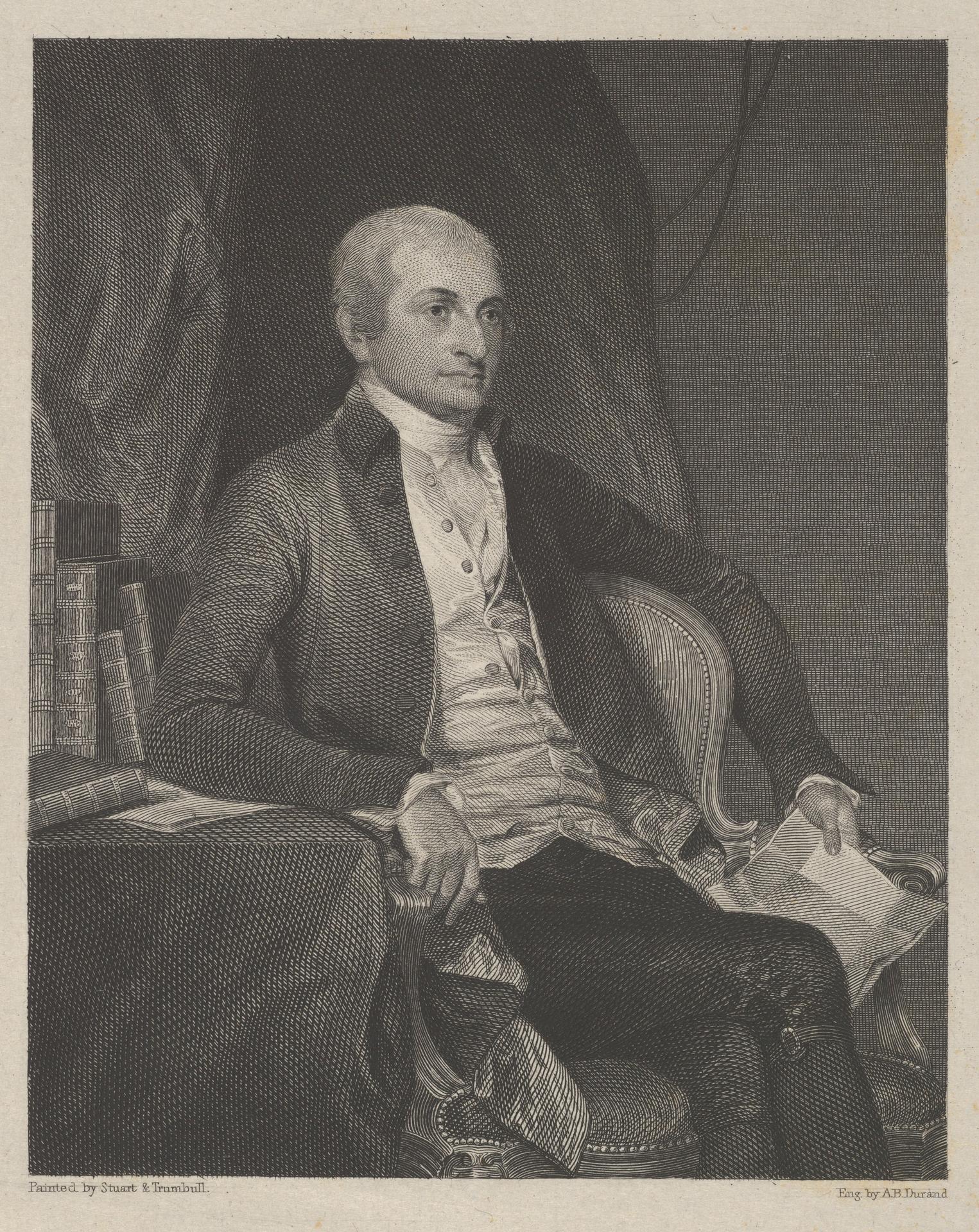
John Jay, one of America's founding fathers, appears here as a seated, pensive man in elegant dress. Asher Brown Durand engraved the portrait on copper in 1834, printed on chine collé mounted on a support sheet. The print demonstrates Durand's skill in the demanding field of formal portraiture.
Description
A gentleman in a fine suit with a light shirt and collar sits quietly, his gaze turned slightly to the side. Books and a portion of a curtain fill the background, suggesting a study. The layout feels balanced, with attention drawn to the seated figure and the books. Fine hatching in gray tones brings out the texture of clothing and space.
Context
This engraving was made in 1834, about five years after John Jay's death in 1829. Durand was then among the leading engravers and later became an important painter of the Hudson River School. The print reflects the era's common practice of circulating portraits of notable figures through print. A painting capturing Jay in his role as politician and diplomat likely served as the source.
Impact
The portrait conveys a quiet, dignified presence that mirrors Jay's standing as a statesman. Careful line work and nuanced shading create a realistic, almost painterly quality. The viewer is drawn into the intellectual sphere of the sitter.
Technique
The engraving was produced using the chine collé method: a thin sheet of China paper is adhered to a sturdier support sheet. This is the second of three states, a proof before the name, which attests to its rarity and the working process. The technique allows for precise lines and fine gradations, used here to render garments and shadows.
AI-generated description text
Source: Metropolitan Museum of Art · Public Domain (CC0 1.0)