Apotheosis of Washington
Original title: Apotheosis of Washington
kurzbeschreibung
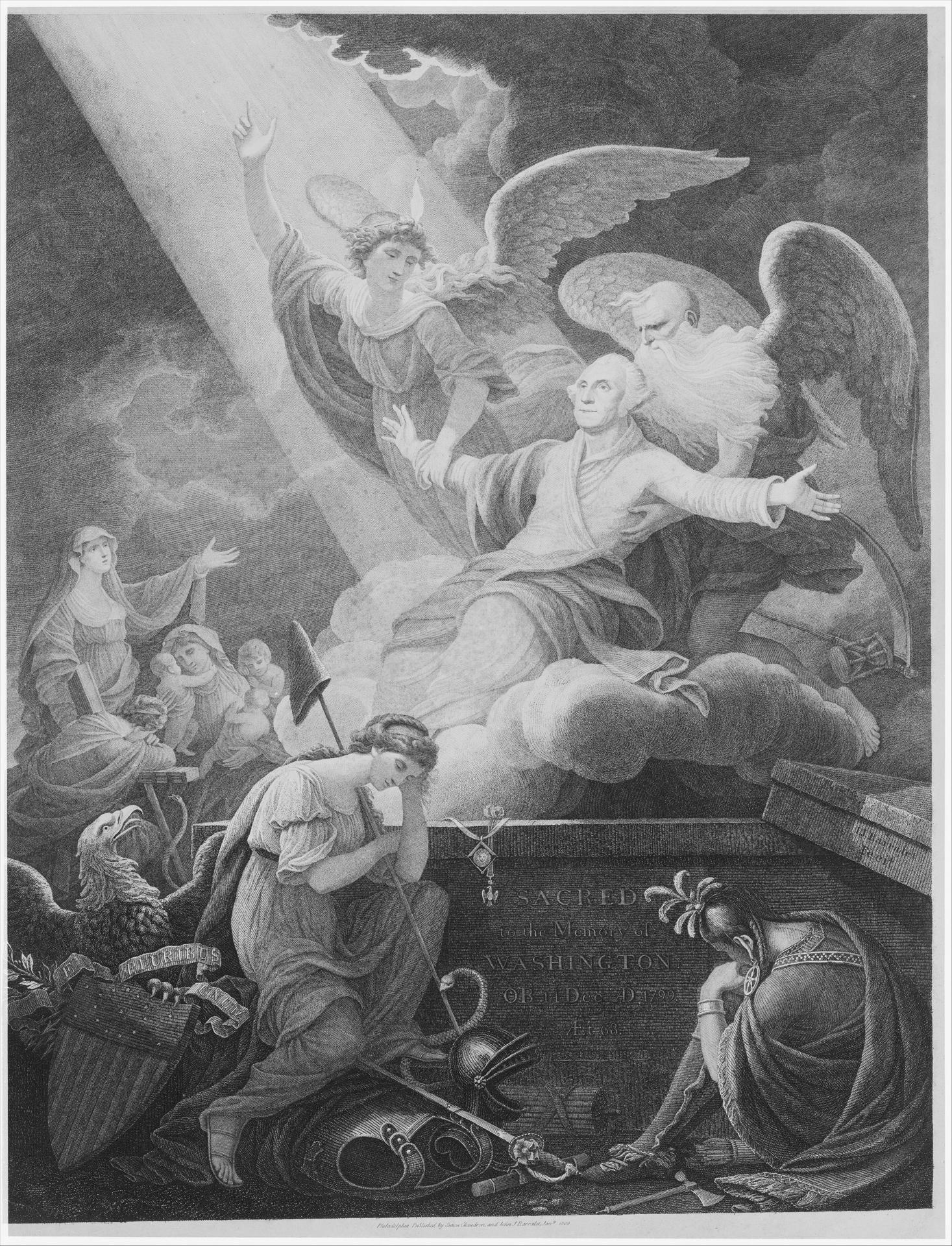
Between 1800 and 1802, John James Barralet produced an engraving and etching titled The Apotheosis of Washington, raising the deceased George Washington onto a cloud-borne throne. Angels and allegorical figures gather around him, his death staged as an ascent into heaven, while a sarcophagus in the foreground recalls his legacy.
Description
Washington sits enthroned high on a mound of cloud, encircled by angels and allegorical figures. A winged angel bearing a coat of arms hovers above him; on the left stands a crowned woman with a lance, and on the right another crowned figure kneels with a sword. Beneath them rests a sarcophagus inscribed "Sacred to the Memory of Washington," attended by an eagle, a shield with the arms of the United States, and a helmet. Further back appear a woman with children and an angel holding a book. Everything stays monochrome, black and white, with a forceful play of light and dark.
Context
Made soon after George Washington's death in 1799, this print belongs among the early American memorial images that turned the first president into a national icon. Barralet, Irish by birth and working in Philadelphia, produced an allegorical work meant to unite the young nation in mourning and reverence. Circulated as a print, it served as a popular keepsake of the statesman.
Impact
Sharp contrast between light and shadow gives the scene a solemn, almost sacred mood. Realistic elements such as the sarcophagus merge with allegorical figures into a compelling blend of history and exaltation that speaks to the viewer emotionally.
Technique
Etching combined with engraving allowed for delicate lines and precise hatching. This method permitted a detailed rendering of figures and symbols, while the monochrome ink heightens the dramatic force of the arrangement.
AI-generated description text
Source: Metropolitan Museum of Art · Public Domain (CC0 1.0)