Louis-Marie, Vicomte de Noailles
Original title: Louis-Marie, Vicomte de Noailles
kurzbeschreibung
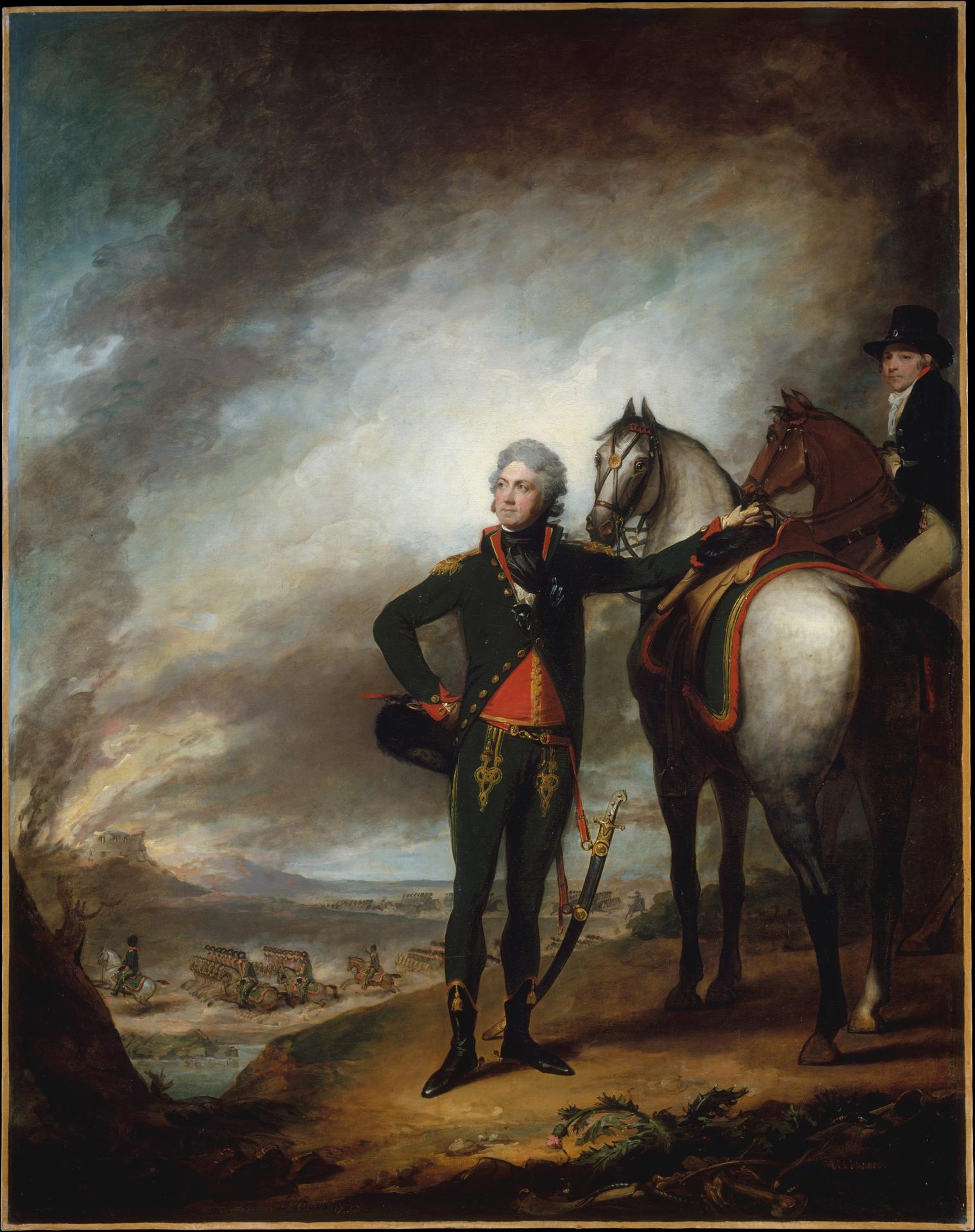
In 1798 Gilbert Stuart painted Louis-Marie, Vicomte de Noailles in military dress, his right hand holding a pistol. The oil on canvas singles out the aristocrat as an individual while hinting at a skirmish behind him, thus marrying the formal portrait with a martial setting.
Description
Noailles occupies the middle of the canvas, wearing a uniform whose red sleeve and gold braid draw the eye. His right hand grips a pistol, his left rests at his hip; his gaze is serious and withdrawn. A horse stands to the side, mounted by another man in a dark coat and black cap. Beyond stretches a battlefield with soldiers, guns and drifting smoke. Light from the left picks out the contours of the figures and the horse.
Context
Stuart ranked among the most esteemed portraitists of the early United States and immortalized several founding fathers. The sitter, Louis-Marie, Vicomte de Noailles, came from the French nobility and had served as an officer in the American Revolutionary War. Painted in 1798, likely commissioned by the Noailles family, the portrait presents him in his military role. Stuart was then working in Philadelphia and prized for likenesses of notable figures.
Impact
The layout is clear and nearly symmetrical, with the sitter unmistakably at the center. The dark uniform stands out against the lighter, war-torn background, creating a dignified, serious mood. Realistic execution and muted tones underscore the portrait's representative purpose.
Technique
Executed in oil on canvas, a common method in the eighteenth century. Stuart's brushwork is precise and rich in detail, the colors carefully harmonized and carrying the mood of the portrait. At 127 x 101.6 cm, the format matches the usual size for representative portraits of the period.
AI-generated description text
Source: Metropolitan Museum of Art · Public Domain (CC0 1.0)