Horatio Gates
Original title: Horatio Gates
kurzbeschreibung
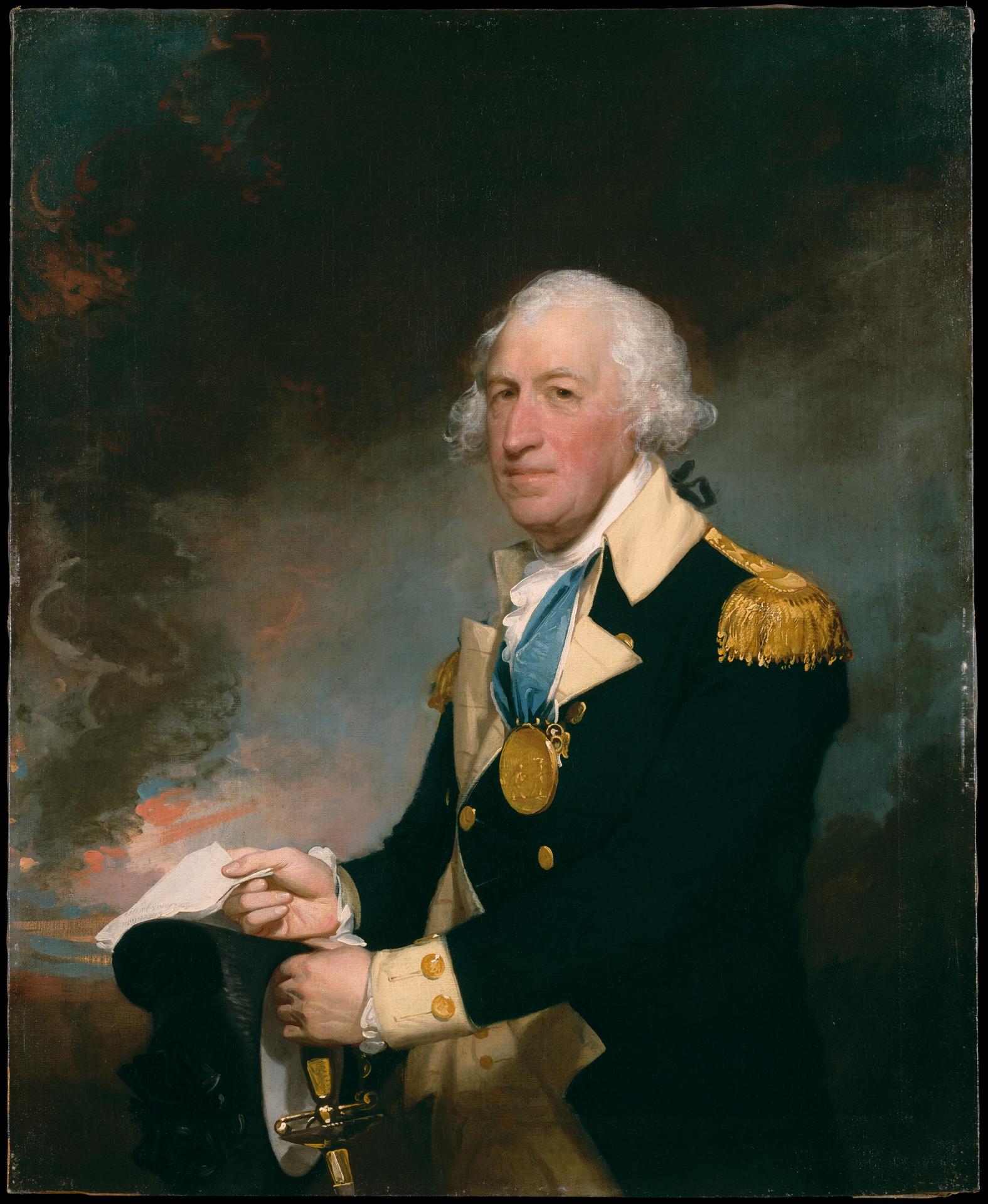
Where many general's portraits of the period lean on pose and drama, Gilbert Stuart's Horatio Gates (ca. 1793–94) presents the officer as a thoughtful, almost private man. Painted in oil on canvas, Gates sits in uniform with his hands folded, holding a sheet of paper. The picture is a characteristic example of Stuart's approach to portraiture from the years around American independence.
Description
Gates's upper body tilts slightly to the left as he sits in a dark interior. He wears a dark blue coat whose gold epaulettes and buttons stand out, and a gold medal hangs at his neck. His hands are clasped, the right one holding a paper. Dark, abstract passages of blue and red suggest smoke or cloud behind him. The expression is grave and contemplative, and the palette as a whole is muted.
Context
Stuart painted the portrait in the 1790s, when Horatio Gates was already regarded as a hero of the Revolutionary War. Stuart was then among the most sought-after portraitists in the young United States and painted numerous Founding Fathers. The work was probably made in his studio in New York or Philadelphia, where he settled after returning from England. Gates had by this time ended his military career and was living as a private citizen.
Impact
Calm and dignified, the portrait makes its impression through the serious face and restrained color. The dark areas of the background draw attention to the features and to the details of the uniform. Altogether the image conveys an air of authority and reflection.
Technique
The painting is executed in oil on canvas, a standard technique for portraits of the day. Stuart worked with fine brushwork and glazing to achieve soft transitions in the face and fabric. The subdued colors and controlled lighting attest to his ability to render psychological depth in paint.
AI-generated description text
Source: Metropolitan Museum of Art · Public Domain (CC0 1.0)