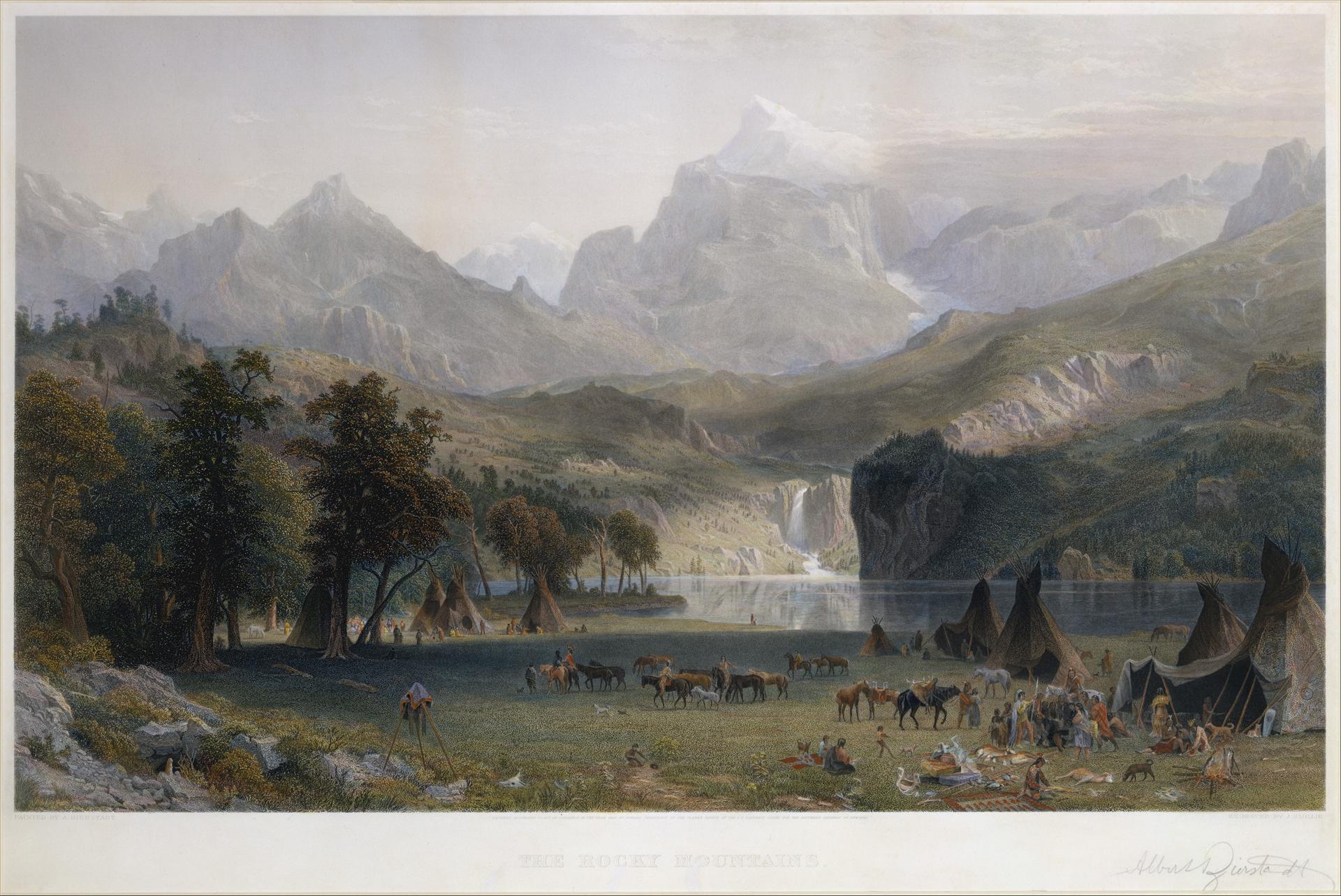
The Rocky Mountains, Lander's Peak (1866)
Original title: The Rocky Mountains, Lander's Peak
kurzbeschreibung
In 1866 James Smillie issued a wide view of the Rocky Mountains dominated by the striking Lander's Peak, as a hand-colored steel engraving. In the foreground are tents, people and animals of an Indian camp; behind them rise snow-capped summits, and a waterfall pours into a lake. The print combines precise topographical detail with a romanticized vision of nature.
Description
An open plain with several Indian tents, surrounded by people, horses and cattle, fills the foreground. Above, mighty mountains with snow-covered peaks tower up; a waterfall plunges into a lake. Trees and bushes frame the view and mark the transition to the mountains. The coloring remains muted and natural, with gray, brown and green tones prevailing. Soft, diffuse light emphasizes the expanse of the sky and the depth of the landscape.
Context
Issued in 1866 by James Smillie as a reproductive engraving after an 1863 painting by Albert Bierstadt, the print appeared in New York. Bierstadt had visited the region during his second expedition to the American West in 1859 and executed the large oil painting from sketches. The engraving helped spread the image of the Rocky Mountains among the American public. The name Lander's Peak goes back to Frederick W. Lander, an engineer and explorer involved in opening up the West.
Impact
Sublimity and idyll merge: the immense mountain backdrop feels overwhelming, while the Indian camp in the foreground provides a human scale. The calm, harmonious layout invites contemplation and highlights untouched nature as an American symbol.
Technique
Smillie's print was made as a steel-plate etching and engraving and then hand-colored. The process allowed fine lines and an accurate rendering of landscape details, while the coloring gave the image a painterly effect. It was printed in an edition intended for commercial distribution.
AI-generated description text
Source: Metropolitan Museum of Art · Public Domain (CC0 1.0)