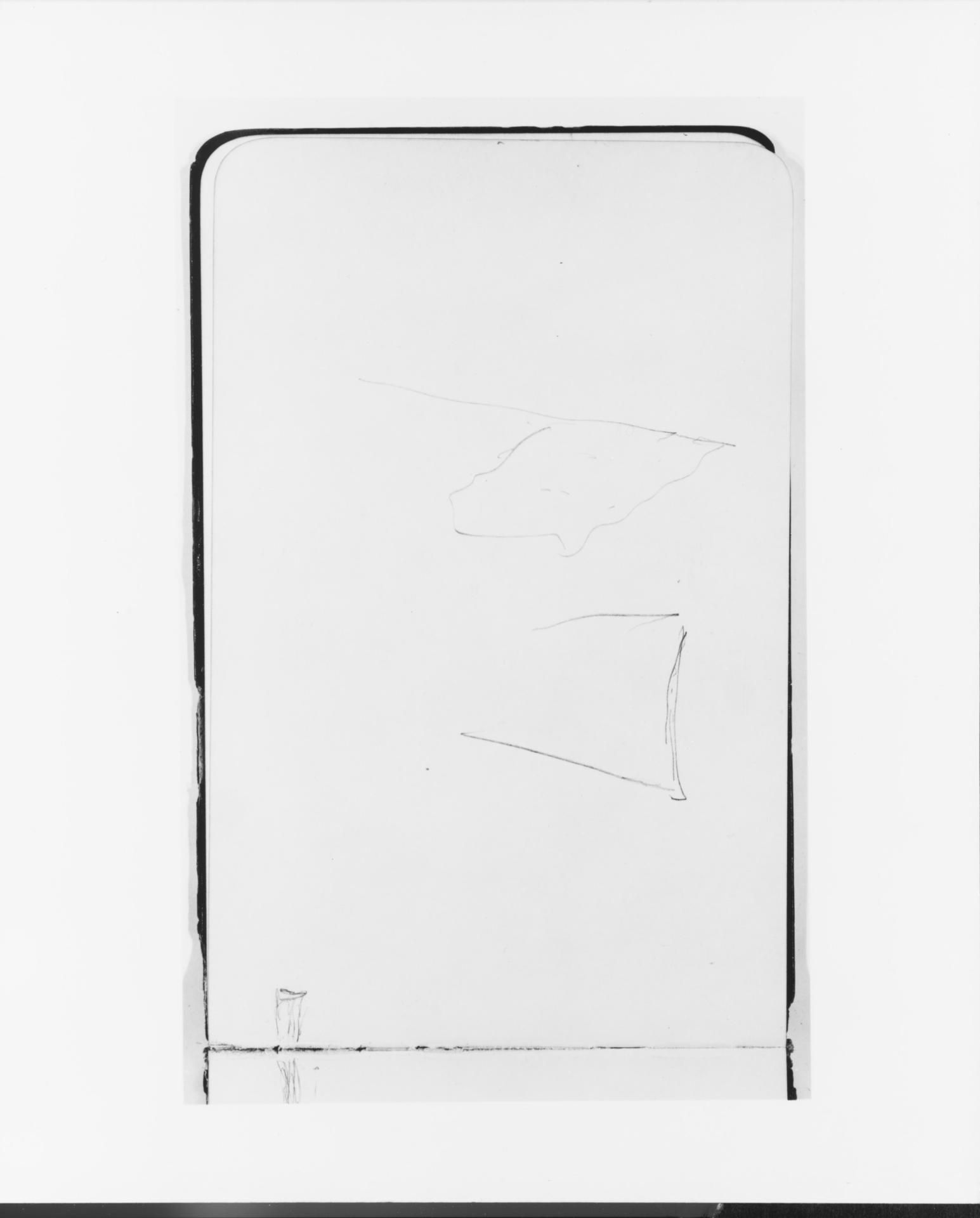
Study of a Flag for the Landing of Columbus (from Sketchbook)
Original title: Study of a Flag for the Landing of Columbus (from Sketchbook)
kurzbeschreibung
Unlike the more finished flag designs found in related sketches, this sheet by Albert Bierstadt stays with the first gesture: a quickly jotted graphite study on paper, made around 1891. It comes from a sketchbook whose pages have gilt edges and are bound in a leather cover.
Description
Two fields make up the flag—a triangle above, a rectangle below—both tilted slightly to the right. The strokes remain plain and fleeting, with no hatching or indication of surface. The white of the paper lies untouched around the form and draws the eye to it; at the edges, the black boundary lines of the sketchbook page are visible, showing slight wear there.
Context
The study probably belongs to a painting about the landing of Columbus that Bierstadt was planning in his later years. The sketchbook from which the sheet comes is dated around 1891—a time when the artist turned more strongly to historical subjects. As a working drawing, it served to prepare a larger work.
Impact
Because the lines are so sparingly set down, the sketch retains something immediate and fresh. The simple flag shape reads like a sudden idea and lets one follow the artist's process. The empty surroundings highlight the formal study and open a view onto the historical context.
Technique
The sheet is executed in graphite on wove paper, which has been refined with gilt edges and bound in a leather cover. It was drawn with fine, irregular strokes typical of quick sketches. At 12.1 x 19.7 cm, the format corresponds to a handy sketchbook.
AI-generated description text
Source: Metropolitan Museum of Art · Public Domain (CC0 1.0)