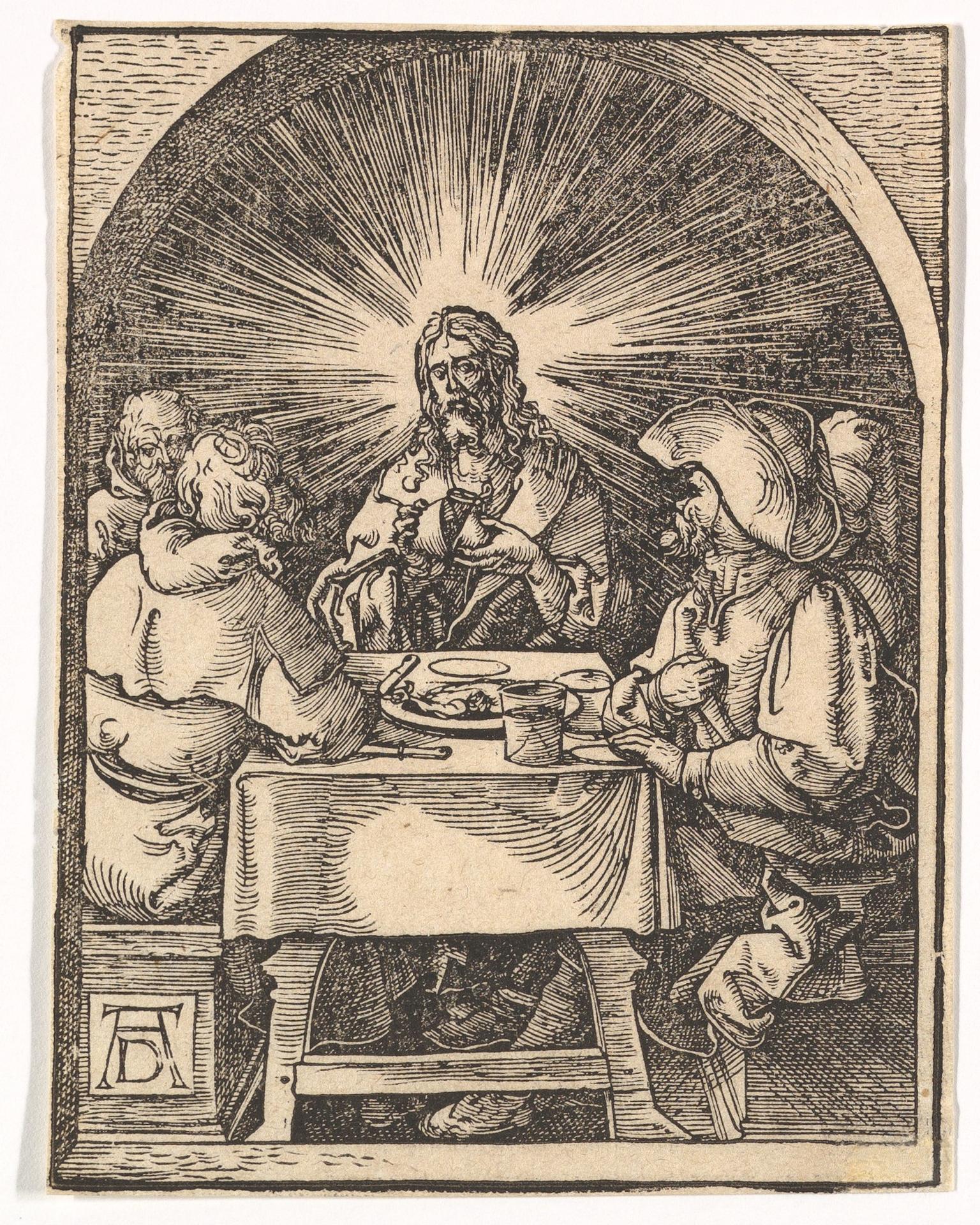
Christ in Emmaus, from "The Small Passion" (copy)
Original title: Christ in Emmaus, from "The Small Passion" (copy)
kurzbeschreibung
This woodcut, attributed to Albrecht Dürer, depicts the Supper at Emmaus from his renowned series The Small Passion. It shows Christ seated at a table with two disciples, his figure radiating divine light. The work is a later copy of Dürer's original print, executed in the woodcut technique.
Description
The composition is centered on Christ, who sits at a table covered with a cloth, flanked by two disciples. A burst of light emanates from above, with rays streaming down and surrounding Christ's head. The table holds plates with food and a vessel, rendered in fine linework and cross-hatching. The figures wear Renaissance-style garments, and the monochrome print uses varied shading to suggest depth and texture.
Context
Dürer created The Small Passion, a series of 37 woodcuts, between 1508 and 1510, and it was first published in 1511 in Nuremberg. The series was highly popular and widely distributed, making Dürer's woodcuts influential across Europe. This particular impression is a copy, likely made after Dürer's original blocks or prints, indicating the enduring demand for his work. The scene follows the Gospel of Luke, where Christ reveals himself to two disciples at Emmaus.
Impact
The stark contrast between the dark background and the radiant light around Christ emphasizes the moment of revelation, giving the print a contemplative and spiritual tone. The intricate linework and balanced composition draw the viewer's eye to the central figure, making the scene both intimate and monumental.
Technique
The work is a woodcut, a relief printing technique where the image is carved into a wooden block, inked, and transferred to paper. Dürer's mastery of the medium is evident in the fine lines and cross-hatching that model forms and suggest light. The copy preserves the original's technical precision, though it may lack some of the subtlety of Dürer's own impressions.
AI-generated description text
Source: Metropolitan Museum of Art · Public domain (CC0)