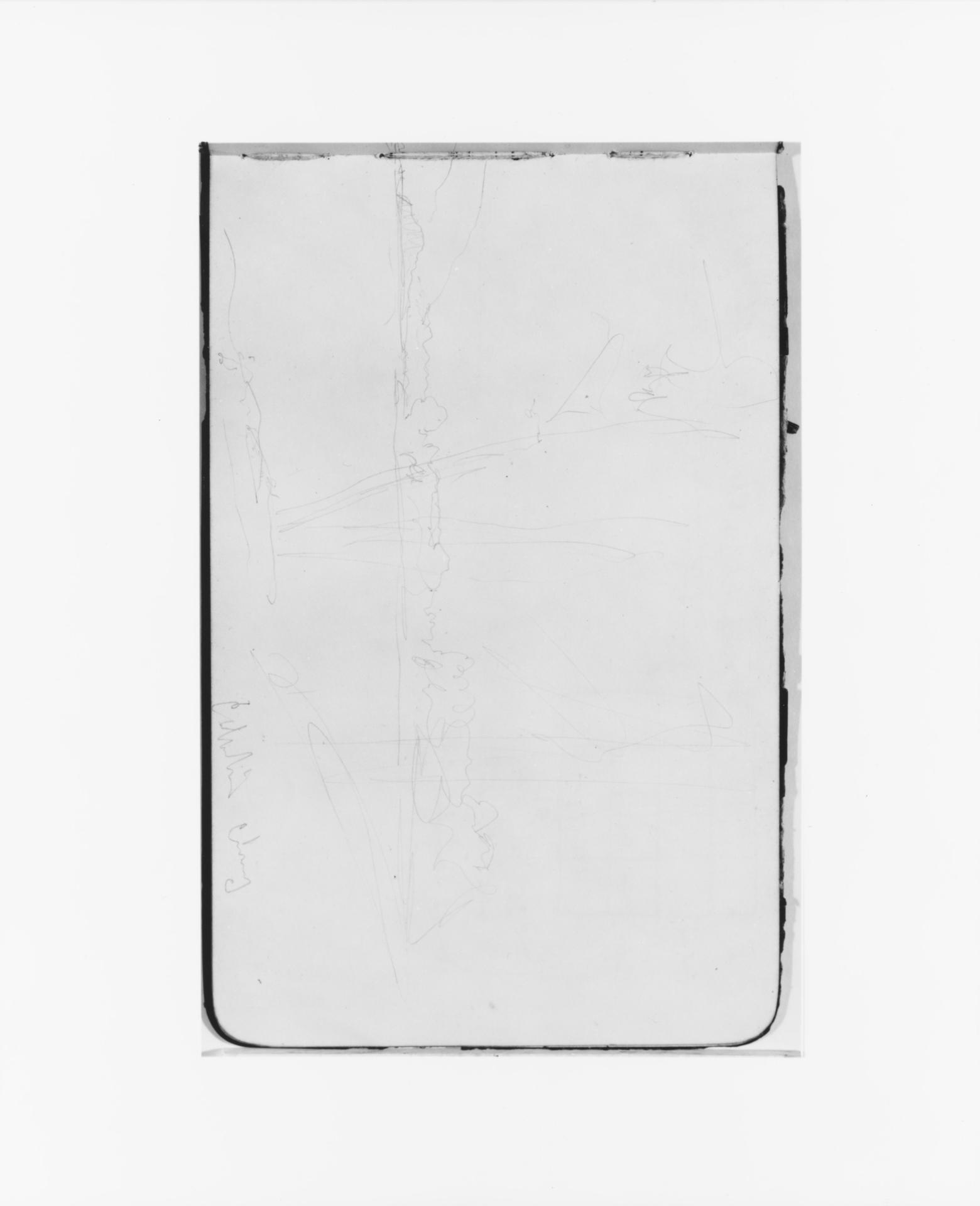
River Scene (Columbia _______?) (from Sketchbook)
Original title: River Scene (Columbia _______?) (from Sketchbook)
kurzbeschreibung
Graphite on wove paper carries this sketchy river landscape that Albert Bierstadt captured in 1890. The sheet measures 12.1 x 19.7 cm and belongs to a sketchbook. In a few strokes, a fleeting observation of nature is caught, retaining the character of an impression noted on the go.
Description
Only a few lines and suggested shapes hint at a river course. Clearly outlined figures or objects are entirely absent; instead, fleeting strokes remain, from which trees, shrubs, and bank contours can be read. The layout feels loose and undetermined, as is typical for a spontaneous sketch. There is no color, since this is a graphite drawing, and the light remains even, without strong shading.
Context
Bierstadt drew this sheet in 1890, long after he had become known for his large-scale landscape paintings of the American West. He presumably used the sketchbook as working material for later compositions or to record travel impressions. The place 'Columbia' cannot be definitively identified; a connection to the Columbia River, which appears several times in Bierstadt's work, is conceivable.
Impact
Because the drawing restricts itself to a few lines, it feels immediate and spontaneous, almost like a fleeting note. A calm, nature-close mood arises without going into detail, and the viewer is left room for their own imaginings.
Technique
Graphite on wove paper, a common material for sketches of that time, forms the basis of this sheet. The strokes are loose and fleeting; hatching or graduated tonal values are absent, suggesting a quickly dashed-off design drawing. At about 12 x 20 cm, the format is small and reinforces the impression of a casual note in a sketchbook.
AI-generated description text
Source: Metropolitan Museum of Art · Public Domain (CC0 1.0)