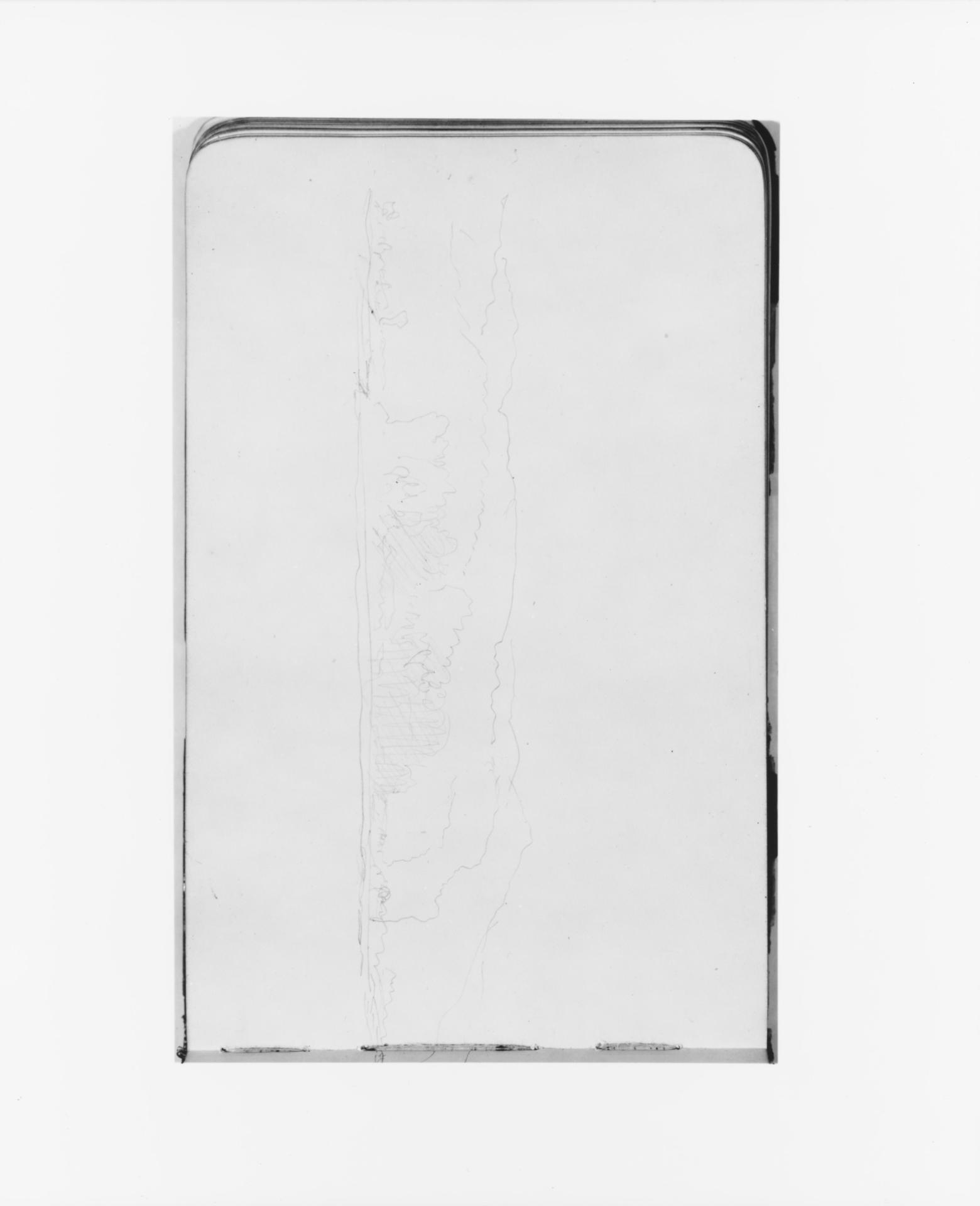
River Scene (from Sketchbook)
Original title: River Scene (Columbia ______?) (from Sketchbook)
kurzbeschreibung
Albert Bierstadt drew this river scene in 1890, working in graphite on wove paper. The sheet measures 12.1 by 19.7 cm and comes from one of his sketchbooks. It records a stretch of flowing water, with the currents observed closely and carefully differentiated, and nothing else is included in the drawing.
Description
Slender lines and sweeping curves describe the waves and the pull of the current. The layout stays plain, directing attention to the river alone; no other objects or figures appear. A light crease in the paper suggests an older sheet that was handled and used. Rendered in black and white, the view reads as realistic and finely observed.
Context
Albert Bierstadt (1830–1902), a German-American painter, became known above all for his landscapes of the American West. The sketchbook this sheet belongs to dates from his later years, when he was already well established. The title points toward a view of the Columbia River, which Bierstadt sketched during his travels in the western United States. Most likely the drawing served as a preparatory study for later paintings, or simply as an independent observation from nature.
Impact
Precise and calm, the sheet captures the water and has a meditative effect. Delicate strokes build a lively texture that makes the river's movement almost tangible. By concentrating on the essentials, the artist gives the work a clear, focused presence.
Technique
Graphite on wove paper allows for fine, exact lines. Hatching and curved strokes reproduce currents and waves convincingly. The medium permits subtle gradations of light and shadow, which lend the drawing depth.
AI-generated description text
Source: Metropolitan Museum of Art · Public Domain (CC0 1.0)