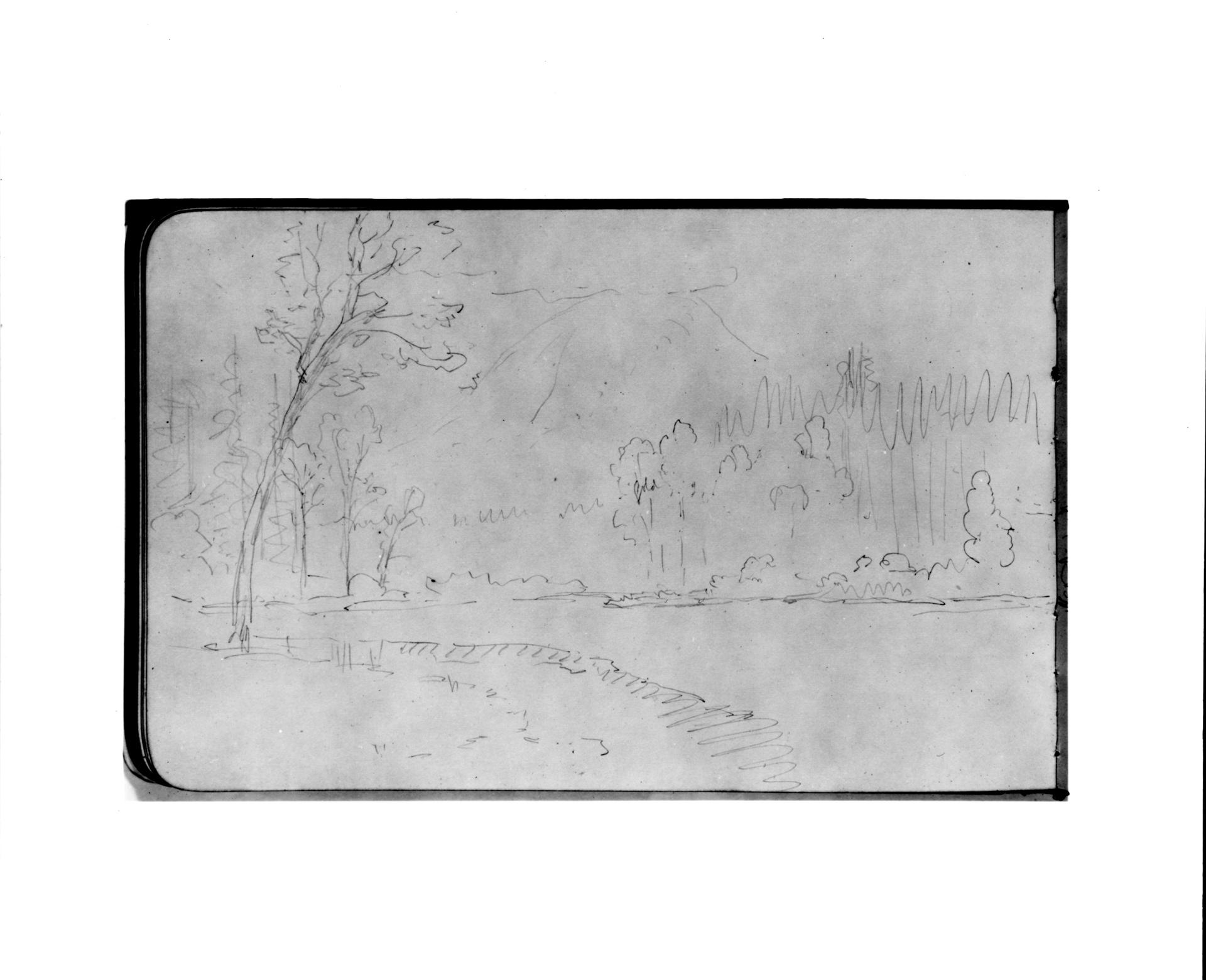
Kalama, Columbia River, Washington (from Sketchbook) (1890, Met-Objekt 2715)
Original title: Kalama, Columbia River, Washington (from Sketchbook)
kurzbeschreibung
Albert Bierstadt recorded the Columbia River near Kalama, Washington, in 1890 with this graphite sketch from a sketchbook. The sheet shows a stretch of river, scattered trees, and hills, drawn in a spare, line-based manner on wove paper.
Description
A faint, undulating line suggests the broad, flat river. In the foreground stand isolated trees, their crowns and branches outlined with simple strokes. Beyond them, several hills or mountains extend from left to right, built up from short horizontal lines. Shadows and contrasts are absent; light falls evenly across the whole, as is typical of a graphite drawing. The layout remains plain and entirely focused on nature.
Context
When Bierstadt made this sketch in 1890, he was long established for his large landscape paintings of the American West. The sheet was likely produced during a trip along the Columbia River, which flows through the northwestern United States. Such records served the artist as study material for later paintings. The fact that the drawing comes from a sketchbook points to a spontaneous capture directly from the motif.
Impact
The reduced linework gives the sheet a quiet, documentary tone. The viewer gains an immediate impression of the landscape, which does not appear idealized. Because the rendering remains so plain, the eye is drawn primarily to the topographical features.
Technique
Graphite on wove paper allows fine and precise lines. For the hills, the drawing uses short horizontal strokes, while trees and river are captured with simple contours. This makes it possible to record the landscape quickly and effectively.
AI-generated description text
Source: Metropolitan Museum of Art · Public Domain (CC0 1.0)