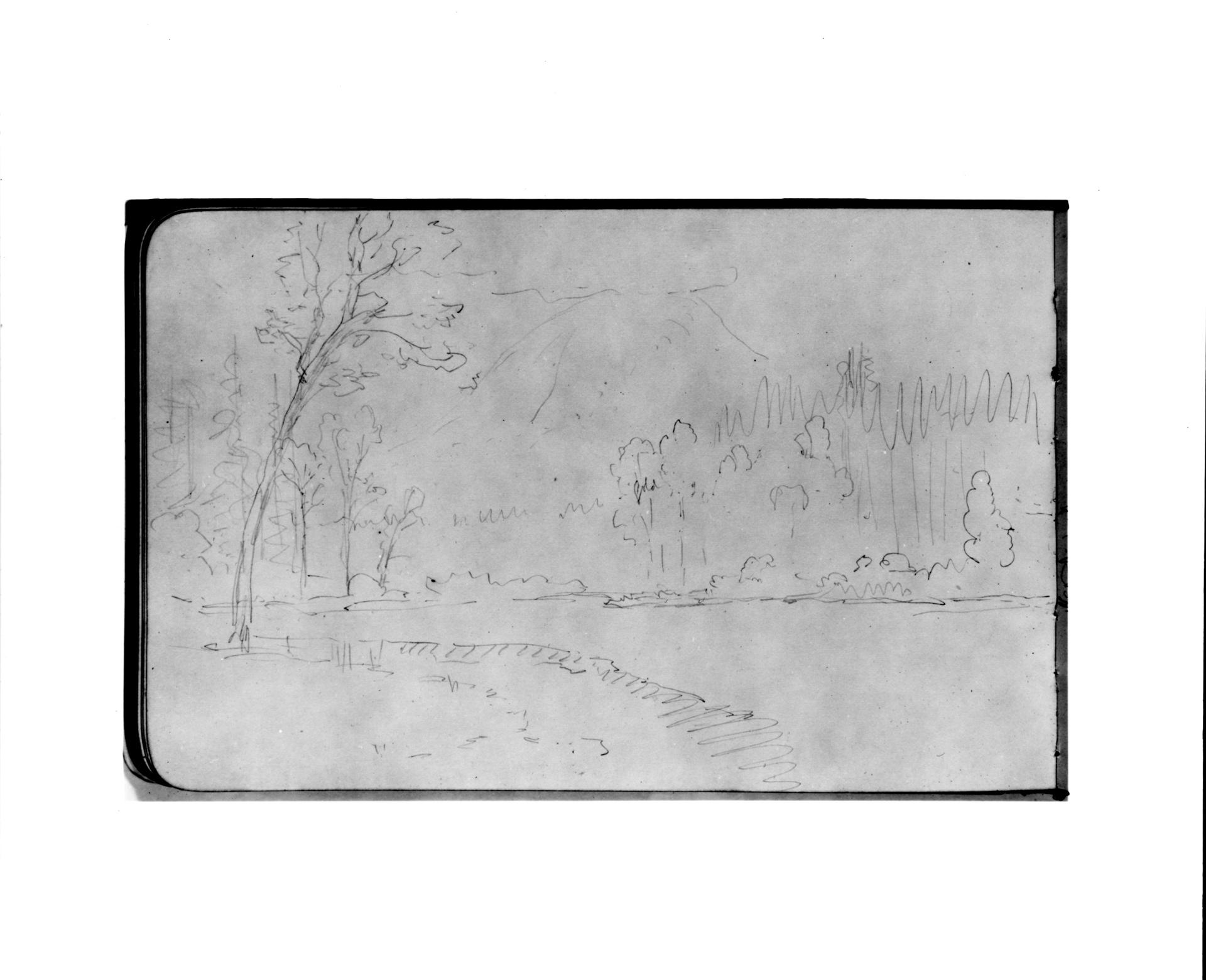
Kalama, Columbia River, Washington (from Sketchbook) (1890, Met-Objekt 2714)
Original title: Kalama, Columbia River, Washington (from Sketchbook)
kurzbeschreibung
Albert Bierstadt captured a river landscape on the Columbia River in Washington in 1890, using graphite on wove paper. This drawing, part of a sketchbook, depicts the area with spare but assured strokes.
Description
The viewer's eye is first drawn to the broad expanse of the river, which cuts horizontally across the sheet. In the foreground, trees and shrubs line the bank, while gently rising hills emerge behind. The view remains in black and white, yet varying line weights and hatching create light and shadow. The realism of the scene is softened by a loose, sketch-like handling.
Context
Bierstadt, a German-American painter of the Hudson River School, gained fame with large-scale landscape paintings of the American West. This drawing dates from 1890, late in his career, after several trips to the West. Kalama, then a small settlement on the Columbia River, was growing in importance as a railway junction. Bierstadt likely used the sketchbook to record motifs for later paintings.
Impact
Despite the limitation to line and gray tones, the sheet radiates a calm, atmospheric mood. The wide landscape with river and hills invites contemplation. The sketchy execution gives the drawing an immediate, intimate note.
Technique
Graphite on wove paper—a high-quality, ribbed support—forms the basis. Fine and broader strokes differentiate the textures of vegetation and terrain. Hatching and varying pressure model light and shadow, entirely without color.
AI-generated description text
Source: Metropolitan Museum of Art · Public Domain (CC0 1.0)