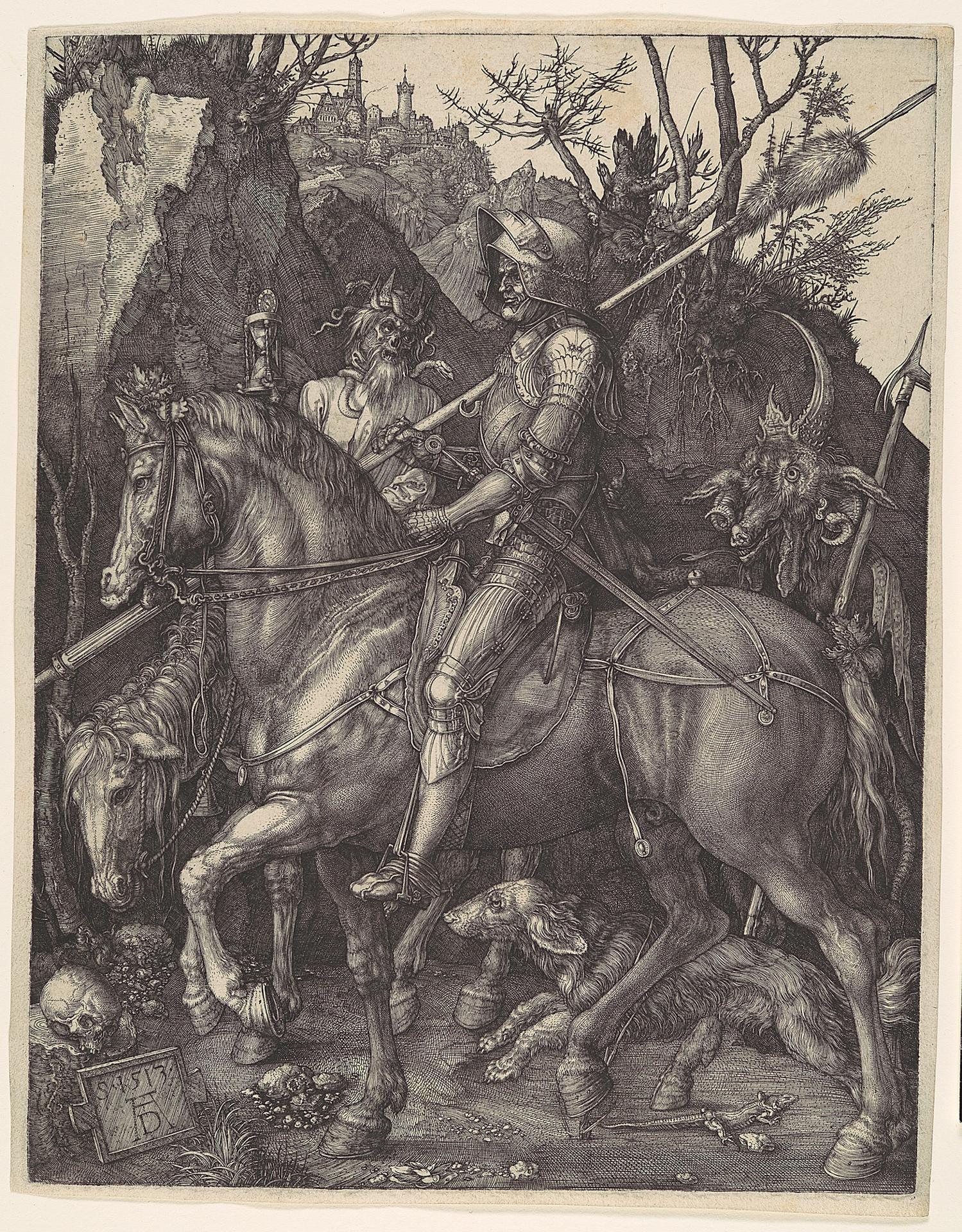
Knight, Death, and the Devil
Original title: Knight, Death, and the Devil
kurzbeschreibung
Knight, Death, and the Devil is an engraving by Albrecht Dürer from 1513. It depicts a fully armored knight riding through a dark landscape, flanked by the personifications of Death and the Devil. The work is a masterful example of Renaissance printmaking.
Description
The composition centers on a knight in full armor atop a horse, holding a shield in his right hand. To the right, a gaunt figure representing Death stands, while on the left, a grotesque devil-like creature lurks. A dog lies near the horse, possibly exhausted or dead, and a skull rests on the ground in the lower left corner. The background features a ruined tower, a city with a castle, and a rugged, tree-lined terrain, all rendered in monochrome with intricate linework and shading.
Context
Created in 1513, this engraving is one of Dürer's three master engravings from his Nuremberg period, alongside Saint Jerome in His Study and Melencolia I. The work reflects the Renaissance fascination with allegory and moral themes, often interpreted as a Christian knight's steadfastness in the face of sin and death. Dürer was a leading figure of the Northern Renaissance, known for his technical skill in printmaking and his engagement with humanist ideas.
Impact
The engraving evokes a somber, tense atmosphere through its dark imagery and the knight's resolute expression. The detailed textures and dramatic contrasts draw the viewer into the moral struggle depicted, leaving a lasting impression of vigilance and faith.
Technique
This work is an engraving, a technique where lines are incised into a metal plate, which is then inked and pressed onto paper. Dürer's masterful use of cross-hatching and varied line thickness creates a rich range of tones, from deep shadows to subtle highlights, demonstrating his exceptional control over the medium.
AI-generated description text
Source: Metropolitan Museum of Art · Public domain (CC0)