Trees on a Hill (from Sketchbook)
Original title: Trees on a Hill (from Sketchbook)
kurzbeschreibung
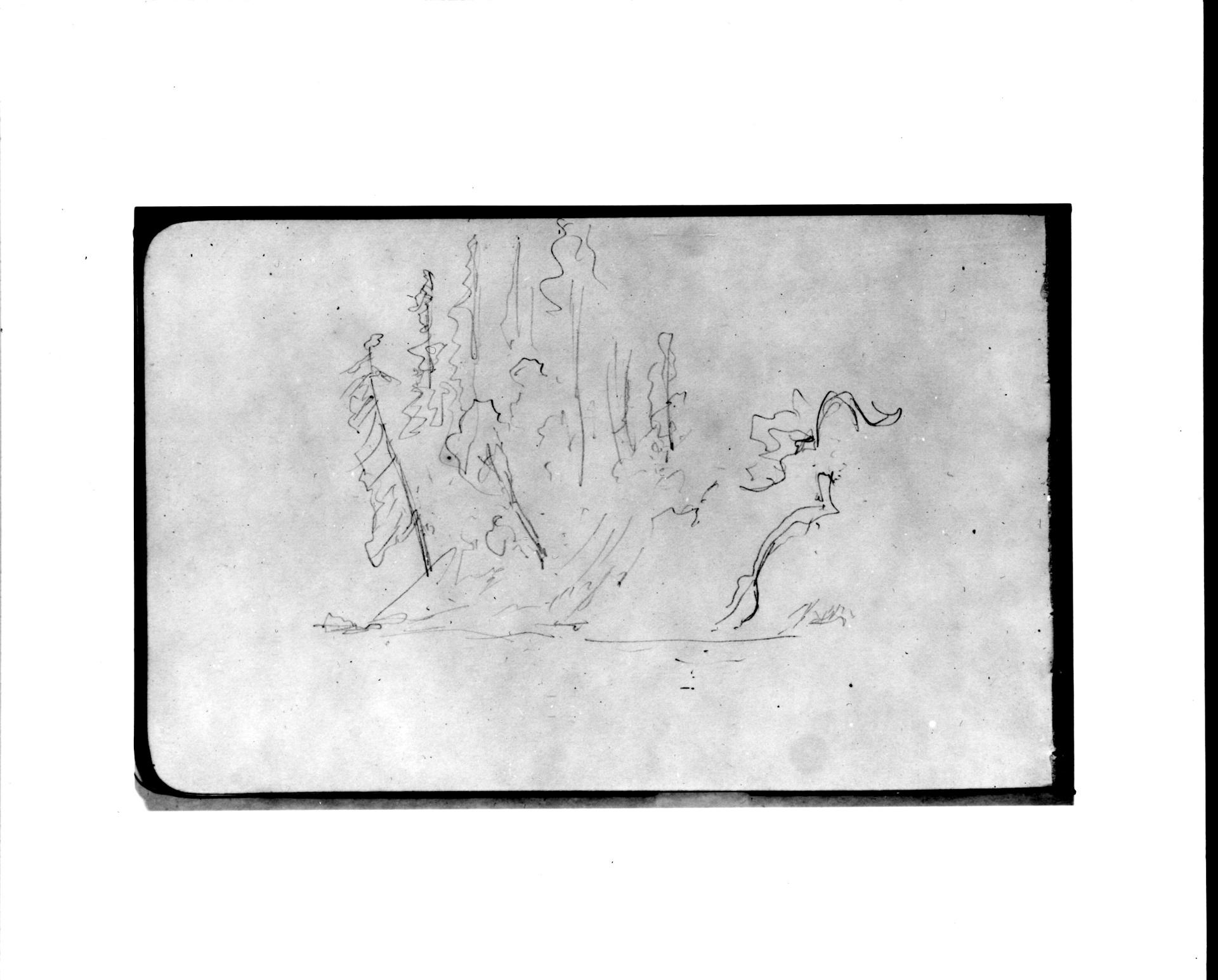
Albert Bierstadt's 1890 drawing "Bäume auf einem Hügel" is a quick graphite sketch of several trees on wove paper. Taken from a sketchbook, the sheet offers a plain but expressive study of tree forms with no background elements at all.
Description
Several trees of different sizes and shapes stand together on the page and hold the viewer's attention. Some trunks look thin and straight, while other branches spread wide and curve. The lines shift in character, now flowing, now firm and sharp. Shading and light effects are absent; the drawing stays purely linear, black and white. The paper bears signs of use that point to a sketch made by hand.
Context
Albert Bierstadt (1830–1902), a German-American painter of the Hudson River School, became known for large-scale landscapes of the American West. He made this sketch in 1890, when he was over 60 and his fame was already fading. It belongs to a sketchbook he used for studies and travel notes. Such books served artists as a visual diary and as a store of material for later paintings.
Impact
Because the drawing is reduced to essentials, it speaks directly and personally. The loose, spontaneous line lets an intimate observation of nature come through and invites the viewer to follow the process of its making. Color and detail step back, so the forms and structures of the trees move into focus.
Technique
Graphite on wove paper, a smooth and even support that allows fine lines. The execution matches a rapid sketch: stroke widths vary from delicate to strong, and hatching or tonal values are missing. In this way the artist's immediate hand shows through, and the documentary character of the study is preserved.
AI-generated description text
Source: Metropolitan Museum of Art · Public Domain (CC0 1.0)