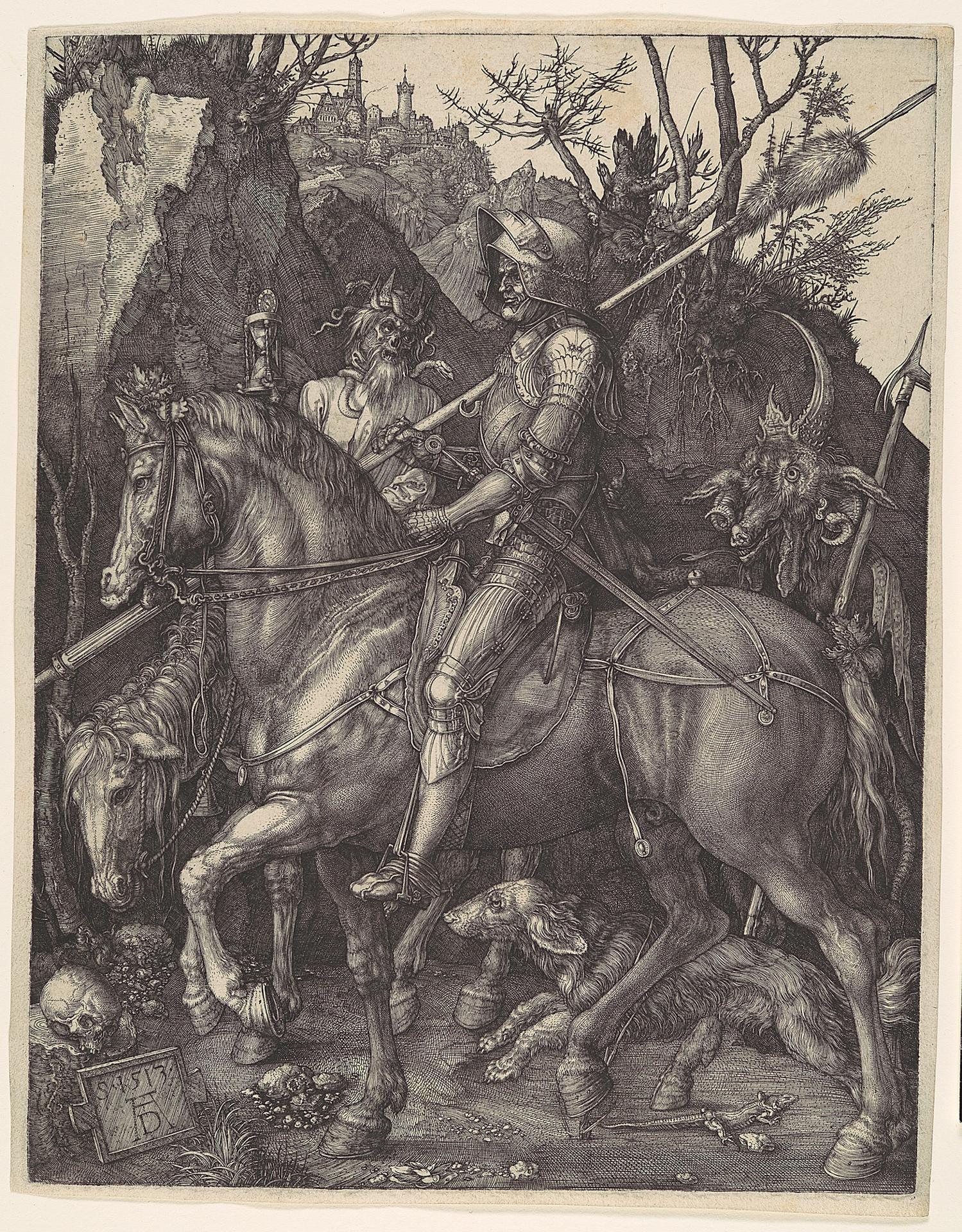
Knight, Death, and the Devil
Original title: Knight, Death, and the Devil
kurzbeschreibung
Knight, Death, and the Devil is an engraving by Albrecht Dürer from 1513. It shows a fully armored knight riding through a narrow mountain pass, accompanied by a dog, while Death and the Devil lurk nearby. The work is one of Dürer's most famous prints, known for its intricate detail and allegorical depth.
Description
The composition centers on a knight in full plate armor, seated on a powerful horse, holding a lance and a shield. To the right, a gaunt figure representing Death rides a pale horse and holds an hourglass, while a horned, goat-like devil follows behind. A small dog runs between the horse's legs, and in the background, a rugged landscape features a castle perched on a rocky crag. The engraving uses fine, dense lines to model forms and create dramatic contrasts of light and shadow, emphasizing the rocky terrain and the figures' textures.
Context
Dürer created this engraving during a period of intense artistic output in Nuremberg, where he was established as a leading printmaker. The work reflects the Renaissance interest in classical and Christian symbolism, and it is often interpreted as a moral allegory of the Christian knight's steadfastness in the face of sin and death. Dürer's engravings were widely distributed across Europe, and this piece was part of a series of master prints that influenced later artists.
Impact
The image evokes a sense of solemn determination and existential struggle, as the knight's resolute gaze contrasts with the eerie figures around him. The meticulous detail and dramatic lighting draw the viewer into the scene, creating a powerful visual impact that underscores the moral tension. The print's enduring appeal lies in its ability to convey both a personal and universal message about faith and mortality.
Technique
Dürer employed engraving on a copper plate, a technique that involves cutting lines with a burin to create precise, varied strokes. The print demonstrates his mastery of cross-hatching and stippling to achieve tonal gradations and textural richness. The fine, controlled lines allowed for exceptional detail, making this one of the most technically accomplished engravings of its time.
AI-generated description text
Source: Metropolitan Museum of Art · Public domain (CC0)