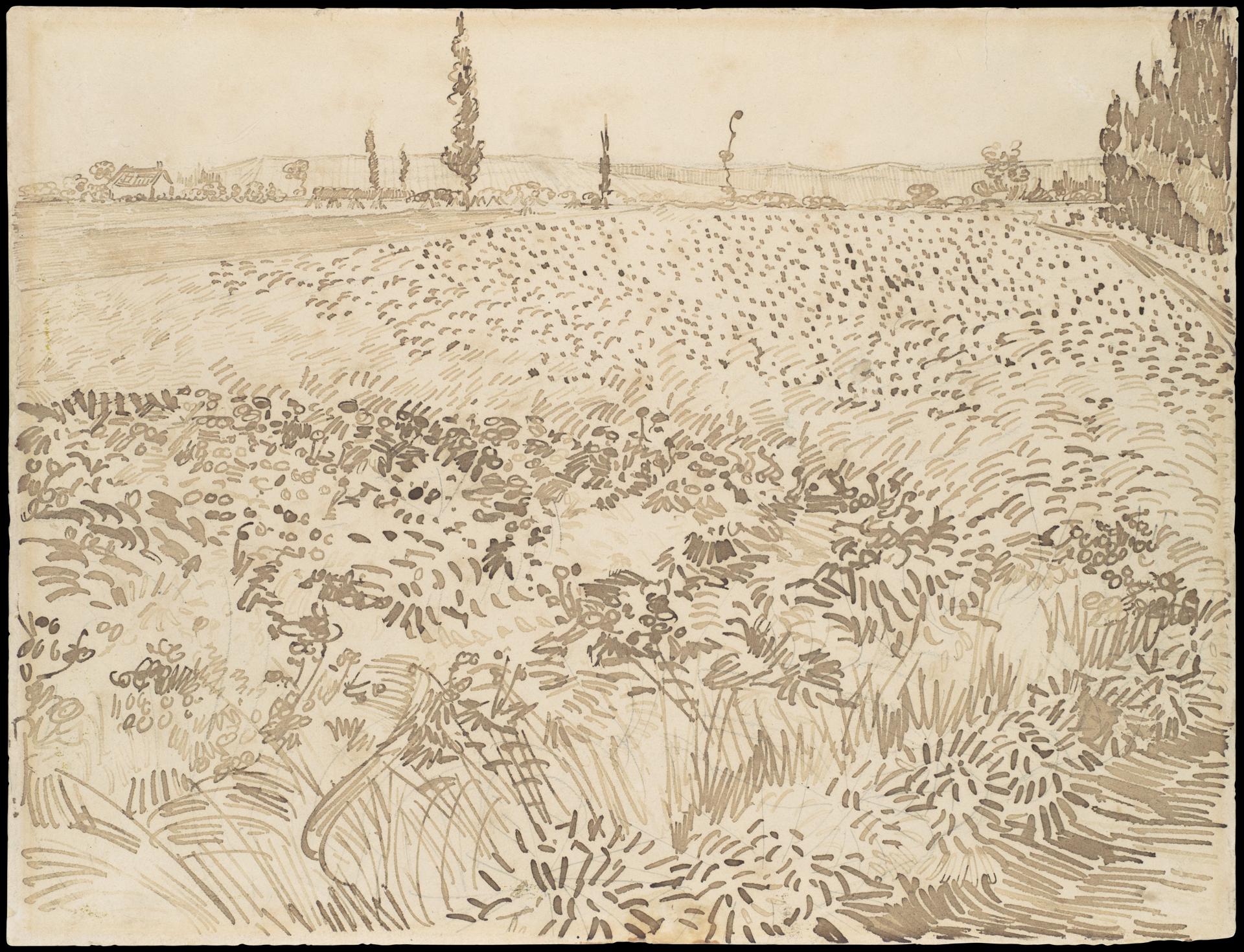
Wheat Field
Original title: Wheat Field
kurzbeschreibung
In July 1888, Vincent van Gogh drew "Weizenfeld" (Wheatfield) using a reed pen and logwood ink over graphite on wove paper. The drawing captures a grain field, with trees and a house in the distance.
Description
A grain field, likely wheat, fills the foreground. Behind it, trees and a house appear. The drawing relies on sparse lines and strokes that outline the structure of stalks and branches. Gray tones dominate the monochrome palette. The layout is broad: field in front, trees and house behind. The light feels diffuse, emerging from the stroke work and tonal values.
Context
Van Gogh was in Arles in July 1888 and made this drawing there. Wheat fields recur often in his work from this period, as he studied the Provençal landscape in depth. The sheet was created as an independent work, not as a preparatory study for a painting, as evidenced by its careful execution.
Impact
The restriction to gray tones and few lines gives the sheet a calm, almost graphic quality. Precise strokes meet diffuse light, creating an atmospheric density that makes the summer heat of the field palpable.
Technique
For this drawing, van Gogh used a reed pen with logwood ink over a graphite underdrawing, executed on wove paper. The reed pen allowed bold, varied lines, while the ink permitted fine gradations of lightness in gray tones.
AI-generated description text
Source: Metropolitan Museum of Art · Public Domain (CC0 1.0)