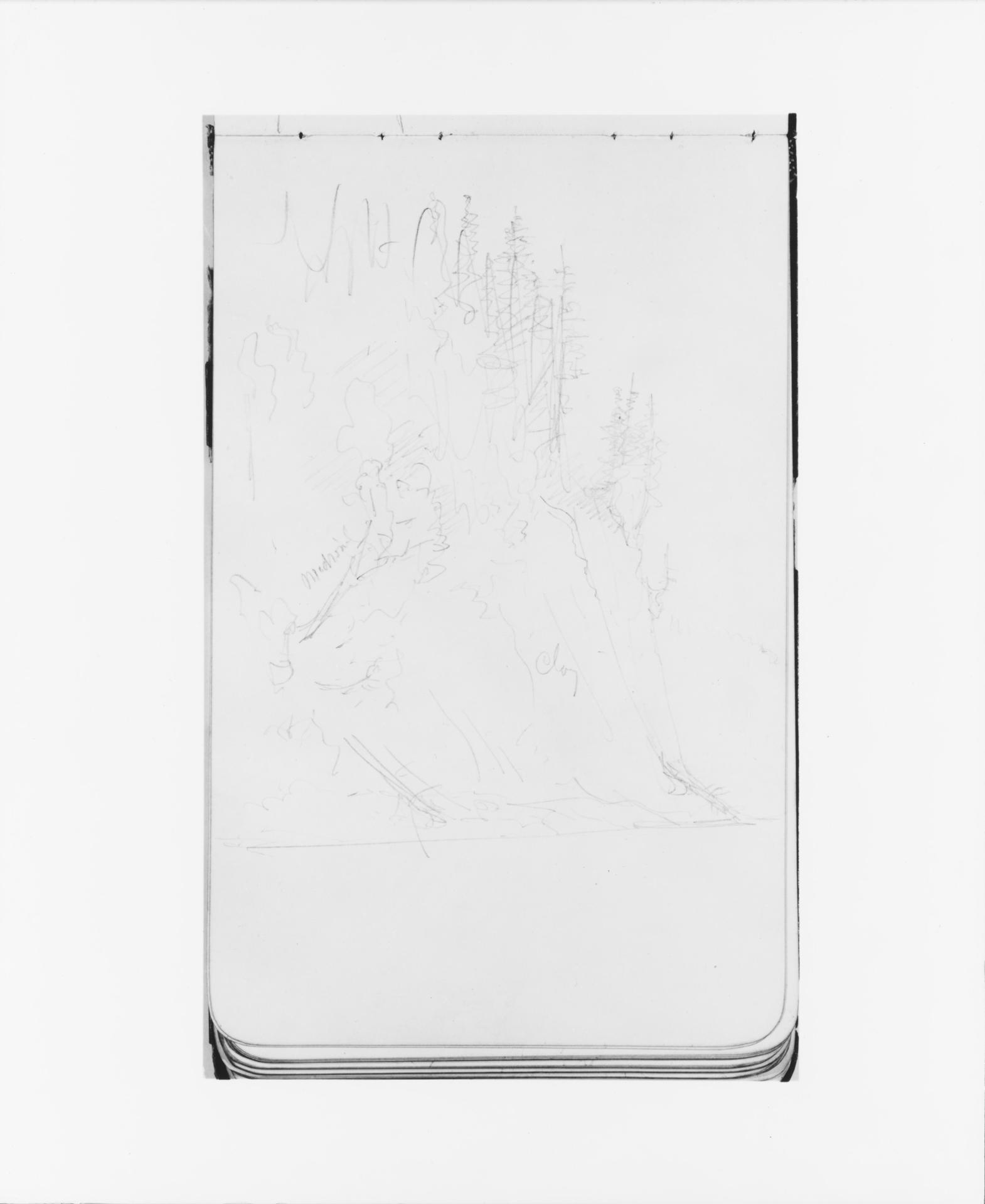
Trees on a Cliffside (from Sketchbook)
Original title: Trees on a Cliffside (from Sketchbook)
kurzbeschreibung
This sketchbook page by Albert Bierstadt dates to 1890: a graphite drawing on wove paper that captures trees on a cliff slope. The execution stays loose and fleeting, like a note taken from nature.
Description
Trees stand scattered across the slope, each angled differently, their growth habit and structure clearly worked out. The strokes run irregularly and look rapidly set, which gives the sheet its casual air. The layout is confined entirely to trees and slope; background motifs are absent. Light and shadow are hinted at through varying stroke weight and the way the trees are positioned relative to one another. Color plays no part—the image remains black and white.
Context
Bierstadt (1830–1902), a German-American painter of the Hudson River School, became known above all for large-format landscapes of the American West. This drawing falls in 1890, a late phase in which he traveled widely and used sketchbooks for studies. In them he repeatedly recorded natural forms, especially trees and rock formations, which later served as foundations for paintings. The sheet belongs to one such sketchbook and can be read as evidence of his working method.
Impact
The drawing feels immediate and lively precisely because of its terse, open line. One seems to follow a quick observation made outdoors, almost to be present at the moment of its making. Because the image stays reduced, the eye is drawn to the branches and the line of the slope.
Technique
The sheet was executed in graphite on wove paper, as was usual for sketches. Stroke weight varies, suggesting differing pressure and a swift hand. At 19.7 x 12.1 cm the format remains small and handy, as if made for a sketchbook.
AI-generated description text
Source: Metropolitan Museum of Art · Public Domain (CC0 1.0)