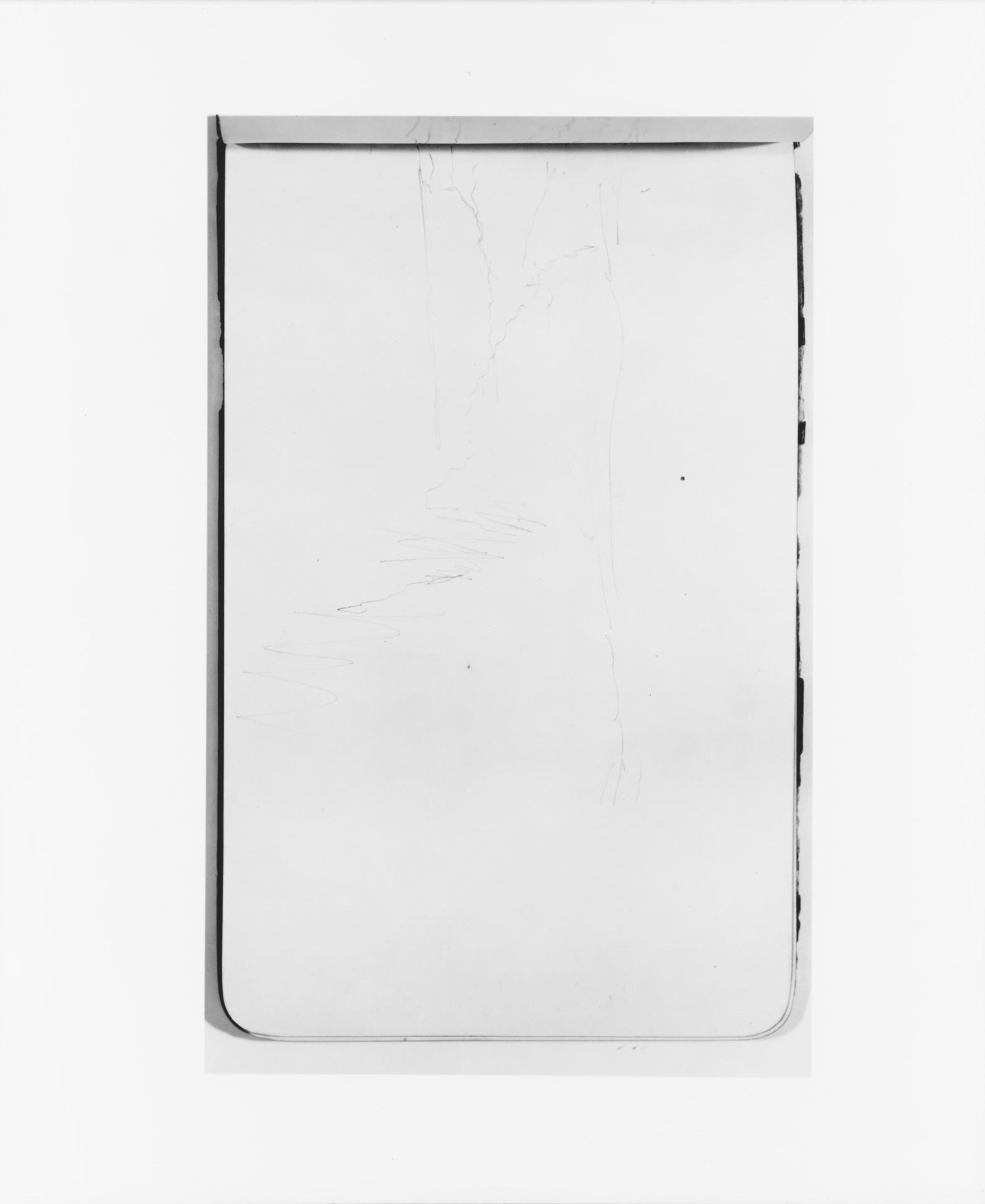
Landscape (from Sketchbook) (1890, Met-Objekt 2693)
Original title: Landscape (from Sketchbook)
kurzbeschreibung
Albert Bierstadt drew this small landscape in graphite in 1890. The sheet comes from a sketchbook and measures 12.1 by 17.1 centimetres. It shows mountains or hills that are only hinted at, worked in pencil on wove paper.
Description
Several lines run across the sheet from left to right, marking out mountain or hill shapes. The strokes vary in length and weight along the way. Details and figures are absent entirely; the rendering stays deliberately brief and sketchy. Shadows and contrasts are nowhere to be found, and the light falls evenly over the view. The motif thus appears reduced to the bare essentials.
Context
Bierstadt, a German-American painter of the Hudson River School, became known above all for large-format landscapes of the American West. This little sketch was made in 1890, late in his career, when his reputation had long been established internationally. He used his sketchbooks as a kind of visual notebook for studies that could later feed into larger works. Here too, the eye on nature remains the deciding factor.
Impact
Because everything superfluous drops away, the sheet gives off a calm, collected mood. The delicate strokes suggest a private, almost casual encounter with nature. For all its simplicity, a quiet presence remains that invites looking.
Technique
Graphite on wove paper — a handmade support with a surface texture of its own — defines the image. The pressure and length of the strokes vary, which points to a quick, direct approach. Colour never comes into play; the sheet stays monochrome throughout.
AI-generated description text
Source: Metropolitan Museum of Art · Public Domain (CC0 1.0)