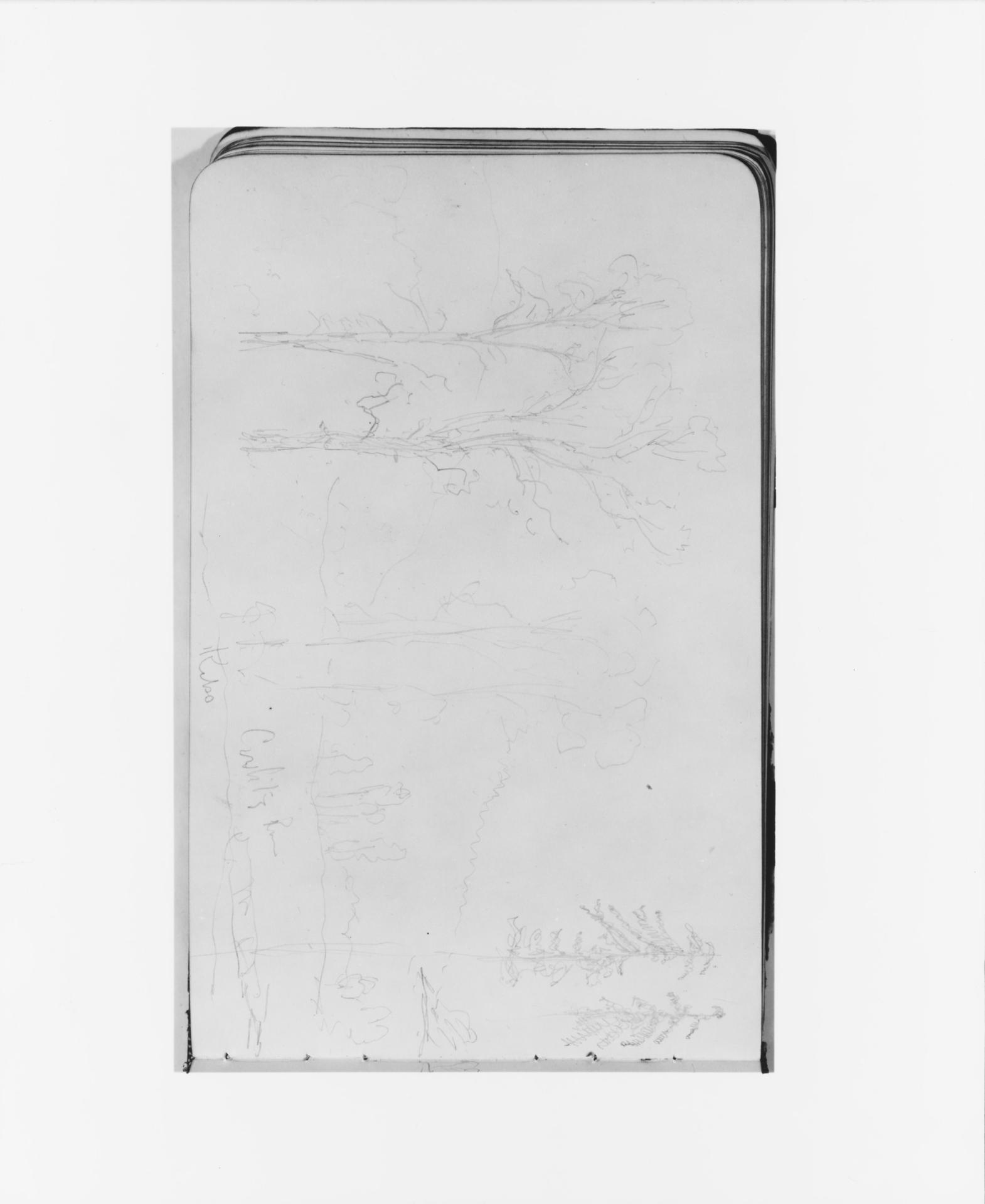
Cowlitz River; Kelso, Washington (from Sketchbook) (1890, Met-Objekt 2687)
Original title: Cowlitz River; Kelso, Washington (from Sketchbook)
kurzbeschreibung
Unlike many of Bierstadt's landscape studies, this sheet from 1890 focuses entirely on close observation: a stretch of riverbank on the Cowlitz River near Kelso, Washington, is captured in graphite on wove paper. The drawing belongs to a sketchbook and measures 12.1 by 19.7 cm in portrait format.
Description
Branches and leaves extend across the entire width of the sheet, recorded with thin, flowing strokes that give the plants a loose, natural feel. Below, trees and shrubs are sketched with similarly lively linework. The layout remains sparse, directing the eye almost entirely to the foliage; there are no people or objects. Light falls evenly across the paper, bringing the outlines forward.
Context
Bierstadt (1830–1902), a German-American painter of the Hudson River School, became known primarily for large-scale landscape paintings of the American West. This sketch was made in 1890, when he was already over sixty and still traveling west to gather material for his paintings. Kelso, Washington, lies where the Cowlitz River flows into the Columbia River—an area he visited on his journeys through the Pacific Northwest. The sheet comes from a sketchbook he used for studies from nature to record details of the landscape.
Impact
Because the lines remain spare and the vegetation sets the tone, the sheet radiates calm and intimacy. It reads as direct observation rather than an idealized scene. The flowing strokes create a light, almost casual mood that draws the viewer into the riverside fragment.
Technique
Graphite on wove paper—a common material for sketches—allows fine gradations and a clear, high-contrast rendering of plant structures. The thin, flowing lines suggest a quick but confident hand, typical of field studies.
AI-generated description text
Source: Metropolitan Museum of Art · Public Domain (CC0 1.0)