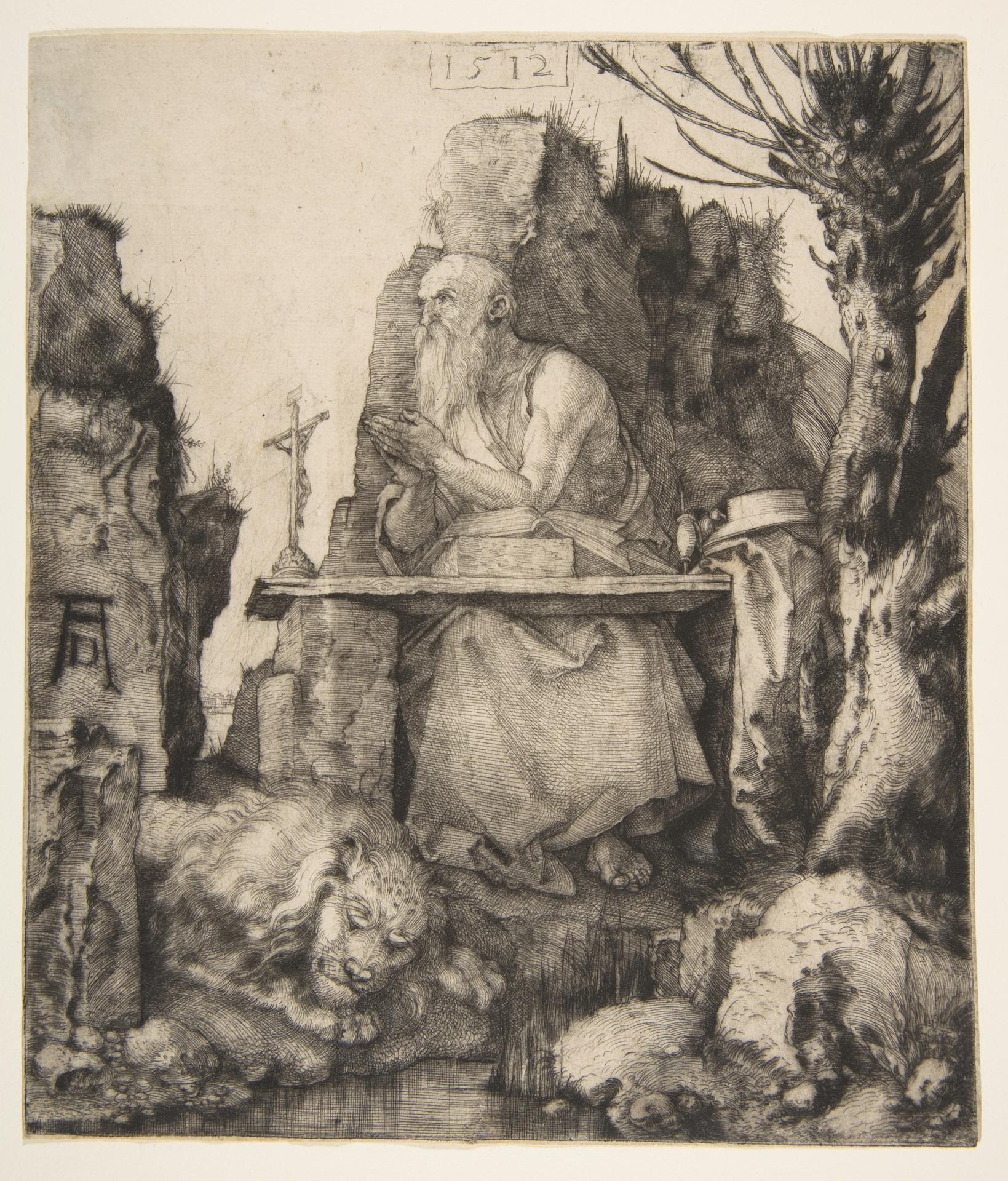
Saint Jerome by the Pollard Willow
Original title: Saint Jerome by the Pollard Willow
kurzbeschreibung
Albrecht Dürer's drypoint print from 1512 depicts Saint Jerome in a hermitage, seated on a rock with an open book, accompanied by a sleeping lion. The scene is set in a landscape with trees and rocks, with a crucifix on the left. This work is one of only three drypoints by the artist.
Description
The composition centers on Saint Jerome, who sits on a rocky outcrop, holding a book in his hands as he prays. To his right, a lion lies asleep, its head resting on its paws, a traditional attribute of the saint. In the background, a landscape unfolds with trees, rocks, and a pollarded willow, while on the left, a crucifix with the figure of Christ rises above the scene. The image is monochromatic, rendered in varied gray tones that result from the differing depths of the drypoint lines. Natural light enhances the texture of the lines and the forms of the figures, creating a contemplative atmosphere.
Context
Created in 1512, this drypoint is one of Dürer's three experiments with the technique, which involves scratching directly onto a copper plate. Dürer, a Nuremberg master, was renowned for his engravings and woodcuts, and his drypoints are notable for their rich, velvety line quality. The subject of Saint Jerome, a fourth-century scholar who translated the Bible into Latin, was popular in Renaissance art, often shown in solitude. This print reflects Dürer's deep engagement with religious themes and his technical innovation in printmaking.
Impact
The print evokes a sense of quiet devotion and introspection, drawing the viewer into the saint's solitary meditation. The soft, burred lines of the drypoint technique give the image a painterly, almost smoky quality, enhancing its emotional depth. The balanced composition and natural lighting create a serene, harmonious mood that invites contemplation.
Technique
Dürer used drypoint, a printmaking technique where a needle scratches the plate, creating lines with a characteristic burr that holds ink, producing rich, soft tones. This method allows for great expressiveness but yields few impressions due to the quick wear of the burr. The monochrome palette relies on varying line depth and spacing to achieve tonal variation, showcasing Dürer's mastery of intaglio printing.
AI-generated description text
Source: Metropolitan Museum of Art · Public domain (CC0)