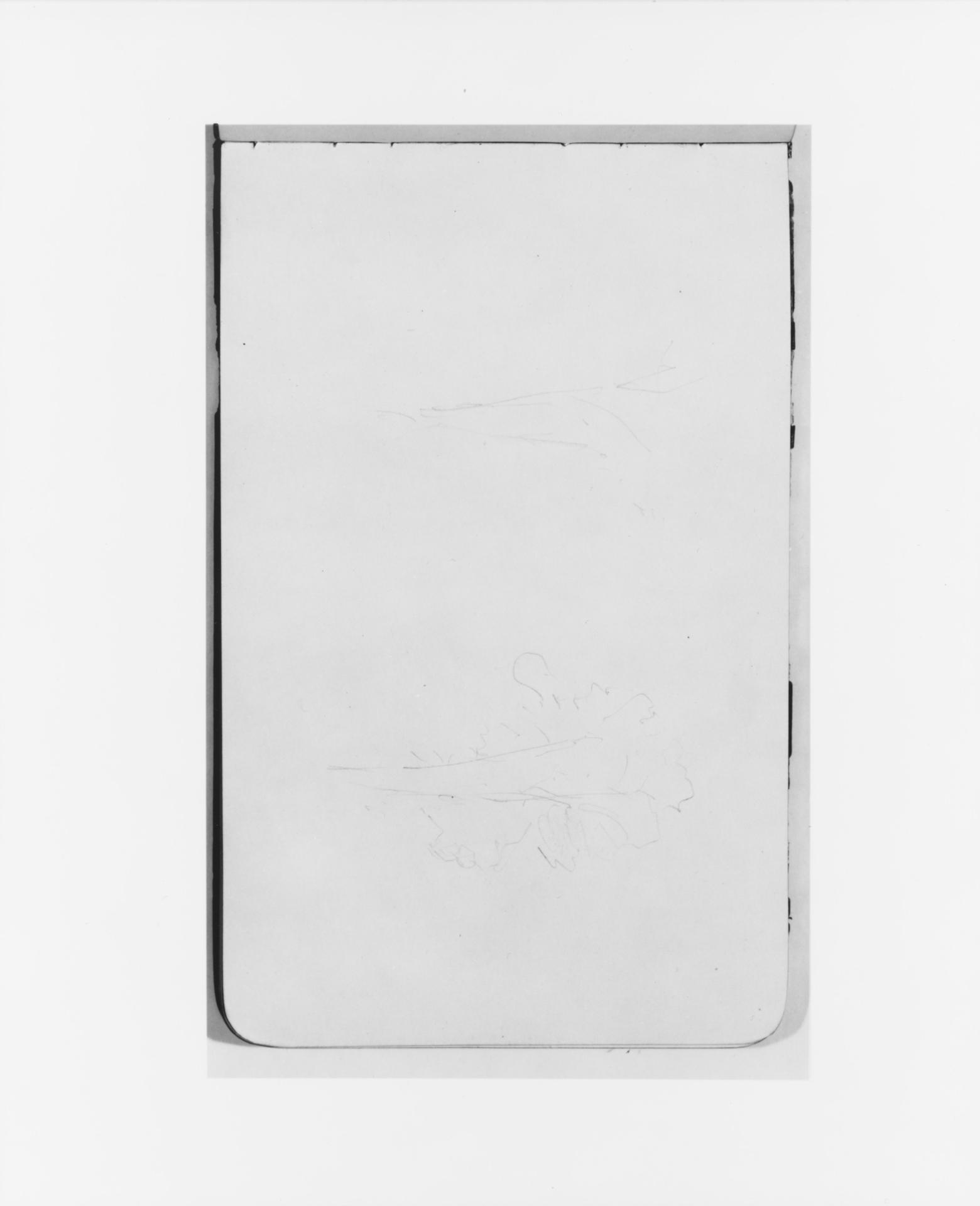
Two Tree Sketches (from Sketchbook)
Original title: Two Tree Sketches (from Sketchbook)
kurzbeschreibung
In 1890 Albert Bierstadt made two tree sketches in graphite on wove paper. A trunk with branches occupies the top of the sheet; below it sits a cluster of leaves on a stem. Both drawings come from a sketchbook and are nature studies made by the artist.
Description
A trunk with branches rising and reaching sideways fills the upper half of the sheet. Beneath it, a group of leaves on a stem has been reduced to simple, almost abstract shapes. The ground stays white and empty, so the sketches stand out at once. Fluid strokes trace the natural forms with feeling. The layout is clear and centered, with no other elements or colors.
Context
Albert Bierstadt (1830–1902), a German-American painter of the Hudson River School, became known for large-scale landscapes of the American West. These sketches date from 1890, late in his career, and served as preparatory studies or personal observations of nature. Sketchbooks were an important working tool for Bierstadt, a way to record impressions. The date falls in a period of fading fame, yet the nature studies show his continued engagement with landscape.
Impact
The spare, flowing lines feel calm and concentrated, drawing the eye to the essential forms of the trees. The emptiness of the background brings out the elegance of the nature depiction and gives the sketches an intimate, almost meditative quality.
Technique
Graphite on wove paper, an absorbent support that allows fine lines. Quick, sketchy strokes capture the natural contours of trees and leaves. Shading and color are absent entirely, which emphasizes the sheet's character as a study.
AI-generated description text
Source: Metropolitan Museum of Art · Public Domain (CC0 1.0)