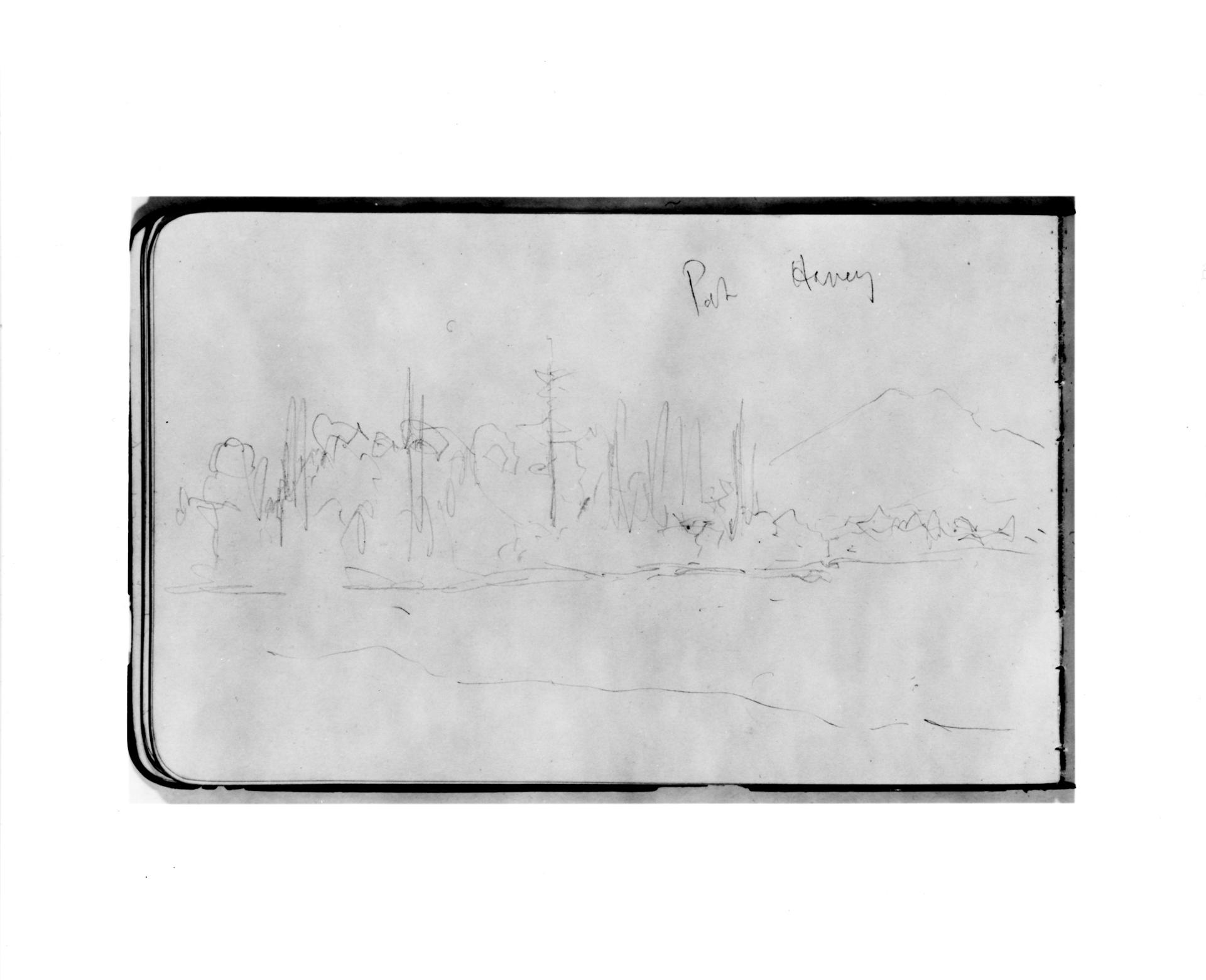
Port Havey (?) (from Sketchbook) (1890, Met-Objekt 2663)
Original title: Port Havey (?) (from Sketchbook)
kurzbeschreibung
Unlike many of Bierstadt's more finished coastal views, this sheet stays entirely at the sketch stage: a shoreline with trees and shrubs beside a body of water, gentle mountains rising behind, all set down in graphite on wove paper. The drawing of 1890 comes from one of the artist's sketchbooks.
Description
Trees and shrubs line the water's edge, indicated with brief, stroke-like lines that give the impression of a quick sketch. Behind the shore, mountains rise at a shallow angle. No people or animals appear anywhere; the image stays in shades of gray. Light falls evenly across the sheet, with no striking shadows or highlights.
Context
The German-American painter Albert Bierstadt (1830–1902), a member of the Hudson River School known for large-scale landscapes of the American West, was already over sixty in 1890 and devoted himself increasingly to travel and studies from nature. Whether the title 'Port Havey' refers to a specific place cannot be established with certainty. The sheet comes from a sketchbook in which Bierstadt recorded the natural world.
Impact
Despite its spare means, the drawing gives off a quiet, atmospheric mood. The simple strokes reveal how spontaneously Bierstadt grasped light and space, almost in an impressionist manner. Looking at the sheet, one has the sense of a fleeting glimpse of a silent coastal scene.
Technique
The sheet is executed in graphite on wove paper, as was customary for sketches. The strokes are mostly delicate and loose, suggesting a fast, observant working method. It is precisely the monochrome quality and the fine gradations of the graphite that produce a restrained sense of depth.
AI-generated description text
Source: Metropolitan Museum of Art · Public Domain (CC0 1.0)