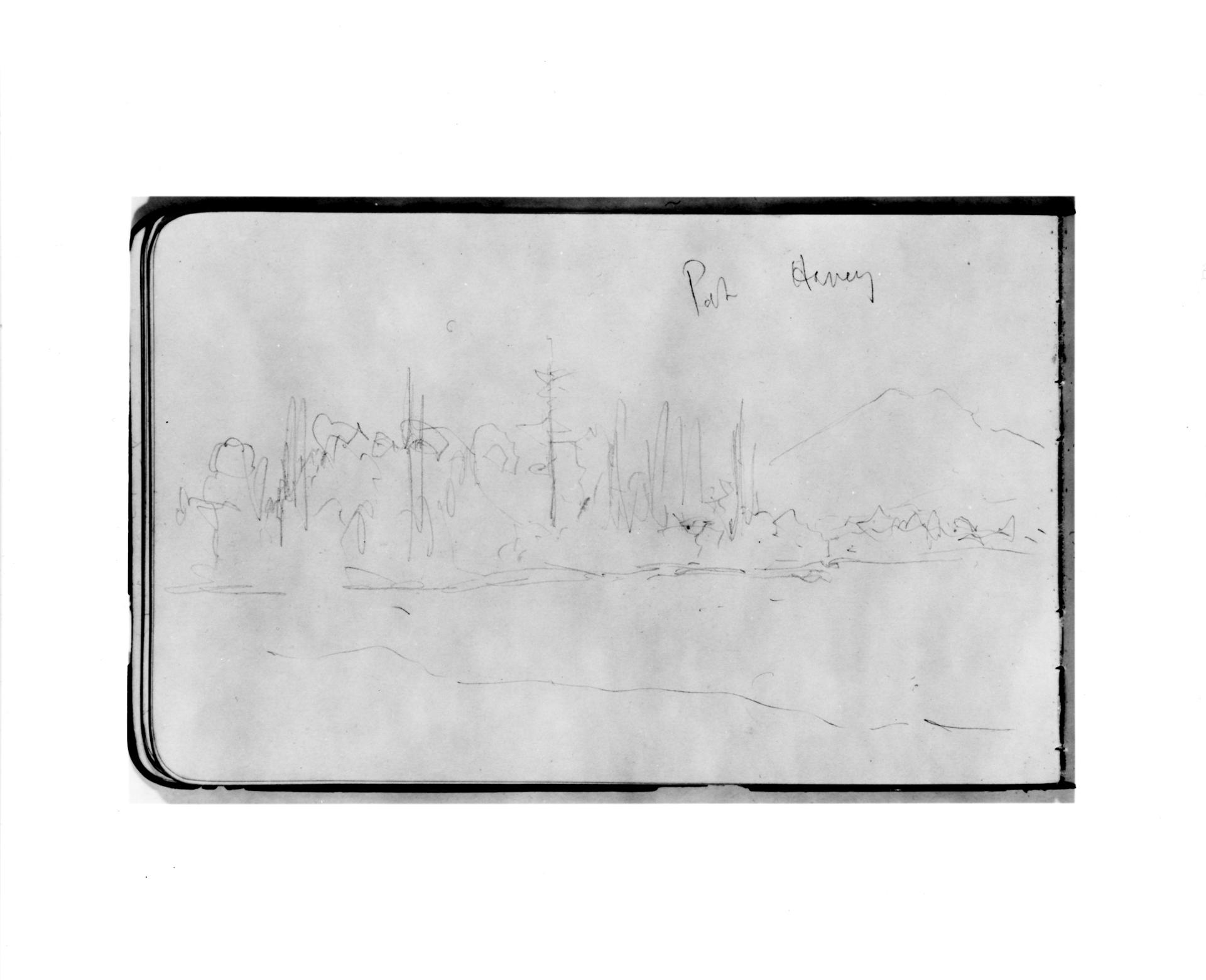
Port Havey (?) (from Sketchbook) (1890, Met-Objekt 2662)
Original title: Port Havey (?) (from Sketchbook)
kurzbeschreibung
Albert Bierstadt drew 'Port Havey (?)' in 1890 with graphite on wove paper. This sheet from a sketchbook captures a loose landscape: trees, a shoreline and hills in the distance.
Description
Along a waterline in the foreground stand individual trees and shrubs. Several hills or mountains rise behind them and close off the pictorial space. The sketch is executed in graphite on white paper; the strokes appear loose and fluid. Color and shading are absent, so the image remains monochromatic and feels reduced and spontaneous.
Context
The German-American painter Albert Bierstadt belonged to the Hudson River School and became known for large-scale landscape paintings of the American West. This sketch was made in 1890, when Bierstadt was already elderly and his artistic recognition had declined. It belongs to a sketchbook he used for travel records, presumably on a trip to Port Havey (possibly Port Harvey in British Columbia).
Impact
Simplicity and the immediate effect of the loose strokes define the sheet. The impression arises of a fleeting observation recorded without any decorative intent. The reduced rendering directs the eye to the essential forms of the landscape.
Technique
Graphite on wove paper – an absorbent support that allows fine lines – forms the basis. The execution corresponds to a sketch: quick, flowing strokes that do without corrections and without shading. The small format of 12.1 x 19.7 cm suggests a portable page from a sketchbook.
AI-generated description text
Source: Metropolitan Museum of Art · Public Domain (CC0 1.0)