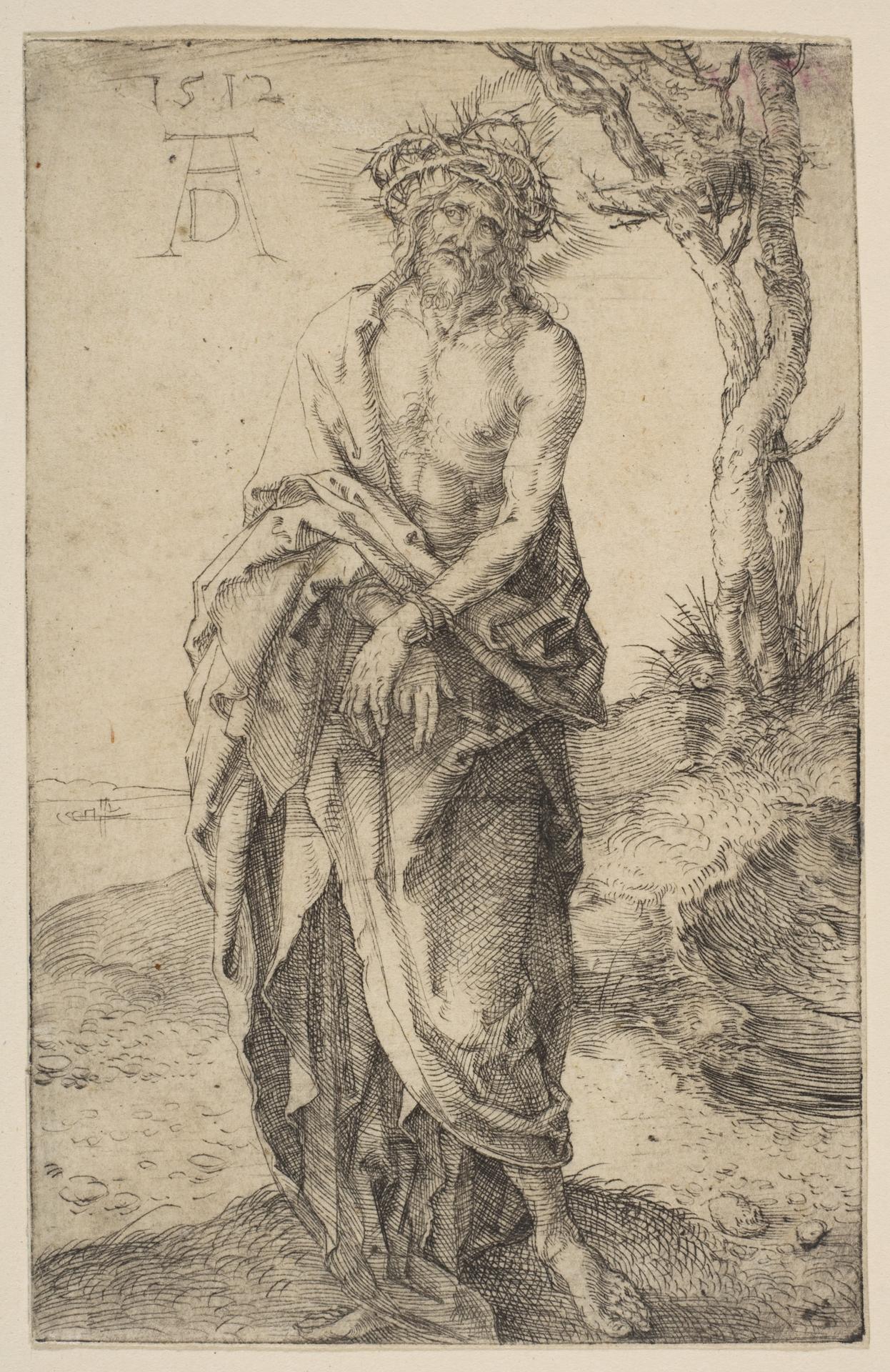
Man of Sorrows with Hands Bound
Original title: Man of Sorrows with Hands Bound
kurzbeschreibung
Albrecht Dürer's drypoint from 1512 depicts Christ as the Man of Sorrows, crowned with thorns and with bound hands. The print captures a moment of quiet suffering against a sparse landscape.
Description
The composition centers on a barefoot Christ, his hands tied before him, wearing a loose garment that drapes over his shoulders. A crown of thorns encircles his head, and his expression is serene yet sorrowful. Behind him, a few trees and a hint of landscape create a calm, melancholic backdrop. The drypoint technique produces rich, velvety lines that model the texture of skin and fabric with remarkable detail.
Context
Dürer created this drypoint in 1512, during a period when he was exploring the expressive potential of printmaking. The Man of Sorrows was a common devotional subject in Northern European art, emphasizing Christ's Passion. Dürer's treatment reflects the Renaissance interest in naturalistic detail and emotional depth.
Impact
The image conveys a profound sense of quiet endurance and pathos. The soft, intricate lines of the drypoint give the print a painterly quality, drawing the viewer into the intimate suffering of the figure. The monochrome palette enhances the somber, reflective mood.
Technique
This work is a drypoint, a technique where the artist scratches directly into a metal plate with a hard needle, creating a burr that holds ink. The resulting lines are softer and more expressive than engraving. Dürer's use of drypoint here is notable for its delicate modeling of light and shadow.
AI-generated description text
Source: Metropolitan Museum of Art · Public domain (CC0)