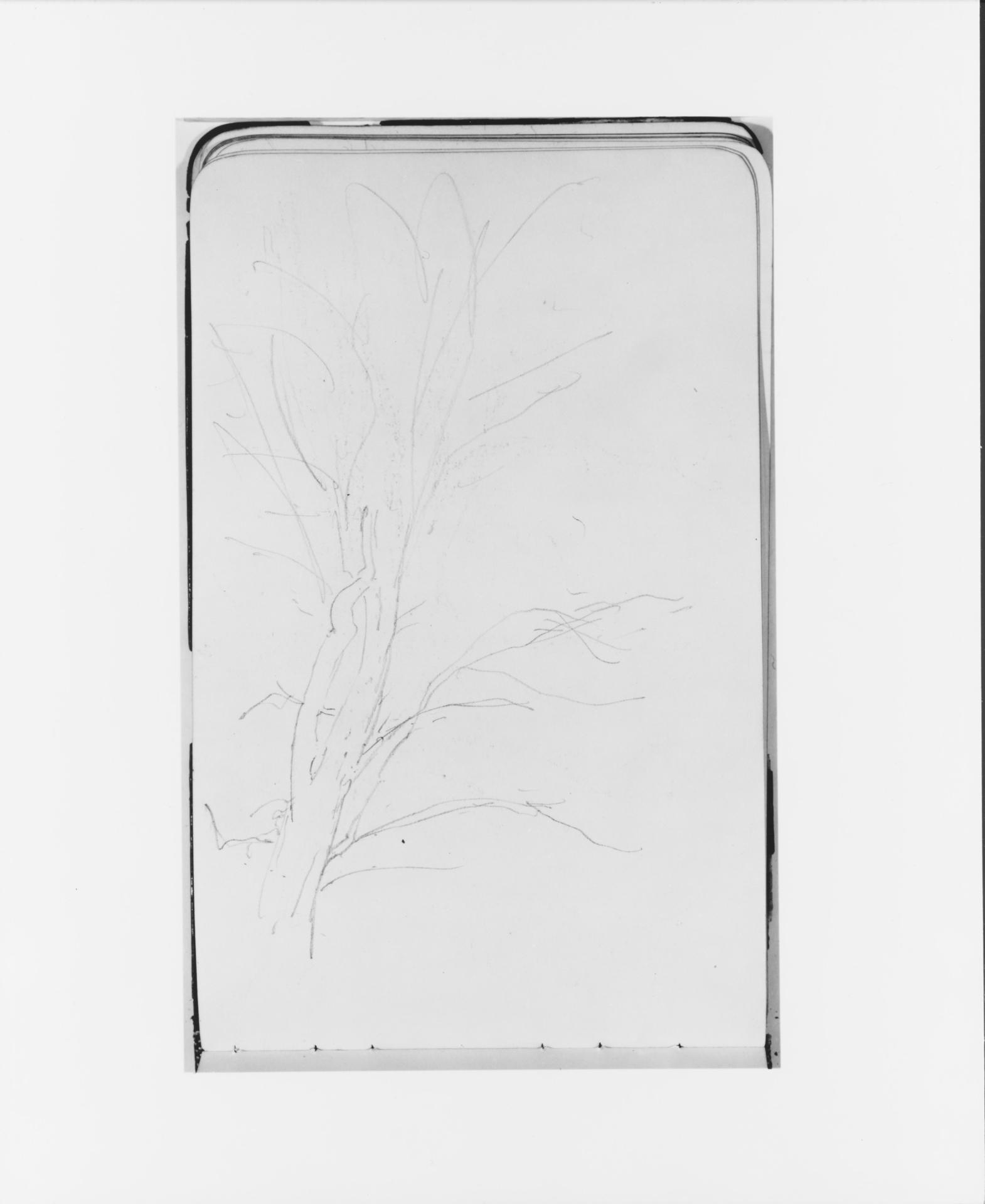
Tree (from Sketchbook) (1890, Met-Objekt 2651)
Original title: Tree (from Sketchbook)
kurzbeschreibung
A single tree, slender and forking into several thin branches, fills Albert Bierstadt's 1890 graphite drawing 'Baum (aus dem Skizzenbuch)'. Leaves are only hinted at, and the sheet comes from a sketchbook, evidence of the artist's close study of nature.
Description
A thin, straight trunk rises and splits into fine branches that divide again, with leaf-like shapes suggested at their tips. The handling stays sketchy and plain, without shading or color. The tree stands alone at the center of the sheet, no background or other objects. Even light falls across the drawing, and cast shadows are absent.
Context
The German-American painter Albert Bierstadt (1830–1902) became known for large-scale landscapes of the American West. By 1890, when he made this drawing, he was well established, though his success was declining. He used sketchbooks for personal studies, recording natural forms often as preparation for paintings. Small formats and a reduced technique are typical of such working sheets.
Impact
Simplicity and concentration on essentials define the drawing. The tree feels fragile and delicate, creating a quiet, intimate mood. Fine lines and the central placement give the sheet a meditative quality.
Technique
Graphite on wove paper is used here. The lines are fine and precise, with minimal shading, suggesting a quick, spontaneous sketch. The subtle texture of the wove paper takes up the graphite lightly, giving the drawing a soft appearance.
AI-generated description text
Source: Metropolitan Museum of Art · Public Domain (CC0 1.0)