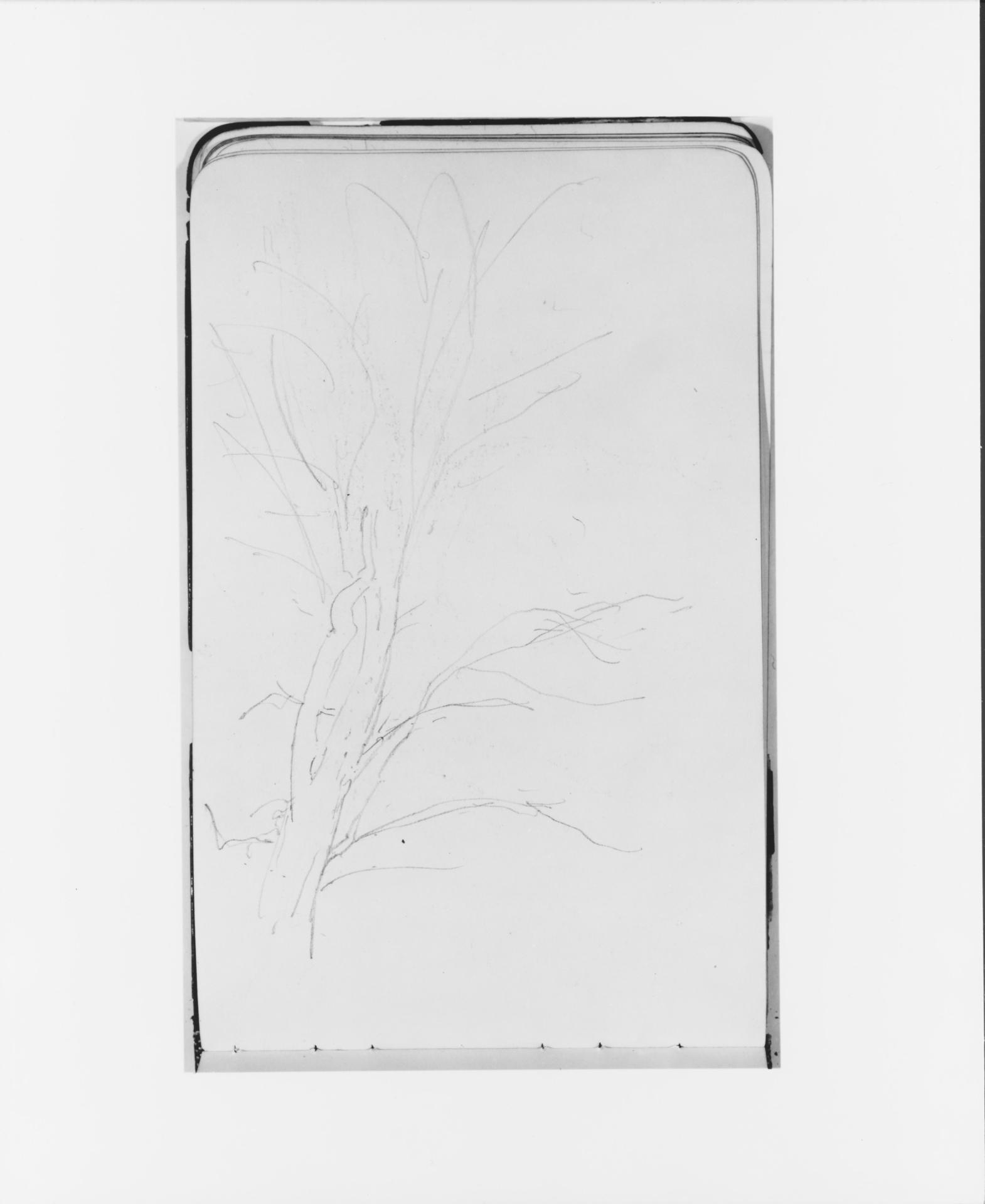
Tree (from Sketchbook) (1890, Met-Objekt 2650)
Original title: Tree (from Sketchbook)
kurzbeschreibung
Albert Bierstadt's graphite drawing "Tree (from the Sketchbook)" from 1890 presents a single tree in a spare, sketch-like manner on wove paper. The pictorial space remains empty; the tree alone occupies the center of the sheet, with no added background motifs.
Description
A slender, straight trunk rises and forks into several branches, which in turn divide into delicate twigs. On them sit simple, almost abstractly simplified leaves. The tree takes up the middle of the sheet; other pictorial elements or a background are entirely absent. The motif is executed in graphite on white paper; even light falls across the drawing, with no shadows or highlights set. The stroke remains concise and study-like, as is typical of a quickly jotted record.
Context
The German-American painter Albert Bierstadt (1830–1902) belongs to the Hudson River School and became known for large-scale landscapes of the American West. This sheet comes from a sketchbook and dates from 1890, thus falling in a late phase of his career. Such drawings often served him as preparatory studies for later paintings; the concise form suggests a private or preparatory function.
Impact
Calm emanates from the sheet, and the eye is drawn directly to the basic form of the tree. Finely placed lines and the central arrangement give the drawing something meditative, almost graphic. Because shadows and details are missing, the impression remains light and restrained.
Technique
Graphite on wove paper, a smooth and even support that allows delicate lines. The work was done quickly and freely, with varying pressure of the stroke; short, fine lines suggest the structure of the tree. No corrections or reworking can be made out, which emphasizes the spontaneous character of the drawing.
AI-generated description text
Source: Metropolitan Museum of Art · Public Domain (CC0 1.0)