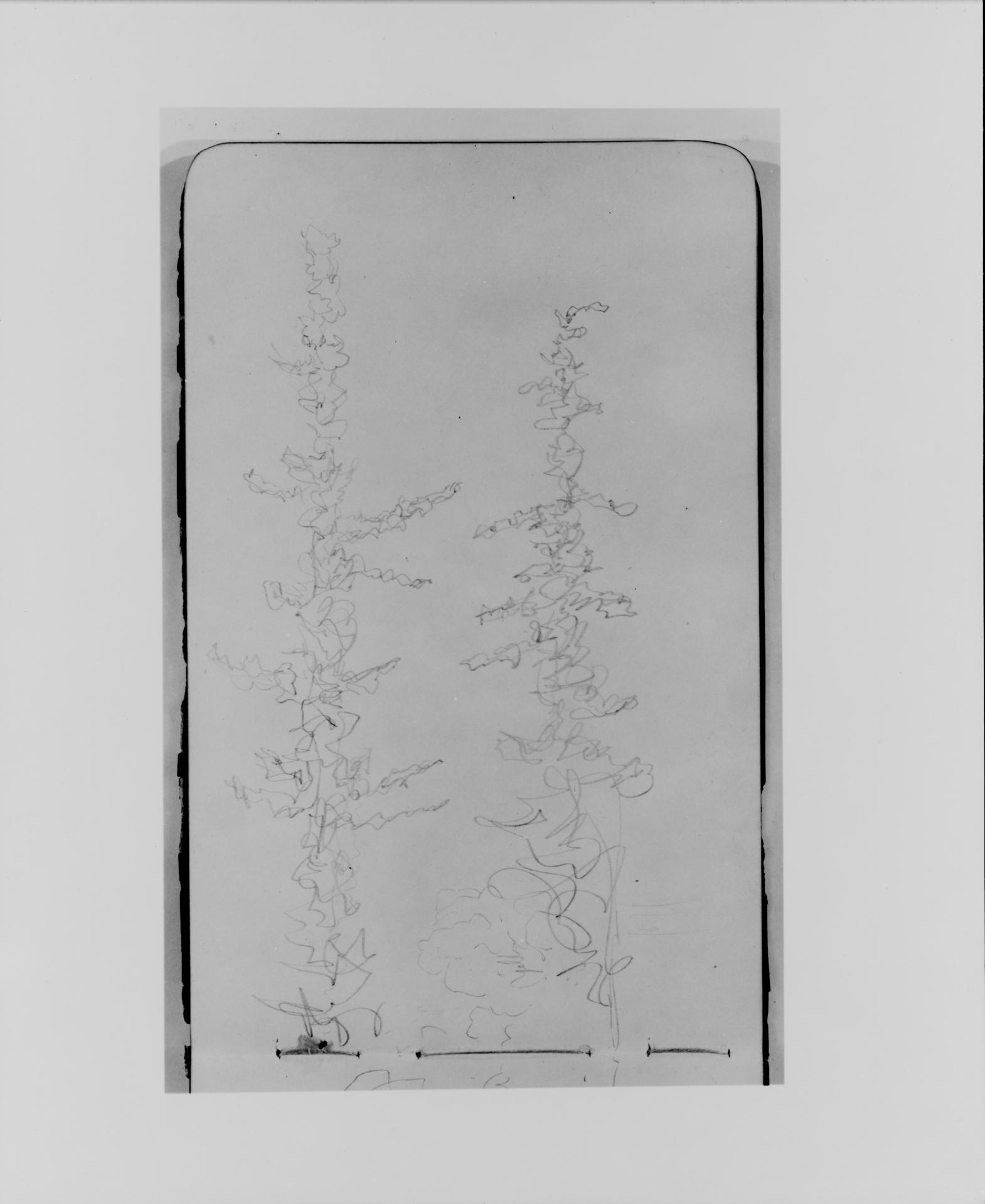
Poplars (from Sketchbook)
Original title: Poplars (from Sketchbook)
kurzbeschreibung
Albert Bierstadt's 1890 drawing "Pappeln" sets itself apart from many of his landscape studies by narrowing its focus to just two trees, put down in graphite on smooth wove paper. The sheet comes from one of the artist's sketchbooks and measures 7 3/4 x 4 3/4 inches (19.7 x 12.1 cm).
Description
Two trees fill the foreground, their trunks, branches and foliage traced with fine lines that shift in weight and keep the drawing lively. Much of the background is left blank; a few scattered, indefinite strokes might hint at other plants or landscape forms. Black and white, without color or accents of light, it sits on white paper.
Context
The German-American painter Albert Bierstadt (1830–1902), associated with the Hudson River School, became known above all for large-scale landscapes of the American West. This sketchbook page dates from 1890, a time when Bierstadt was increasingly making small-format studies. Poplars appear often in the landscape art of his day, seen as native trees and at the same time as resonant symbols.
Impact
Despite the few details given, the flowing lines and their varying thickness create a vivid, true-to-nature impression. Reducing things to essentials gives the sheet a quiet, concentrated presence and draws the eye to the structure of the trees. The monochrome underlines the graphic quality and the artist's hand.
Technique
Graphite on wove paper allows fine, precise lines; the changing stroke weight builds up the depth and texture of the trees. That the drawing comes from a sketchbook points to a spontaneous, exploratory way of working.
AI-generated description text
Source: Metropolitan Museum of Art · Public Domain (CC0 1.0)