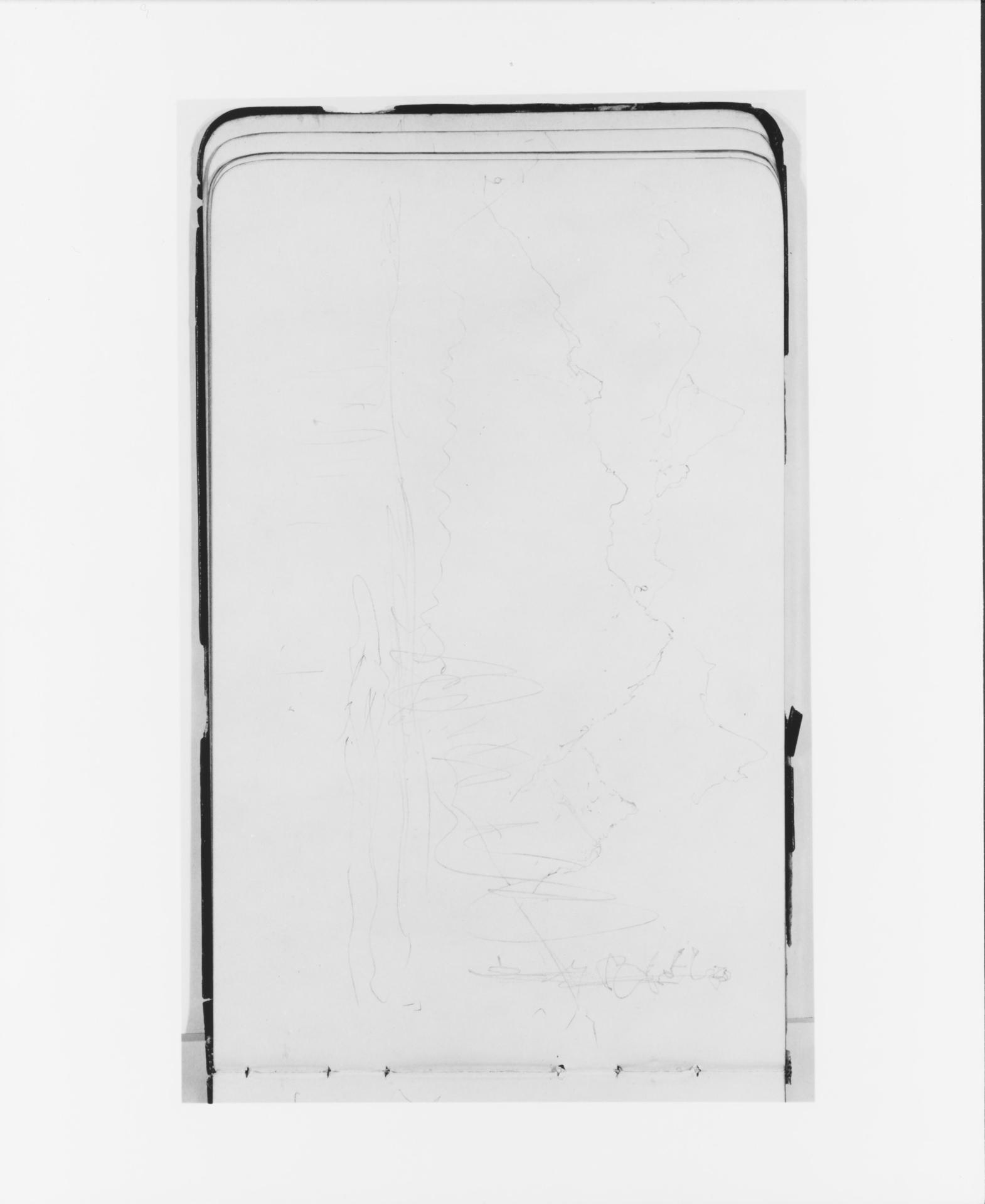
Sketch of Mountains, Peaks, and Terrain (from Sketchbook) (1890, Met-Objekt 2633)
Original title: Sketch of Mountains, Peaks, and Terrain (from Sketchbook)
kurzbeschreibung
This sketchbook sheet by Albert Bierstadt dates to 1890: a graphite drawing on wove paper that captures mountain formations, peaks, and terrain studies. With delicate strokes, the artist feels out the natural contours of the landscape.
Description
Graphite on toned paper, simple yet rich in detail: elevation lines and terrain curves are rendered with strokes of varying strength and length, revealing the forms and height differences of the landscape. Figures or human activity are entirely absent; only natural formations occupy the view. The lines run from bottom to top and from left to right, with no color or light effects. The white ground emphasizes the drawn forms.
Context
Albert Bierstadt (1830–1902), a German-American painter, gained fame with large-scale landscapes of the American West. By 1890, the year of this sketch, he was long established and had made numerous journeys to the Rocky Mountains and other mountainous regions. Such study sheets served him as references for later paintings in the studio.
Impact
The concentration on line and form gives the sheet a quiet, collected presence. It conveys the impression of immediate, almost intimate observation of nature, without decorative additions. The fine gradations of stroke create spatial depth that draws the viewer into the landscape.
Technique
Graphite on wove paper—a support whose surface texture favors fine line drawings. Bierstadt varied stroke strength and length to precisely render topographical features such as elevation lines and terrain curves. This approach is typical of his study sheets, which he made for later use in the studio.
AI-generated description text
Source: Metropolitan Museum of Art · Public Domain (CC0 1.0)