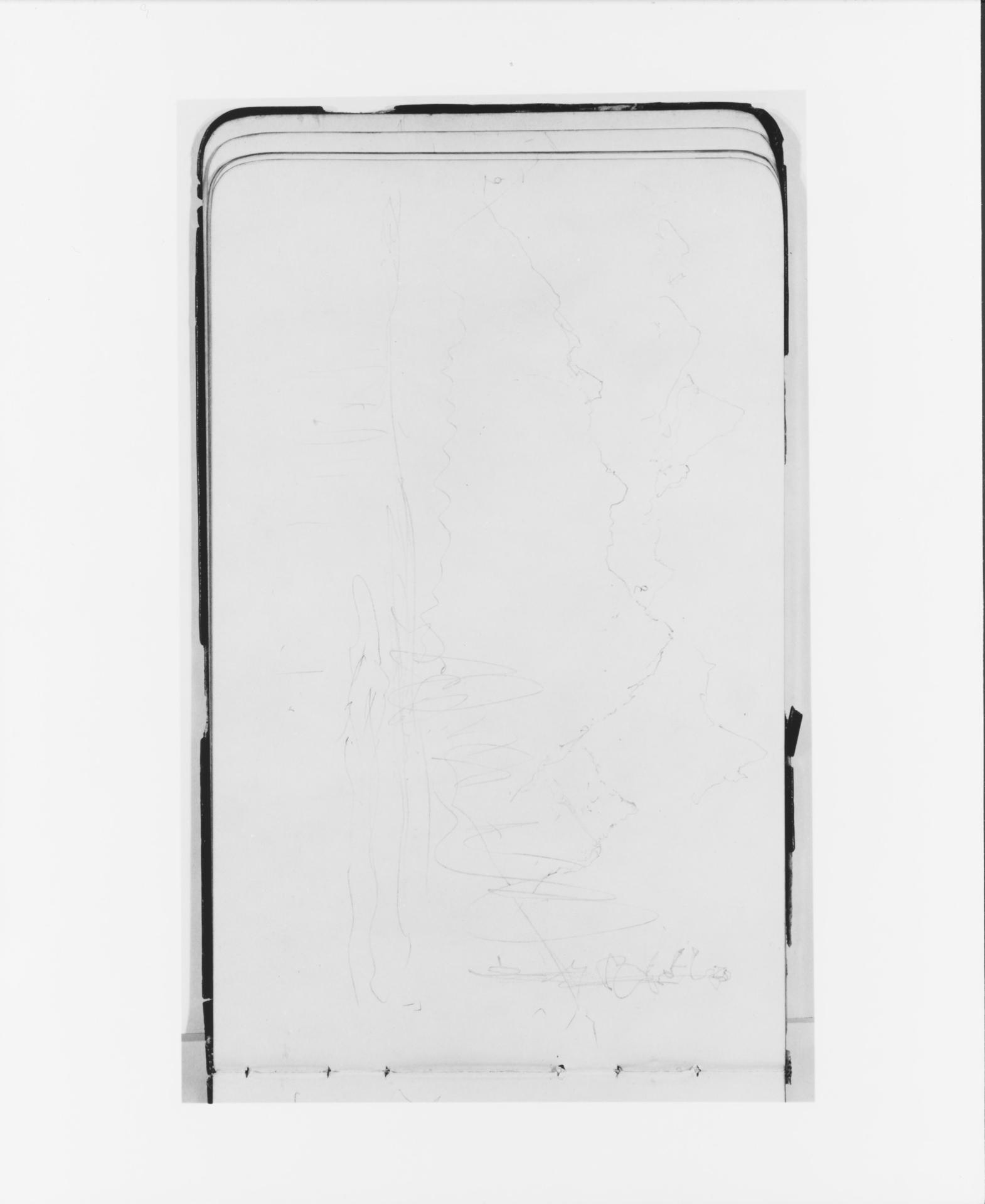
Sketch of Mountains, Peaks, and Terrain (from Sketchbook) (1890, Met-Objekt 2632)
Original title: Sketch of Mountains, Peaks, and Terrain (from Sketchbook)
kurzbeschreibung
In a loose sketch from a sketchbook, Albert Bierstadt captures mountains, individual peaks, and terrain forms in 1890. The sheet is executed in graphite on wove paper. Such studies from nature in the American West run throughout Bierstadt's drawn work.
Description
Several mountain peaks and hill ranges are outlined with thin pencil strokes of varying strength. The changing line weight makes the forms stand out lightly and creates a sense of depth. Lines that trace the edge of the sketchbook finish the sheet. Shading or details are entirely absent; clear, sparse contours remain. The layout stays simple and limited to the basic structure of the landscape.
Context
Albert Bierstadt became known for large-scale landscape paintings of the American West, whose sources were made during his expeditions. This sketch dates from 1890, when the artist was already established and continued to travel. He used his sketchbooks as a visual notebook from which paintings later emerged. The sheet belongs to a series of studies in which his eye for observation and topographical detail is evident.
Impact
Because the drawing limits itself to a few lines, it feels calm and collected. One has the impression of an observation recorded immediately, and sees the landscape reduced to its basic forms. The delicate strokes give the sheet a lightness and let the viewer share in the artist's gaze on nature.
Technique
Graphite on wove paper carries the drawing, with the absorbent paper taking fine lines well. To distinguish terrain forms from one another, Bierstadt varies the line strength. The sheet remains sketchy and unfinished, as is usual for studies made outdoors.
AI-generated description text
Source: Metropolitan Museum of Art · Public Domain (CC0 1.0)